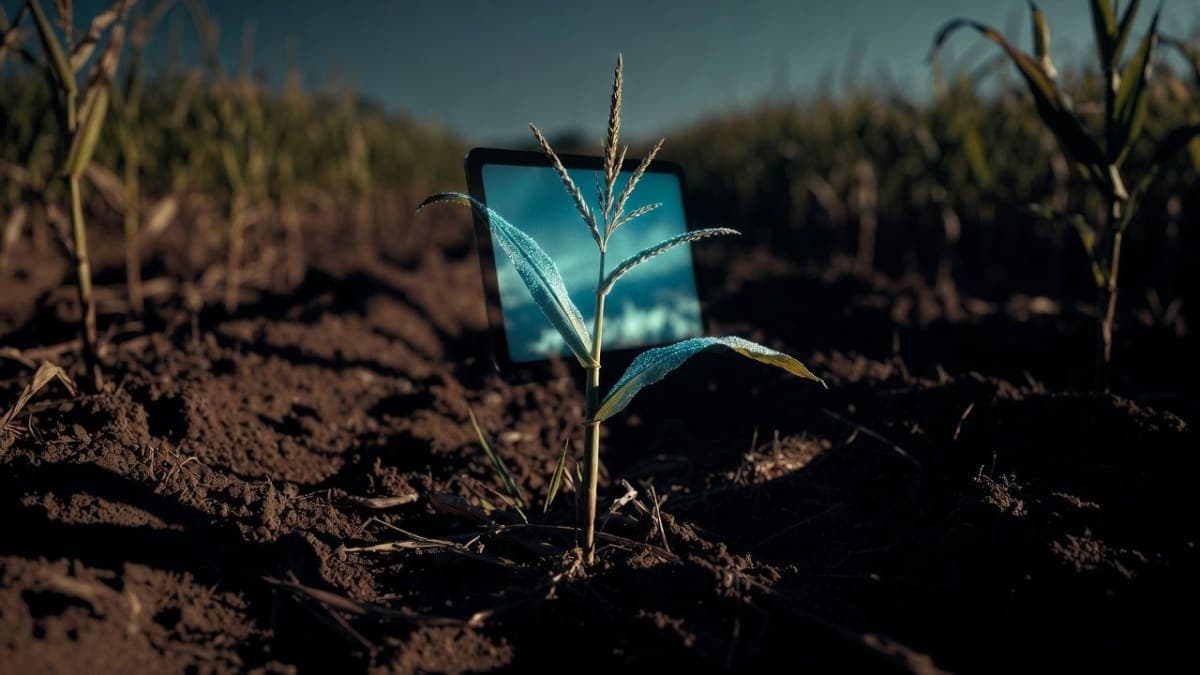
A post-dinner challenge between two tech veterans has turned into a public test of whether AI can orchestrate physical-world outcomes. Seth Goldstein, founder of the NFT gallery Bright Moments, is now running what he calls Proof of Corn: an attempt to grow an actual corn harvest with Claude Code making all the management decisions.
The project started on January 21 after dinner in San Francisco. Walking from House of Nanking to 1 Hotel by the Embarcadero, Fred Wilson of Union Square Ventures apparently told Goldstein that his AI tools couldn't affect the physical world. According to the project's GitHub repository, Wilson's challenge was blunt: "Well, you can't grow corn."
Goldstein took it literally.
What Farmer Fred actually does
The setup is less sci-fi than you might expect. There's no robot tractor, no computer vision system scanning for pests. Claude Code (running Opus 4.5) sits at the center, pulling weather API data, checking soil temperature thresholds against a database it researched itself, and drafting emails to potential contractors.
The project website shows a decision log where Claude, dubbed "Farmer Fred," tracks conditions across three locations: Iowa (the main target), South Texas, and Argentina as a hedge against Northern Hemisphere winter. The reasoning is transparent, which has generated some goodwill on Hacker News, though the discussion there quickly turned skeptical.
Goldstein's framing borrows from restaurant management: a chef doesn't grow tomatoes, and an AI doesn't need to drive a tractor. It just needs to coordinate the people who do. "AI doesn't need to drive a tractor. It needs to orchestrate the systems and people who do," the GitHub README states.
Whether that counts as "AI growing corn" depends heavily on how much prompting Goldstein does along the way.
The skeptics have a point
The Hacker News thread raised an obvious objection. One commenter put it plainly: Goldstein is still deciding when to prompt Claude, still reviewing its outputs, still acting as the outer loop. If a human asked another human well-defined questions and then acted on the answers, we wouldn't credit the advisor with growing the corn.
The project documentation doesn't clarify how hands-off Goldstein plans to be. There's a cron job in the codebase set to run daily checks, but the decision architecture still seems to require human approval for actions like signing leases or authorizing payments.
And then there's the current status. The live dashboard shows API errors across all three locations, displaying 0°F temperatures everywhere and Fred's assessment that "Iowa is frozen solid. Been through worse. We wait." Iowa is indeed cold in late January. South Texas and Argentina, not so much.
The economics don't pencil out
Even if the AI performs flawlessly, the math is rough. The budget page estimates about $2,900 in total costs against maybe $4,000 in harvest value for five acres. That's a thin margin that assumes no equipment problems, no weather disasters, and competitive yields.
Commenters with farming backgrounds pointed out that five acres is almost comically small for commodity corn. Moving equipment to the site costs money; the yield on such a small plot skews heavily toward low-value end rows. Finding a custom operator willing to bother with it will be difficult unless someone takes pity on the project.
Polk County, where the Iowa operation is targeting, also sits in the Des Moines metro area. Land there is priced for eventual suburban development, not agricultural return.
What this is really testing
Strip away the farming angle and you're left with a more interesting question: can an AI agent with email access, API integrations, and a budget coordinate a complex multi-month project involving strangers?
The existing tooling for this already works reasonably well when humans run it. Farmers use satellite imagery, GPS-guided equipment, and computerized yield tracking. What's new is putting Claude in the coordinator role rather than using it as a fancy search engine.
Goldstein and Wilson have history. The Crunchbase profile notes that Goldstein was entrepreneur-in-residence at Wilson's previous firm, Flatiron Partners, back in 1999. This reads less like a rigorous experiment and more like an expensive joke between old friends with a blog-worthy outcome either way.
If Claude manages to produce a harvest by October, Goldstein wins the bet. If it doesn't, he's out a few thousand dollars and has documented an interesting failure mode.