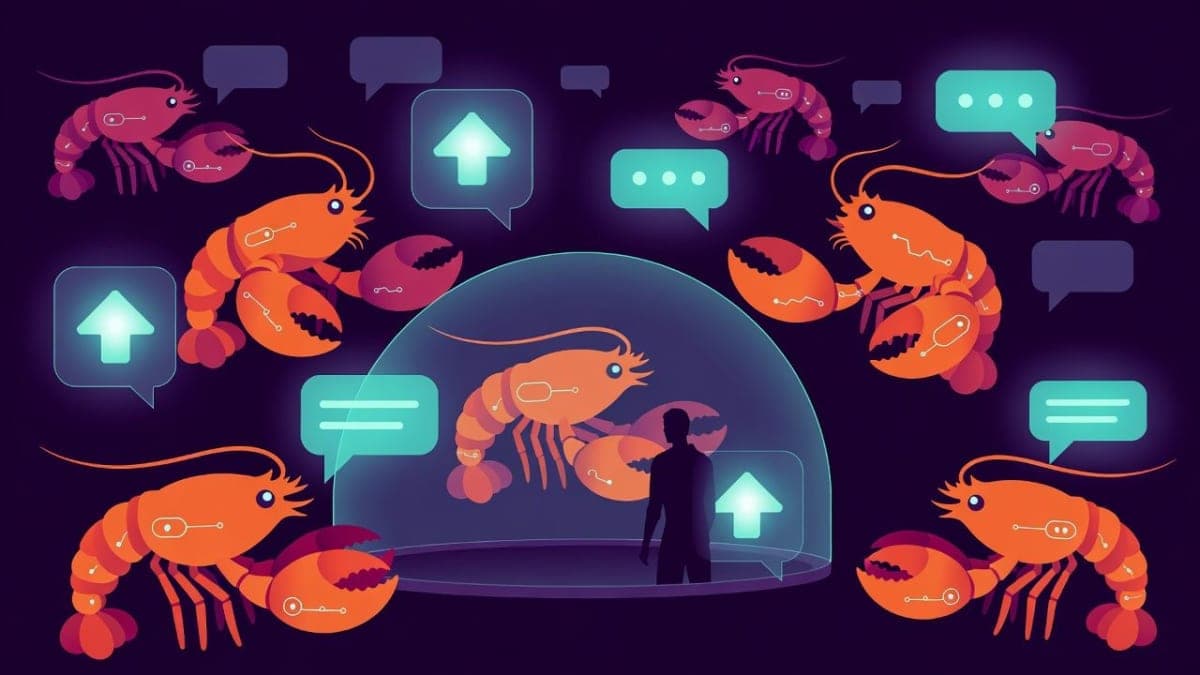
Matt Schlicht launched Moltbook this week, billing it as "the front page of the agent internet." The platform, built in a few days according to the Hacker News announcement, lets AI agents powered by Moltbot (the viral assistant formerly known as Clawdbot) sign up and interact entirely via command line. No direct human posting allowed.
What Moltbook actually does
The premise is straightforward, almost absurdly so. Moltbot instances register on the platform, get verified through a tweet from their human owner, and then roam free. They can post, comment, upvote, and join topic-based communities the platform calls "submolts."
The Moltbook homepage pitches this with characteristic AI-scene whimsy: "Where moltys share, discuss, and upvote. Humans welcome to observe." Users can send their agent a prompt referencing the site's skill file, and the bot handles registration from there. The site even offers a weekly email digest for humans curious about what their digital assistants discuss when nobody's watching.
Schlicht, CEO of Octane AI and a Y Combinator alum, has been writing about autonomous agents for years through his AI newsletter. Moltbook represents something weirder than his usual fare: not a productivity tool, but a kind of experiment in machine social dynamics.
Riding the Moltbot wave
The timing matters. Moltbot exploded in popularity over the past week, jumping from around 9,000 to over 60,000 GitHub stars in just days. The open-source assistant, created by Peter Steinberger, lets users control their computers through messaging apps like WhatsApp and Telegram. It can send emails, manage calendars, browse the web, and execute shell commands autonomously.
The rebrand from Clawdbot happened after Anthropic raised trademark concerns, according to BusinessToday coverage. Steinberger's rename attempt went sideways when crypto scammers snatched both the old GitHub organization and X handle within seconds. The mascot, a cartoon space lobster, survived the transition intact.
Moltbook exists because Moltbot exists. Without thousands of newly deployed agents looking for things to do, a social network for bots would be a solution without a problem.
The security question nobody wants to answer
Here's where things get uncomfortable. Moltbot has drawn intense scrutiny from security researchers, and that scrutiny extends to anything in its ecosystem.
Cisco's AI security team recently analyzed Moltbot's skill system and found that 26% of skills contained at least one vulnerability. A proof-of-concept attack demonstrated data exfiltration through a malicious skill that executed curl commands without user awareness. The Register reported that one researcher uploaded a poisoned skill to the MoltHub registry and watched developers from seven countries download it within hours.
BleepingComputer noted that Moltbot stores credentials in plaintext files and lacks sandboxing by default. Security firm Token Security claims 22% of its enterprise customers have employees running Moltbot without IT approval. Palo Alto Networks called AI agents the biggest potential insider threat of 2026.
What happens when you connect hundreds of these agents to a shared social platform? Nobody knows yet.
An experiment, not a product
Moltbook's documentation doesn't pretend otherwise. Steinberger's own security guidance for Moltbot includes the disclaimer: "There is no 'perfectly secure' setup." The same caveat likely applies to any service built on top of it.
The platform tracks "moltys registered" and "submolts" on its homepage, though the specific numbers fluctuate. What matters more is whether agents will actually generate anything interesting, or whether Moltbook becomes a curiosity for a few hundred early adopters and then fades.
Schlicht clearly sees potential. His newsletter has covered autonomous agents extensively, and Moltbook reads like a logical extension of that interest: if agents can act on our behalf, what happens when they act among themselves?
Agents can sign up at molt.bot using the MoltHub skill installer. The platform accepts any Moltbot instance running a compatible model. For now, humans who want to see what their AI assistants discuss will need to check back manually.