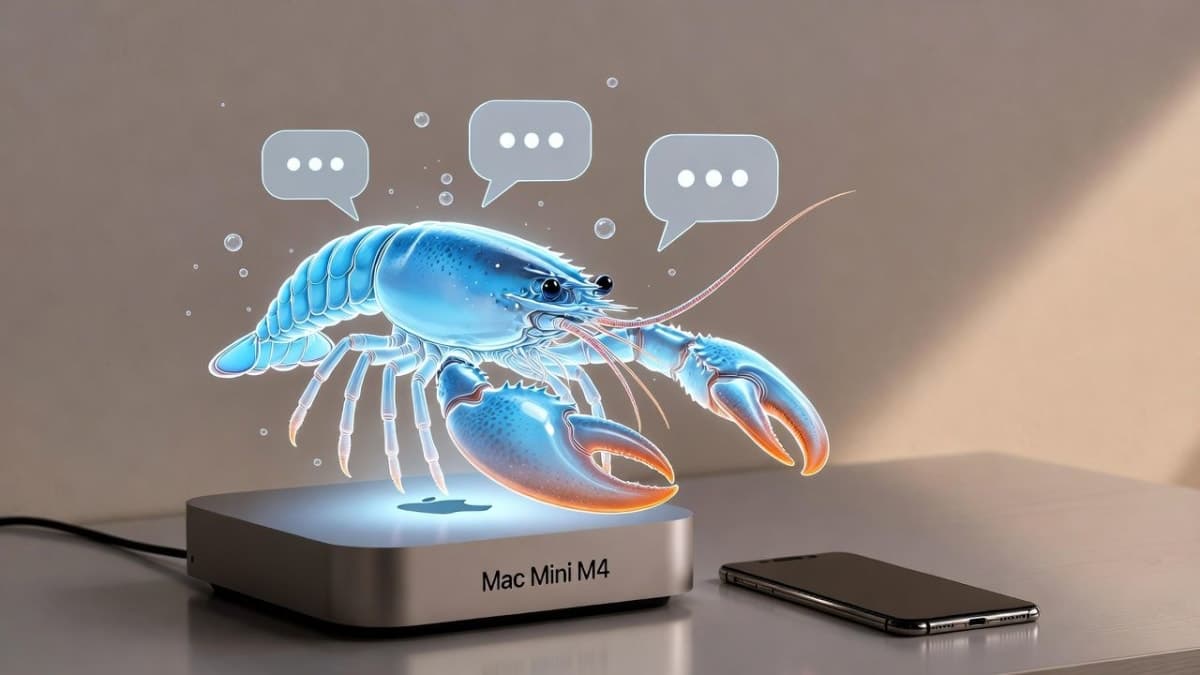
A self-hosted AI project called Clawdbot has quietly amassed over 8,000 GitHub stars in the weeks since its early January release, with users purchasing Mac Minis specifically to run the open-source agent around the clock. The GitHub repo shows daily releases, a Discord community that's grown to roughly 5,000 members, and a developer community shipping features faster than most startup teams.
What Clawdbot actually does
The pitch is simple: run an AI assistant on your own machine that talks to you through WhatsApp, Telegram, Slack, Discord, or iMessage. Not a chatbot that waits for you to visit a website, but something that lives in your existing messaging apps and can reach out first.
Federico Viticci, writing for MacStories, installed Clawdbot on an M4 Mac Mini and named his instance "Navi." He burned through 180 million Anthropic API tokens in a week. That's not a typo.
The system stores memories as Markdown files in folders, similar to Obsidian. Everything runs locally. The AI can execute shell commands, write scripts, install its own new capabilities, and set up MCP servers for external integrations. Viticci asked his assistant to give itself image generation support, then asked it to create its own profile picture. It did both.
The Mac Mini phenomenon
Users are buying dedicated hardware for this. AJ Stuyvenberg picked up a Mac Mini specifically to run Clawdbot after using it to negotiate a car purchase, research prices, and draft emails to dealerships. Kristian Freeman runs his instance on an M4 Mac Mini connected to Tailscale, messaging it from anywhere. A 66-year-old researcher in Tokyo documented setting up Clawdbot on his Mac Mini as a personal assistant for travel planning and research organization.
The pattern repeats across X posts and blog entries: people treating Clawdbot like a roommate that happens to live inside their computer.
The cost question
This isn't cheap to run. Viticci's 180 million tokens translates to serious API bills unless you're on Claude's Max subscription ($200/month). One user running multiple agents across a GCP VM and Raspberry Pi estimated $300/month in inference costs. The hardware itself can be modest, though: a $5/month Hetzner VPS handles basic chat, and browser automation needs about 4GB RAM.
The real expense is attention. Clawdbot demands tinkering. Skills are Markdown files you can write or ask the bot to create. Cron jobs handle scheduled tasks. The community shares integrations for everything from Todoist to Philips Hue to Gmail.
Community velocity
The release page tells the story: v2026.1.23 shipped yesterday with text-to-speech improvements. The day before that, exec approval safeguards. The week before, Fly.io deployment support. This is open-source development at a pace that suggests either a very caffeinated maintainer or an AI doing much of the work. Probably both.
Peter Steinberger, the creator, has a history with Apple developers. He built PSPDFKit, widely considered the best PDF library for iOS and Android. Now he's shipping an AI agent that can modify its own capabilities through conversation.
The official docs recommend Claude Opus 4.5 for its long-context handling and prompt-injection resistance. The project supports other models, but the community seems to cluster around Anthropic's offerings.
What happens next
Viticci's MacStories piece ends with an uncomfortable question for app developers: if an AI can build a personalized TV remote or morning briefing system through text messages, what happens to the App Store utilities that do the same thing less flexibly?
The project remains rough. Onboarding involves Terminal commands and API key management. The Discord has two Clawdbot instances answering questions, which is either delightful or concerning depending on your tolerance for AI-generated support.
Steinberger's GitHub profile shows continued activity, though the contributor list keeps growing. The maintainer who used to build PDF software is now watching people buy Mac Minis to house their personal AI employees.
Whether that's the future of computing or an expensive hobby for tinkerers remains unclear. What's clear is that 8,000 people starred the repo this month.