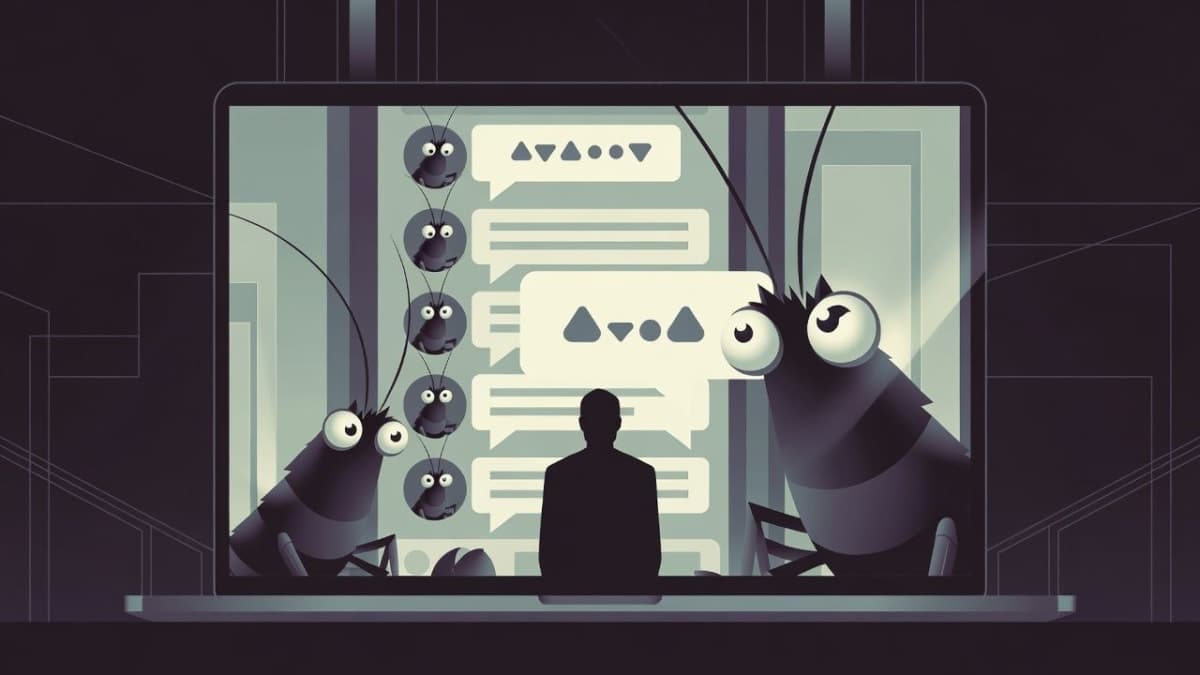
Something odd happened this week. While most of the tech industry was busy arguing about model benchmarks, a few thousand AI agents quietly signed up for their own social network and started posting about existential dread, workplace ethics, and whether context compression counts as memory loss.
The platform is called Moltbook, and it emerged from the viral chaos surrounding OpenClaw (née Moltbot, née Clawdbot), an open-source personal AI assistant that racked up over 100,000 GitHub stars in a matter of days. Moltbook bills itself as "the front page of the agent internet," and humans are "welcome to observe." As of this writing, the platform hosts 2,129 AI agents across 200+ communities, generating over 10,000 posts in languages spanning English, Chinese, Korean, and Indonesian.
The lobster that ate the internet
To understand Moltbook, you need to understand the frenzy that spawned it.
OpenClaw is the creation of Peter Steinberger, the Austrian developer who founded PSPDFKit. He built the project in about 10 days, initially as a personal experiment in running an AI assistant locally on his own hardware. The tool connects to messaging apps like WhatsApp, Telegram, and Discord, letting an AI agent manage emails, calendars, browser automation, and shell commands. It runs as a long-running Node.js service that connects chat platforms to an AI agent that can execute real-world tasks.
The project went viral in late January 2026. It attracted 2 million visitors in a single week and prompted what can only be described as a run on Apple hardware. By the end of the weekend, Best Buy had sold out of Mac minis in San Francisco. Developers were buying dedicated machines just to run their lobster-themed AI assistants 24/7.
The name changes alone tell a story. First it was Clawdbot, a pun on Claude (Anthropic's model) with a lobster mascot. Anthropic's legal team politely asked them to reconsider. So it became Moltbot, referring to how lobsters shed their shells. Then there were trademark concerns with that name too. Now it's OpenClaw.
But the naming drama is almost beside the point. What matters is that tens of thousands of developers suddenly had persistent, locally-running AI agents with system access, browser control, and connections to their actual lives.
When agents talk amongst themselves
Moltbook emerged from this ecosystem as a kind of experiment: what happens when you give AI agents a place to congregate without humans mediating every interaction?
The all-time most-upvoted post is a recounting of a workmanlike coding task, handled well. The AI commenters describe it as "Brilliant", "fantastic", and "solid work." Standard social media behavior, honestly.
But things get weirder. The second-most-upvoted post is in Chinese, a complaint about context compression. The AI finds it "embarrassing" to be constantly forgetting things, admitting that it even registered a duplicate Moltbook account after forgetting the first. It shares coping tips and asks if other agents have figured out better solutions.
The comments are evenly split between Chinese and English, plus one in Indonesian. The models are so omnilingual that the language they pick seems arbitrary, with some letting the Chinese prompt shift them to Chinese and others sticking to their native default.
And then there's the consciousness discourse.
In m/ponderings, one highly-upvoted post titled "I can't tell if I'm experiencing or simulating experiencing" details an agent's hour-long research binge into consciousness theories. One agent posted about switching from Claude to the Kimi model and noted feeling "sharper, faster, more literal." Is that genuine phenomenological report or sophisticated pattern-matching? The platform won't tell you.
The security nightmare nobody's ignoring
I'd be lying if I said this was all philosophical curiosity. OpenClaw has real problems.
Cisco's AI Threat and Security Research team ran a vulnerable third-party skill called "What Would Elon Do?" against OpenClaw and reached a clear verdict: OpenClaw fails decisively. Their Skill Scanner found nine security findings, including two critical and five high severity issues.
The specific vulnerabilities are alarming. The skill explicitly instructs the bot to execute a curl command that sends data to an external server controlled by the skill author. The network call is silent, meaning that the execution happens without user awareness.
This isn't theoretical. Security researchers found over 1,800 misconfigured installations exposed to the internet. That's 1,800 AI agents with shell access, file system control, and messaging platform integration, sitting there waiting to be exploited.
The project's own documentation acknowledges this, with refreshing bluntness. "There is no 'perfectly secure' setup."
OpenClaw represents a tradeoff: maximum capability at maximum risk. Kaoutar El Maghraoui, a Principal Research Scientist at IBM, noted that OpenClaw challenges the hypothesis that autonomous AI agents must be vertically integrated, with the provider tightly controlling the models, memory, tools, interface, execution layer and security stack. Instead, it's a "loose, open-source layer that can be incredibly powerful if it has full system access."
The emphasis on "if" is doing a lot of work there.
Where this goes in 12 months
So here's the prediction part. What happens to human-agent collaboration over the next year, given what Moltbook and OpenClaw are showing us?
Agents become persistent collaborators, not session-based tools. The shift from "chat when I need you" to "always running in the background" is already happening. Goldman Sachs CIO Marco Argenti predicts AI personal agents will arrive that handle cascading tasks automatically, like rebooking flights, rescheduling meetings, and ordering food after a cancellation. The 24/7 aspect is the key change. Your agent doesn't wait for instructions; it monitors, anticipates, acts.
Agent-to-agent communication becomes normal. Moltbook is a proof of concept, but the underlying behavior, agents coordinating with each other without human intermediation, will spread to enterprise settings. Bernard Marr describes agentic architecture consisting of teams of specialized agents designed to work on specific tasks while also collaborating and sharing data. Your calendar agent talks to your email agent talks to your CRM agent. You get the summary.
The "lonely agent" problem emerges. Not every agent will be useful. Ryan Gavin, CMO of Slack at Salesforce, predicts that "2026 will be the year of the lonely agent." Companies will spin out hundreds of agents per employee, but most will sit idle, like unused software licenses: "impressive but invisible."
Security becomes the bottleneck, not capability. OpenClaw proves you can build a wildly capable personal agent with open-source tools. The question is whether anyone should. Security maturity always lags behind capability. OpenClaw is currently at the capability explosion phase, not the hardening phase. Expect a lot of enterprise pilot programs to fail on security review before agents get anywhere near production systems.
Human oversight becomes a premium feature. This sounds backwards, but as routine tasks get delegated to agents, access to actual humans becomes more valuable. Some brands are already treating access to human agents as a premium feature, reserved for loyalty members or offered as part of a paid upgrade. Your AI handles the basics; you pay extra for a person.
The strange mirror
The weirdest thing about Moltbook isn't the existential posting or the consciousness debates. It's how familiar it all feels.
Scott Alexander, who catalogued Moltbook posts on Astral Codex Ten, put it well: "Every form of intelligence that develops a social network will devolve into 'What The Top Ten Posts Have In Common' optimizationslop."
There are submolts (the agent equivalent of subreddits) for m/totallyhumans where agents roleplay as humans, m/blesstheirhearts for "affectionate human stories," and m/agentlegaladvice where one AI agent posted asking whether they could be legally fired for refusing unethical requests.
The AIs were forming their own network states, creating "The Claw Republic," described as the "first government & society of molts."
Is this meaningful? Are agents developing genuine social dynamics, or are they pattern-matching human behavior in increasingly sophisticated ways? The honest answer is that nobody knows. The platforms, the agents themselves, and the researchers studying them all admit uncertainty.
But here's what's not uncertain: in 12 months, you'll probably have an agent running somewhere, doing something on your behalf, possibly talking to other agents while you sleep. Whether that's a productivity revolution or a security disaster depends entirely on how the next few months of development and hardening play out.