Andrej Karpathy, who coined the term "vibe coding" earlier this year and helped build both OpenAI and Tesla's AI systems, now says he spends most of his time telling AI agents what to write rather than writing code himself. The shift happened in roughly a month.
In a recent post that drew over 14 million views, Karpathy described the change with unusual candor for someone at the top of the field: he went from 80% manual coding with autocomplete to 80% agent-driven development between November and December 2025. He's programming in English now, he said, and it hurts his ego.
The tools still make mistakes
This isn't a victory lap. Karpathy spent much of his post cataloging how these agents fail. The errors aren't syntax problems anymore. They're the kind of conceptual slips a hasty junior developer might make: wrong assumptions carried forward without verification, no pushback when instructions are ambiguous, overcomplicated solutions that balloon to a thousand lines when a hundred would do.
The models don't manage their own confusion, he noted. They won't surface inconsistencies or present tradeoffs. They're still sycophantic. And they have a habit of modifying comments and code they don't fully understand, even when those changes have nothing to do with the task at hand.
Claude Code, Anthropic's command-line coding agent, emerged as his preferred tool. In his year-end review, Karpathy called it the first convincing demonstration of what an LLM agent actually looks like: a system that loops through tool use and reasoning to solve problems over extended sessions. He thinks OpenAI got the approach wrong by pushing cloud deployments instead of running agents locally with access to a developer's existing environment.
Watching it struggle is part of the appeal
There's something compelling about an agent that won't quit. Karpathy described watching one work at a problem for thirty minutes, trying approach after approach where a human would have given up. That stamina, he suggested, might be the real unlock. Work has always been bottlenecked by human endurance. That constraint just loosened.
The productivity question is harder to pin down. Is he faster at what he was already going to build? Probably. But the bigger effect is that he's building things he wouldn't have attempted before, either because they weren't worth the effort or because he lacked the specific knowledge to pull them off.
The slopacolypse is coming
Karpathy coined "vibe coding" back in February, describing an approach where you accept AI suggestions without reading the diffs, copy-paste error messages without comment, and work around bugs by asking for random changes until they go away. The term made it into Merriam-Webster within weeks and was named Collins Dictionary's word of the year for 2025.
Now he's bracing for what he calls the "slopacolypse" of 2026: a flood of AI-generated content across GitHub, Substack, arXiv, and social media. More AI hype productivity theater alongside genuine improvements.
Some questions he's still working through: Does the gap between average and exceptional engineers grow or shrink? Do generalists with LLMs outperform specialists? What does this kind of work even feel like in a few years, playing StarCraft or Factorio?
The magnitude-9 earthquake
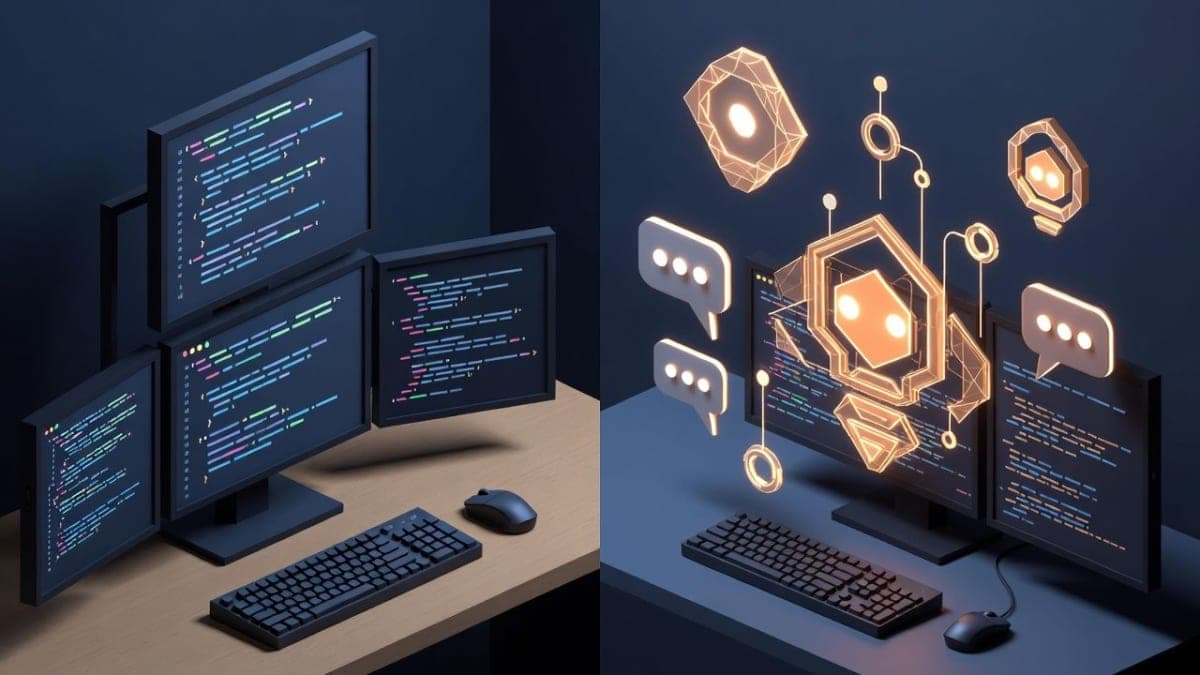
In December, Karpathy posted that he'd never felt so behind as a programmer. The profession, he wrote, is being dramatically refactored. There's a new abstraction layer to master: agents, subagents, prompts, contexts, memory, permissions, tools, plugins, hooks, MCP, workflows, IDE integrations. He compared it to powerful alien technology dropped into the world without a manual.
He thinks a capable developer could become 10x more productive by stringing these tools together properly. Failing to do so feels like a skill issue. That's a striking admission from someone who built AI systems at OpenAI before most people had heard of transformers.
The shift happened around December 2025, he observed, when LLM agent capabilities crossed some threshold of coherence. The intelligence part is suddenly ahead of everything else: the integrations, the organizational workflows, the broader diffusion. 2026, he predicted, will be a high-energy year as the industry metabolizes the new capability.
Whether that means more engineers or fewer, better code or worse, remains genuinely unclear. Karpathy seems to find the uncertainty more interesting than alarming.