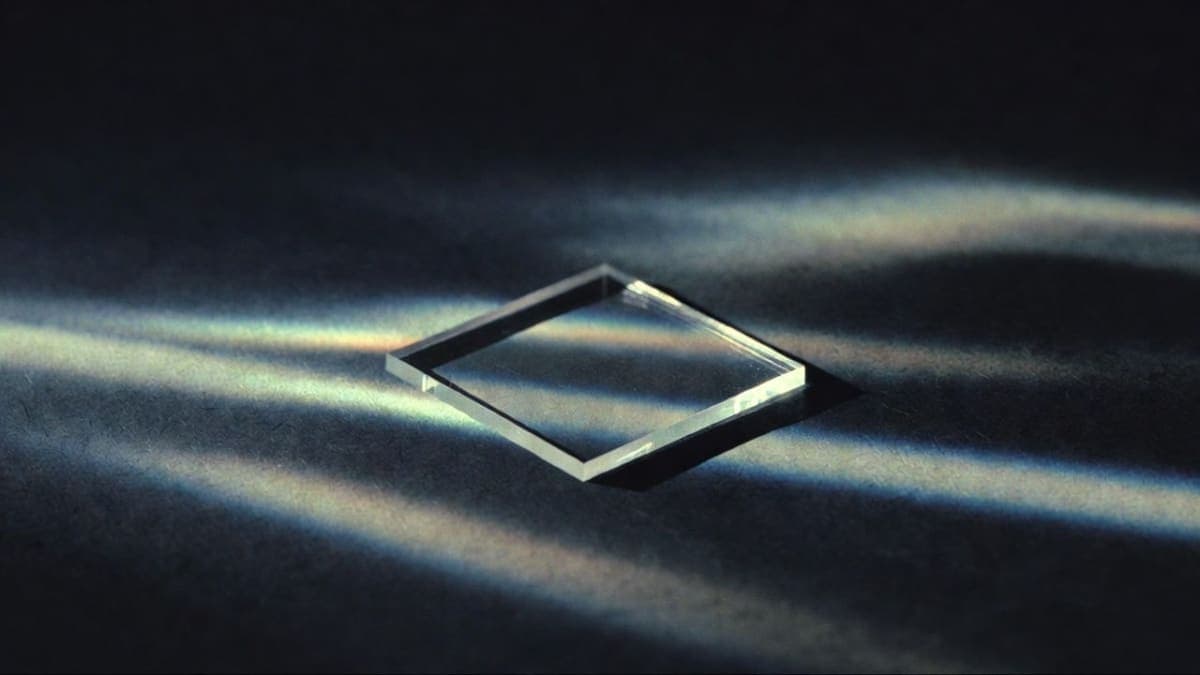
Microsoft Research published a paper in Nature this week detailing how its Project Silica team encoded 4.8 terabytes of data onto a 12-centimeter square of glass, 2 millimeters thick, using femtosecond laser pulses. The data, spread across 301 layers of three-dimensional voxels, should survive at least 10,000 years at room temperature. And the glass in question isn't some exotic lab material. It is borosilicate, the same stuff your Pyrex baking dish is made of.
That last detail is the actual news here. Project Silica has been around since 2019, and the team at Microsoft Research in Cambridge, UK, has been writing data into glass with ultrafast lasers for years. But previous iterations required fused silica, a high-purity glass available from a handful of specialty manufacturers. Expensive, hard to source, and not exactly the foundation you'd build a commercial storage product on.
The phase voxel trick
The key invention in the paper is what the team calls "phase voxels." Earlier glass storage methods (including Microsoft's own previous work, and the research from Peter Kazansky's group at the University of Southampton, who hold the Guinness record for durable digital storage) relied on birefringent voxels, tiny elongated nanovoids that refract light differently depending on polarization. Those can store more than one bit per voxel, which is great for density, but they only form properly in fused silica.
Phase voxels take a different approach: instead of modifying polarization, a single laser pulse changes the refractive index of the glass at a precise point. One pulse, one voxel. And because the physics are simpler, phase voxels work in borosilicate glass, where the birefringent method doesn't.
Richard Black, the partner research manager who led Project Silica, described the laser's effect to Nature as a "plasma-induced nano explosion." Which is a fun phrase for what amounts to a very controlled bit of damage to the glass's internal structure.
The tradeoff nobody's headlining
Here's what the coverage mostly glosses over. The 4.8TB figure that keeps appearing? That was achieved on fused silica, not borosilicate. On the cheaper glass, the team managed 2.02TB on the same size platter. Less than half the density. The Microsoft blog post breezes past this, and most outlets have been happy to lead with the larger number.
Write speeds tell a similar story. Per beam, the system hits 25.6 megabits per second in fused silica. With four parallel beams writing borosilicate, that climbs to 65.9 Mbps, which sounds like progress until you compare it to LTO-10 tape at 400 megabytes per second uncompressed. That is not a typo. Megabits versus megabytes. Glass storage is roughly 50 times slower than tape, and tape is not exactly famous for being fast.
The researchers suggest 16 or more parallel beams could dramatically improve throughput. But "could" and "demonstrated" are different things, and the paper only tested up to four.
So what does the reader look like?
One genuinely impressive detail: the reading system now needs a single camera, down from three or four in earlier prototypes. The team uses phase contrast microscopy paired with a convolutional neural network to interpret the voxel images, compensating for the heavier inter-symbol interference that phase voxels produce compared to birefringent ones. The machine learning decoding is doing real work here, not just smoothing edges.
The team described this as the first fully demonstrated end-to-end glass archival system, from writing through storage to retrieval. Their ACM paper from 2025 covered the broader system design, including the datacenter robotics and erasure coding. The Nature paper adds the material science breakthrough and the accelerated aging validation.
"The research phase is now complete"
And then there is the odd corporate epilogue. Microsoft's blog post announcing the paper includes this sentence: "The research phase is now complete, and we are continuing to consider learnings from Project Silica as we explore the ongoing need for sustainable, long-term preservation of digital information."
That is not a product roadmap. That is a polite way of saying the project might be finished.
The Register pressed Microsoft for clarification and got this: "Microsoft continues to value the intellectual property in Project Silica and is exploring options for how to apply the research learnings." A spokesperson quote that manages to say nothing while using a lot of words. "Value the intellectual property" is what you say about a patent portfolio, not an active development effort.
Gartner analyst Divya offered some cold water in an interview with Computerworld, noting that glass storage would likely emerge as a niche for ultra-long retention rather than a tape replacement. Any new medium, she said, has to compete on economics, hardware, software, and operational model, not just media longevity. And that's exactly where the numbers get hard to justify: tape is faster, cheaper per terabyte today, and already has the infrastructure.
There is a timing element worth noting, too. Sony discontinued its Optical Disc Archive in March 2025, the main optical alternative at 5.5TB per cartridge with a 100-year rated shelf life. That leaves no comparable optical product on the market. Project Silica could fill a gap that just opened, if Microsoft decides to fill it.
What's actually proven
Strip the hype and the corporate ambiguity, and what's left is a solid piece of materials science. The team proved that a cheap, widely manufactured glass can hold dense, laser-written data with verified longevity exceeding 10,000 years. They built a working read/write system. They published it in Nature with reproducible methods.
Whether anyone builds a product out of it is a separate question, and Microsoft apparently does not know the answer either. The paper has been released for others to build on, which is how you close out a research program, not how you launch a product line. I've seen this before with corporate research labs: the science works, the demos impress, and then the business case never quite materializes.
For now, the most honest summary comes from Black himself: "We have removed all of the scientific challenges. Now, it's only about the laser." That "only" is doing a lot of heavy lifting.