Sam Altman spent an hour with Indian press at the AI Impact Summit in New Delhi last week, and what came out was a mix of geopolitical candor, infrastructure realism, and at least one factual stretch about OpenAI's math capabilities.
The summit itself, which ran February 16 through 20, pulled an absurd roster of tech executives to India's capital: Sundar Pichai, Dario Amodei, Jensen Huang, Demis Hassabis. Altman delivered a keynote, sat for a CNBC interview, and apparently found time for a longer press session that covered everything from nuclear energy to why he'd pick Gemini over Claude.
The space jab
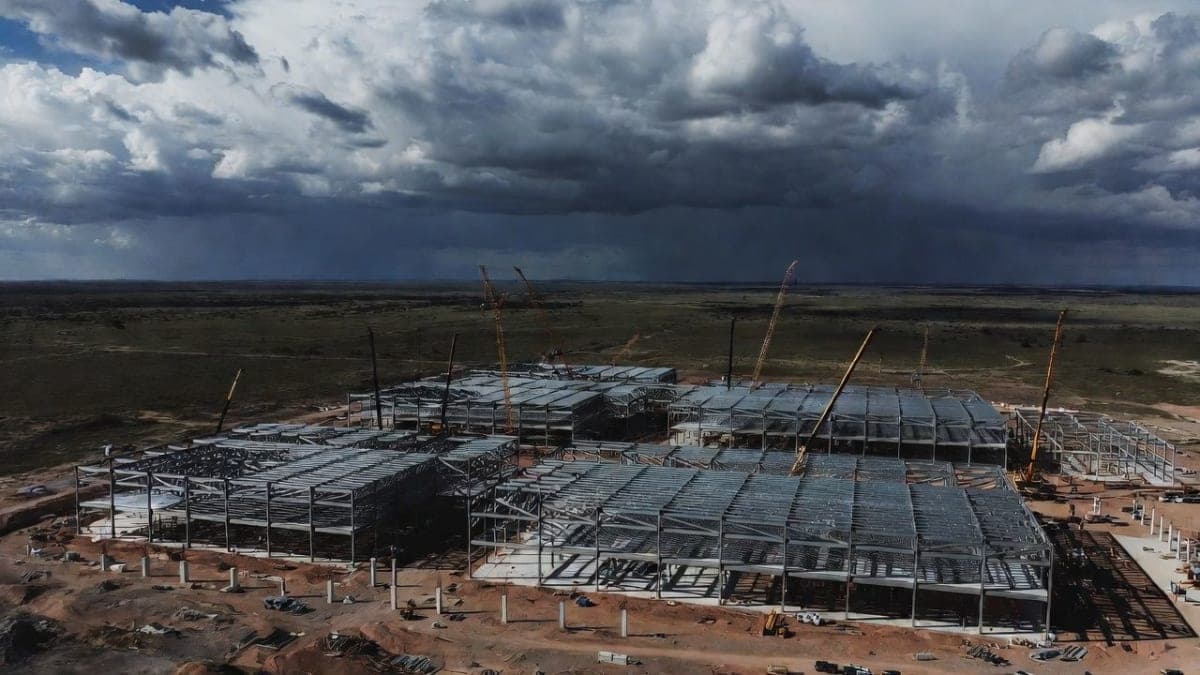
Altman's most quotable moment landed when he addressed orbital data centers, an idea Elon Musk floated in a December xAI all-hands and that Google has explored through its Project Suncatcher initiative. "I honestly think the idea with the current landscape of putting data centers in space is ridiculous," Altman told the audience, which laughed. He pointed to launch costs and a practical problem nobody in orbital computing likes to talk about: when a GPU breaks in space, there is nobody to fix it.
"Orbital data centers are not something that's going to matter at scale this decade," he added, leaving the door open for some future where it makes sense. Altman has clearly done the napkin math on this and decided it doesn't work, though Google's Pichai has suggested space-based data centers powered by solar energy could arrive as early as 2027. Someone is going to be wrong.
On China, something close to honesty
The more substantive remarks came when Altman addressed China's position in the AI race. In his CNBC sit-down, he called Chinese tech companies' progress across the stack "remarkable" and said the pace of advancement in AI and adjacent fields was "amazingly fast." That's a significant public concession from the CEO of America's most prominent AI company, even if the framing ("in some areas they're near the frontier, while in others they lag behind") left him some hedging room.
During the broader press session, Altman reportedly went further, arguing that China holds a commanding advantage in physical industries adjacent to AI: industrial robotics, electric motors, magnets, energy infrastructure deployment. The implication is that even if American labs maintain an edge in model development, China's manufacturing ecosystem could prove decisive as AI moves from software to physical infrastructure at scale.
This tracks with a theme Altman has been pushing for months. He's argued that building AI infrastructure will be the most expensive project in human history and that it can't be done with conventional methods. Robots building data centers for AI that runs on chips produced in factories staffed by more robots. The circularity is dizzying, and China's head start in the physical layer makes Altman visibly uncomfortable.
The math problem
Altman referenced OpenAI's performance on the First Proof challenge, a set of ten unpublished research-level math problems created by eleven leading mathematicians (including a Fields Medalist) and released on February 5. He reportedly claimed AI solved seven of the ten problems. That number doesn't match what OpenAI itself has said.
OpenAI's chief scientist Jakub Pachocki initially claimed six solutions, then walked one back to five. And even those five came with significant caveats: the company used an unreleased internal model, had human experts review outputs, and Pachocki himself called the whole effort a "chaotic sprint" whose methodology "leaves a lot to be desired." Publicly available models like ChatGPT and Gemini solved two.
So somewhere between Pachocki's qualified five and Altman's confident seven, there's a gap of at least two problems and a lot of nuance. Scientific American reported that mathematicians had already poked holes in at least one of the claimed solutions before the ink was dry. "None of the LLMs came close to solving them all," the magazine noted. Altman's version of events is the kind of selective rounding-up that makes AI progress harder to evaluate honestly.
The ads question
Altman also confirmed that OpenAI won't rule out advertising as a revenue model. This is old news by now: the company started testing ads in ChatGPT on January 16 for free and Go tier users. But the timing is awkward. Just days before the summit, Anthropic ran Super Bowl ads mocking the idea of chatbot advertising, and Altman responded by calling Anthropic "dishonest" and "authoritarian." Then he and Amodei stood next to each other on stage while Modi tried to get them to hold hands. They didn't.
From the press session, Altman reportedly said he'd choose Gemini if forced to pick a competitor's AI assistant, which is a pointed snub given that Anthropic's CEO was literally in the same building. He also called giving up his equity stake in OpenAI one of his dumbest decisions, which is the sort of thing that's easy to say when the company is closing a $100 billion funding round at a $300 billion valuation.
What actually matters
Strip away the one-liners and there's a coherent argument underneath: the AI buildout requires government partnership at a scale Silicon Valley's libertarian roots never anticipated, the energy demands are real but overstated by critics, and no single company or country should control the outcome. "Centralization of AI in one company or country could lead to ruin," Altman said in his keynote, which is a fascinating position for the CEO of the company most likely to centralize it.
OpenAI announced new offices in Bengaluru and Mumbai, a partnership with Tata's data center business, and academic collaborations with IIT Delhi and AIIMS. India now has 100 million weekly active ChatGPT users, per Altman's own count, making it OpenAI's second-largest market behind the U.S.
The next round of First Proof math problems drops March 14. Altman predicted early versions of superintelligence could arrive by the end of 2028. The India AI Impact Summit runs again next year. Between those dates, there's a lot of time for reality to catch up with the rhetoric.