Something strange happened while everyone was busy complaining about AI ruining the internet. The rubbish got interesting.
Open TikTok or Instagram right now and you'll likely encounter the grainy, fish-eyed aesthetic of fake surveillance footage: a driveway at night, an empty grocery store, JD Vance materializing at someone's doorstep in an inexplicable outfit. Scroll further and there's a crocodile-bomber hybrid screaming pseudo-Italian nonsense, elderly Asian women transforming into industrial mermaids, a humanoid emerging from a pot of boiling dough. This is AI slop in its current form, and dismissing it as garbage might be missing the point entirely.
MIT Technology Review's Caiwei Chen spent months talking to the people actually making this stuff. What she found wasn't a wasteland of zero-effort content farms. It was something closer to the messy, collaborative birth of a new medium.
The term carries baggage
"Slop" started as an insult on 4chan in the early 2010s, a way to describe anything mass-produced and contemptible. The Cambridge Dictionary's new definition cements the association with AI: content that is "of very low quality, especially when it is created by AI." Oxford named "brain rot" its 2024 Word of the Year, with "slop" as a finalist, both terms pointing at the same anxiety about what screens are doing to us.
The creators working in this space have complicated relationships with the label. Daryl Anselmo, a creative director who has posted an AI-generated video every single day since 2021, titled his yearslong project AI Slop with deliberate irony. His work has shown at the Grand Palais Immersif in Paris. "I am working with the slop, pushing the models, breaking them, and developing a new visual language," he told Chen. "I have no shame that I am deep into AI."
Others bristle at the dismissal. Eric Suerez and Adam Vaserstein, creators of Granny Spills (an AI-generated glamorous grandmother dispensing life advice, 1.8 million Instagram followers in three months), say they "hate it" when their work gets called slop. They're making creative choices, they argue. They're not just pressing a button.
What it actually takes
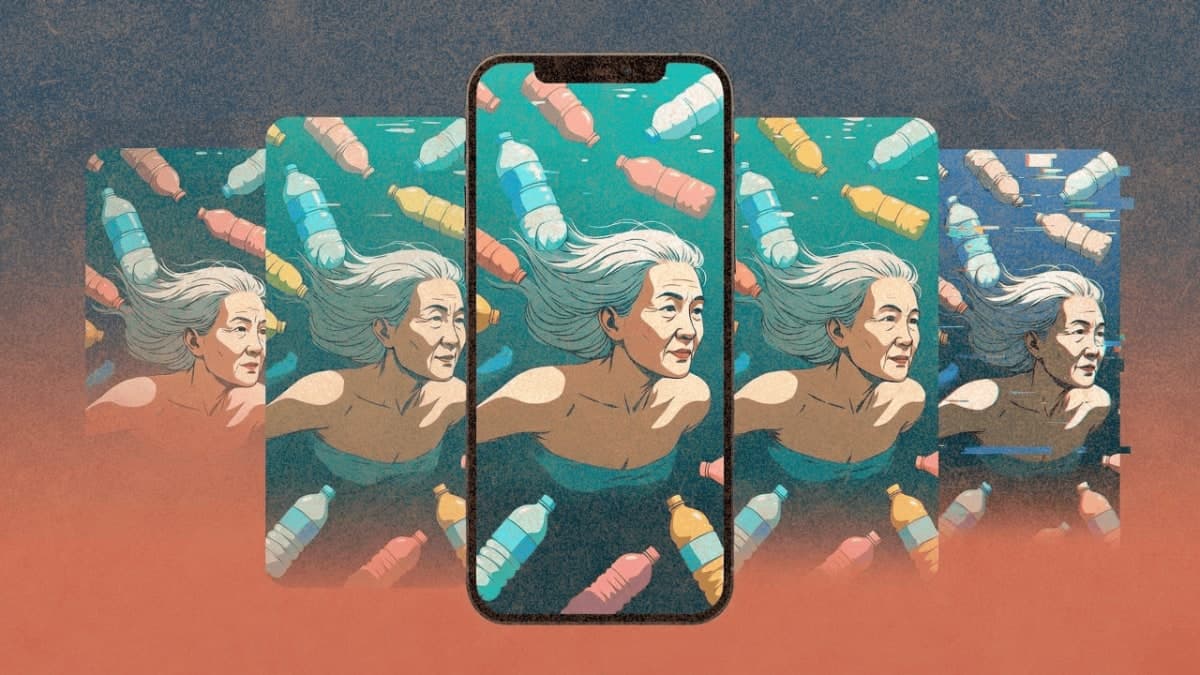
Here's where the critics' assumptions start breaking down. Making AI video that people actually watch is not a one-click operation. Wenhui Lim, an architectural designer who runs the popular Niceaunties account, says a single one-minute video can take hours, sometimes days, to produce. Her Auntlantis series, featuring silver-haired Asian women as industrial mermaids cleaning a plastic-choked ocean, has racked up over 13.5 million views on a single post.
Lim's project grew from something personal. "The word 'aunties' often has a slightly negative connotation in Singaporean culture," she explained. "They are portrayed as old-fashioned, naggy, and lacking boundaries. But they are also so resourceful, funny, and at ease with themselves." She wanted to build a world where older women could be outrageous, joyful, and unbound by expectation. AI gave her the tools to do it without a film crew or a budget.
Drake Garibay, a software developer from California, got pulled in through body-horror clips circulating in early 2025. His viral video showing a human face emerging from boiling dough has over 8.3 million views. He spends hours each week iterating on his creations. "There is a heck of a lot more involved, if you want a higher-end result," he said.
The weirdness is the point
AI video tools are genuinely good at one thing traditional filmmaking isn't: pushing physics past what cameras can capture or bodies can do. "There is definitely a competition of 'How weird can we push this?' among AI video creators," Lim observed.
This makes AI a surprisingly natural fit for satire, absurdism, and experimental work. The surrealism isn't a bug. Creators are chasing it deliberately, using the uncanny artifacts of AI generation as aesthetic features rather than flaws they need to hide.
Anselmo's recent work has leaned into body horror: a hyperrealistic bot peeling open its own skull, a midnight diner populated by anthropomorphized Tater Tots. The pieces feel closer to art-house vignettes than throwaway memes. Whether that qualifies as "art" isn't something he's interested in debating. "I see this series as an experimental sketchbook," he said.
Italian brainrot and collective lore
The most revealing case study might be Italian brainrot, which swept TikTok in early 2025. The phenomenon features AI-generated animal-object hybrids with pseudo-Italian names: Tralalero Tralala (a three-legged shark wearing Nike sneakers), Bombardiro Crocodilo (a crocodile fused with a military bomber plane), Chimpanzini Bananini, Ballerina Cappuccina.
What made it interesting wasn't any single video. "It was the collective lore-building that made it wonderful," software developer Denim Mazuki told Chen. "Everyone added a piece. The characters were not owned by a studio or a single creator—they were made by the chronically online users."
The barrier to participation collapsed. You didn't need costumes or filming locations. You tweaked a prompt, generated something absurd, and contributed to a shared hallucination. OpenArt, a platform designed for AI video storytelling, created templates specifically to let regular people join the trend. More than 80% of their users have no artistic background, according to cofounders Coco Mao and Chloe Fang.
Panini, the trading card company, released an official Italian brainrot sticker album. Hungarian PM Viktor Orbán posted a TikTok featuring one of the characters. Whether this represents cultural democratization or civilizational decline probably depends on how you felt about the internet before any of this started.
The infrastructure arrives
The slop boom coincided with OpenAI launching the Sora app in late September 2025, putting video generation on phones. Some internet users and online content creators, such as Hank Green, have called the mobile app "SlopTok," a reference to both TikTok and the content it enables. Meta's Vibes app followed with an all-AI video feed. Both companies are betting that personalized, endless AI content isn't a novelty but a new category of media consumption.
The tools have improved substantially. Earlier text-to-video systems from 2022-2023 managed only a few seconds of blurry motion, with warping objects and melting faces. Current models like Sora 2, Veo 3, and Runway's Gen-4.5 can produce realistic clips up to a minute, some with synchronized audio and rough dialogue.
Companies pitched these tools as the future of cinema, courting Hollywood with demos of dramatic widescreen shots. The reality of how they're actually used is "more modest, weirder—and arguably much more interesting," Chen wrote. The home turf for AI video turned out to be the six-inch screen in our hands.
The dark side is obvious
None of this means the critics are wrong about the risks. Sora has been used to create racist deepfakes of Martin Luther King Jr. at such volume that his estate pushed OpenAI to block new MLK videos entirely. TikTok and X are seeing clips of women being strangled, posted by accounts dedicated to that single theme. "Nazislop" repackages fascist aesthetics and memes into glossy, algorithm-ready content aimed at teens' feeds.
An AI video of the CN Tower on fire went viral on Facebook with users reacting in shock, thinking it was real. Fake videos related to SNAP benefits made it to Fox News, which initially covered them as if they were genuine. The line between harmless absurdity and harmful deception is not self-policing.
A Brookings study of one major freelance marketplace found that after new generative AI tools launched in 2022, freelancers in AI-exposed occupations saw about a 2% decline in contracts and a 5% drop in earnings. Every creator I've read about has received hateful messages accusing them of taking opportunities from working artists.
Is it art? Wrong question.
Mindy Seu, a researcher and associate professor in digital arts at UCLA, offers a frame that sidesteps the argument. "The phrase 'AI slop' implies, like, a certain ease of creation that really bothers a lot of people—understandably, because [making AI-generated videos] doesn't incorporate the artistic labor that we typically associate with contemporary art," she said.
Digital art and internet art have always been slow to gain institutional recognition. New technology has always carried stigma in creative fields. "Every big advance in technology yields the question 'What is the role of the artist?'" she added.
OpenArt's Mao believes learning to use these tools will be essential for future content creators, "much as learning Photoshop was almost synonymous with graphic design for a generation." That comparison might be generous. It might also be prescient.
Zach Lieberman, who leads a research group at the MIT Media Lab exploring code-enabled images, sees promise alongside unease. A younger generation will inevitably see AI as just another tool in the toolbox, he said. But by relying on black-box AI models, artists lose some of the direct control over output that they've traditionally enjoyed.
The interesting question
Charles Pulliam-Moore at The Verge called AI slop "formulaic derivativeness" that defines internet culture at its worst: unimaginative, unoriginal, uninteresting. That critique lands. A lot of what floods feeds is exactly that.
But Chen ended up somewhere more ambivalent after months of reporting. "To 'love AI slop' is to admit the internet is broken, that the infrastructure of culture is opportunistic and extractive," she wrote. "But even in that wreckage, people still find ways to play, laugh, and make meaning."
There's a Chinese creator named Mu Tianran who makes skits that deliberately mimic AI slop aesthetics, acting out the uncanny movements and awkward timing of generated video. In one widely circulated clip, he plays an interviewer asking actors, "Do you know you are AI generated?" Their responses seem so AI, but of course they're not.
"Watching this, it was hard to believe that AI was about to snuff out human creativity," Chen observed. "If anything, it has handed people a new style to inhabit and mock, another texture to play with."
The urge to imitate, remix, and joke might be stubbornly human enough that AI can't take it away. Or maybe we're just telling ourselves that because the alternative is too depressing to accept.
Either way, the aunties are still dancing, the sharks are still wearing Nikes, and somewhere right now someone is tweaking a prompt to make something slightly weirder than what came before. Call it what you want.