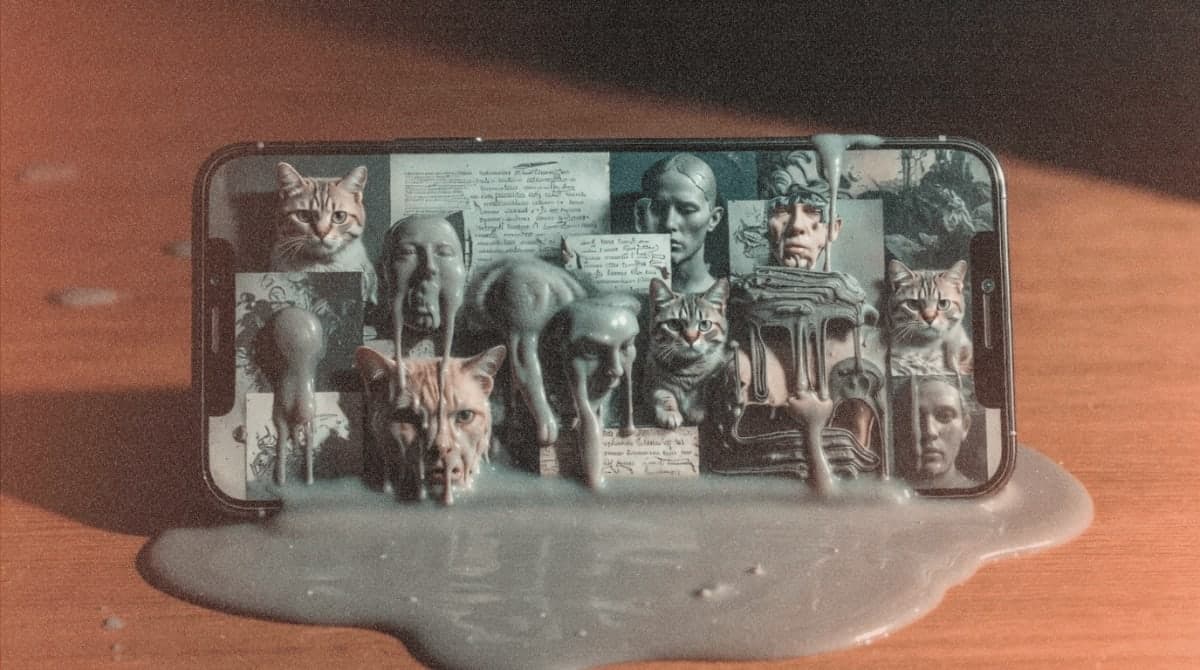
Merriam-Webster announced Monday that "slop" is its 2025 Word of the Year, capping a season in which essentially every major English dictionary chose a term reflecting anxiety about technology, social media, or artificial intelligence. The word means "digital content of low quality that is produced usually in quantity by means of artificial intelligence," which is a polite way of describing the weird hands, hallucinated text, and uncanny valley cats that have colonized social media feeds this year.
What makes the choice interesting isn't that a dictionary noticed AI content exists. Oxford picked "rage bait." Collins went with "vibe coding." Cambridge chose "parasocial." Dictionary.com landed on "67," a Gen Alpha catchphrase. They're all in the same anxious orbit.
No, what's interesting is the tone. "Slop" is a word that drips with contempt. It evokes pig troughs and kitchen waste. It's the linguistic equivalent of a dismissive hand wave.
The mockery is the message
Greg Barlow, Merriam-Webster's president, called it "something that people have found fascinating, annoying and a little bit ridiculous" in an interview with the Associated Press ahead of the announcement. That tracks. There's an edge to how people talk about AI-generated content now that wasn't there two years ago, when ChatGPT still felt novel and the discourse leaned toward either utopian or apocalyptic.
Peter Sokolowski, the dictionary's editor at large, put it more directly: the word "sends a little message to AI: When it comes to replacing human creativity, sometimes you don't seem too superintelligent."
Merriam-Webster's editors traced the word's evolution from its 1700s origins (soft mud) through the 1800s (food waste, then pig slop) to its current digital meaning. The progression feels fitting. AI slop isn't scary, exactly. It's just... gross. And everywhere.
The other dictionaries went clinical
Compare this to Oxford's choice. "Rage bait" is technically accurate, sure. Content designed to make you angry does exist, and its usage did triple over the past year according to Oxford's language data. But the term sounds like something from an academic paper on digital media literacy. It describes a phenomenon from the outside.
Collins Dictionary's pick, "vibe coding," has the opposite problem. The term, which refers to using natural language prompts to generate code without actually understanding what you're building, is genuinely insider baseball. Andrej Karpathy, who co-founded OpenAI and ran AI at Tesla, popularized it earlier this year when he wrote on X about "fully giv[ing] in to the vibes" and forgetting "that the code even exists."
That's fine for people who follow AI discourse closely. For everyone else, it requires explanation.
Cambridge went with "parasocial," describing the one-sided relationships people form with celebrities, influencers, and increasingly, AI chatbots. The term has academic roots dating to 1956, when sociologists Donald Horton and Richard Wohl first described how television viewers formed connections with people on their screens. Cambridge's editors noted that searches spiked this year after Taylor Swift announced her engagement to Travis Kelce, which prompted mass online reactions that demonstrated just how intensely fans feel they "know" celebrities they've never met.
All of these are legitimate observations about where culture is right now. But they're observations, not judgments. "Slop" is a judgment.
A year of wanting to log off
The runner-up that came closest to winning, according to Barlow, was "touch grass," the now-common imperative to step away from the internet and participate in the physical world. The phrase got a particular boost in September when Utah Governor Spencer Cox, announcing the capture of a suspect in the assassination of conservative activist Charlie Kirk, urged Americans to disconnect from social media.
"Social media is a cancer on our society right now," Cox said at a press conference. "I would encourage people to log off, turn off, touch grass, hug a family member, go out and do good in your community."
It was a striking moment: a governor, at a briefing about a politically motivated killing, issuing what amounted to a public health warning about screens.
The other notable finisher was "conclave," which spiked after Pope Francis died in April and cardinals gathered to elect Pope Leo XIV, history's first American pope. That one's more event-specific than culturally diagnostic, though the film "Conclave" had already been driving searches before the real thing happened.
What the dictionaries measure
The selection methodologies vary. Merriam-Webster relies heavily on lookup spikes throughout the year, which tends to favor words connected to news events. Oxford incorporates public voting on a shortlist, which brought in more than 30,000 votes this year. Collins monitors a 24-billion-word corpus that includes social media.
None of them are pure science, but they're not trying to be. The annual ritual is marketing as much as lexicography. Still, when every major dictionary independently lands on some variant of "the internet is making us feel bad," that's worth noting.
The convergence suggests something obvious: people are frustrated with what digital life has become. The specific flavors of frustration differ. Rage bait captures the manipulation. Parasocial captures the loneliness. Vibe coding captures the abdication of expertise.
Slop captures the sheer volume of garbage.
There's an FTC complaint to file somewhere about the misleading name "artificial intelligence" when so much of what these systems produce is artificial mediocrity. Four letters does the job faster.