QUICK INFO
| Difficulty | Intermediate |
| Time Required | 25-35 minutes |
| Prerequisites | Basic Python or TypeScript, familiarity with LLM APIs |
| Tools Needed | Python 3.10+ or Node.js 18+, API keys for at least one LLM provider |
What You'll Learn:
- Architectural differences between graph-based, role-based, and type-safe agent frameworks
- Which framework fits specific production scenarios
- Performance characteristics and real-world limitations of each option
- How to evaluate frameworks for your team's technical requirements
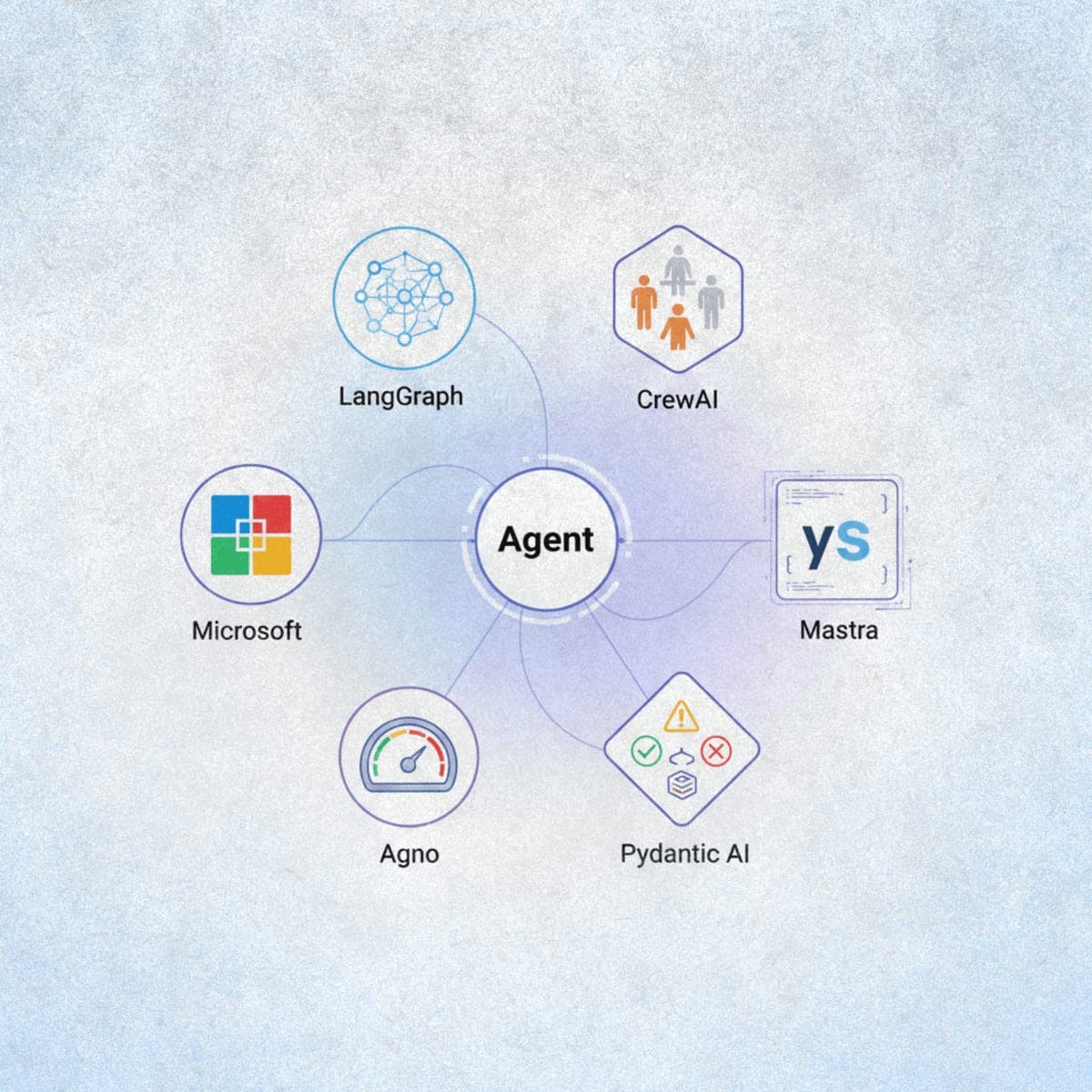
The agent framework landscape shifted considerably in 2024-2025. What started as experimental research projects became production infrastructure at companies like Klarna, Replit, and LinkedIn. This guide examines six frameworks that have emerged as serious options for building agent systems, covering their architectural choices, actual limitations (not marketing claims), and the scenarios where each makes sense.
I've focused on frameworks with meaningful adoption and active development. There are dozens of others, but these six represent distinct philosophical approaches to the same problem: how do you get LLMs to reliably complete multi-step tasks?
The Frameworks at a Glance
Before diving into details, here's the fundamental distinction: some frameworks prioritize explicit control over agent behavior (LangGraph, Pydantic AI), others prioritize multi-agent collaboration patterns (CrewAI, AutoGen), and some optimize for specific ecosystems or performance characteristics (Mastra for TypeScript, Agno for speed).
None of them solve the hard problem of agent reliability. They all provide scaffolding for building agents. The scaffolding differs significantly.
LangGraph
LangGraph emerged from the LangChain ecosystem in early 2024 as a response to criticism that LangChain's abstractions were too opaque for production use. It treats agent workflows as directed graphs where nodes represent computation steps and edges control flow between them.
The core idea: model your agent as a state machine. Each node can be an LLM call, a tool invocation, or custom logic. State persists between nodes and gets checkpointed automatically. This makes debugging tractable because you can inspect what happened at each step, replay from any checkpoint, and understand exactly why your agent did what it did.
LangGraph's flexible framework supports diverse control flows: single agent, multi-agent, hierarchical, sequential. The framework provides time-travel debugging (roll back to any state and try different actions) and human-in-the-loop interrupts where agents can pause for approval before proceeding.
Architecture: Graph-based state machines with explicit nodes and edges. State management is built-in through a centralized StateGraph. You define both what happens and the structure of how it happens.
What it's actually good at: Complex workflows requiring precise control. If you need to implement retry logic, conditional branching, parallel execution with result merging, or any scenario where you need to understand exactly why something failed, LangGraph gives you the visibility. Companies like LinkedIn use it for SQL Bot, an internal tool that transforms natural language into SQL queries. AppFolio's Realm-X copilot reportedly improved response accuracy by 2x after migrating to LangGraph.
Where it struggles: The learning curve is real. The abstraction layering and insufficient documentation cohesion demand significant onboarding time. If you're building something simple, you'll spend more time wrestling with graph definitions than actually building your agent. The LangChain ecosystem carries baggage: some developers find the abstractions unnecessarily complex, and you'll encounter opinions about this if you search developer forums.
Performance: LangGraph's checkpointing and state management add overhead. For high-throughput scenarios with thousands of concurrent agents, you'll notice it. The framework prioritizes observability and reliability over raw speed.
Best for: Production workflows at scale, enterprise applications requiring audit trails, anything where you need to explain to stakeholders exactly what your agent did and why.
Avoid if: You're prototyping quickly, building something simple, or your team doesn't have experience with state machine concepts.
CrewAI
CrewAI takes a different approach entirely. Instead of modeling agents as graphs, it uses the metaphor of a team: you define agents with roles, goals, and tools, then let them collaborate to accomplish tasks. A "Researcher" agent gathers information, a "Writer" agent produces content, an "Editor" reviews it.
The framework launched in early 2024 and grew quickly, accumulating over 30,000 GitHub stars. CrewAI is built entirely from scratch, completely independent of LangChain or other agent frameworks. This independence is intentional and frequently mentioned in their documentation.
Architecture: Role-based agents organized into "Crews" that execute tasks sequentially or hierarchically. CrewAI Crews optimize for autonomy and collaborative intelligence, enabling AI teams where each agent has specific roles, tools, and goals. CrewAI Flows enable granular, event-driven control.
The latest versions support two modes: autonomous crews (agents decide how to collaborate) and explicit Flows (you script the interactions). This flexibility helps bridge the gap between prototyping and production.
What it's actually good at: Multi-agent scenarios where the role metaphor fits naturally. Content pipelines, research automation, any workflow that humans would organize as a team. CrewAI likely covers 80% of use cases out of the box, like content pipelines and data assistants. The YAML-based configuration makes it accessible to developers who want quick results without deep framework knowledge.
Where it struggles: Users have reported difficulties when utilizing 7B parameter open-source models with CrewAI's function-calling features. The framework works best with capable models like GPT-4 or Claude. If you're trying to use smaller open-source models, expect friction.
As the number of agents and tasks grows, maintaining clear role definitions and ensuring smooth communication between agents becomes increasingly challenging. Complex multi-agent setups require careful architectural planning.
The pricing model for their hosted platform has gaps: the gaps between plan tiers widen significantly, making CrewAI not much of an option if you've outgrown the Basic Plan but can't justify forking out $6,000/year.
Performance: CrewAI executes up to 5.76x faster than competitors like LangGraph while maintaining higher accuracy according to their benchmarks. I haven't independently verified these numbers, and benchmark claims from framework authors should be treated skeptically.
Best for: Rapid prototyping of multi-agent workflows, content generation pipelines, scenarios where the team metaphor maps cleanly to your problem.
Avoid if: You need fine-grained control over agent interactions, you're using smaller open-source models, or you need transparent pricing for production scale.
Mastra
Mastra is the TypeScript option in this comparison. From the team behind Gatsby, Mastra is a framework for building AI-powered applications and agents with a modern TypeScript stack. If your team lives in the JavaScript ecosystem and doesn't want to context-switch to Python, Mastra deserves consideration.
Architecture: Declarative agent definitions with strong TypeScript support. Mastra follows a declarative approach to agent definition, with TypeScript support providing strong type safety. Its architecture emphasizes component reusability and extension patterns.
The framework integrates with React, Next.js, and Node.js, or deploys as a standalone server. It includes built-in workflow orchestration (graph-based, similar in concept to LangGraph but with TypeScript ergonomics), RAG support, memory management, and evaluation tools.
What it's actually good at: TypeScript developers building web applications with AI features. The integration with Vercel's AI SDK and frontend frameworks like CopilotKit makes it straightforward to build AI-powered UIs. One stack, one set of primitives, no glue code. If you are tired of gluing together multiple third-party libraries to build GenAI and agentic workflows, this is likely for you.
The local development experience is polished: a built-in playground for testing agents, tracing, and OpenAPI documentation generation.
Where it struggles: The ecosystem is smaller than Python alternatives. You'll find fewer examples, tutorials, and community solutions. If you hit an edge case, you may be on your own more often than with LangGraph or CrewAI.
Multi-agent orchestration isn't as mature as dedicated multi-agent frameworks. Mastra is better for single-agent or simple multi-agent scenarios than complex team-based workflows.
Performance: I haven't seen independent benchmarks. The framework is designed for web application contexts where response latency matters more than raw throughput.
Best for: TypeScript/JavaScript teams, web applications with AI features, developers who want strong typing and don't want to maintain Python infrastructure.
Avoid if: You need mature multi-agent patterns, your team is already comfortable with Python, or you need the largest possible ecosystem of examples and integrations.
Pydantic AI
Pydantic AI brings the philosophy of FastAPI to agent development: type safety, validation, and explicit contracts. FastAPI revolutionized web development by offering an innovative and ergonomic design, built on the foundation of Pydantic Validation and modern Python features like type hints. The Pydantic team built this framework because existing options didn't match their standards for developer experience.
Architecture: Agents as typed Python objects with dependency injection, structured outputs, and validation at every step. Fully Type-safe: Designed to give your IDE or AI coding agent as much context as possible for auto-completion and type checking, moving entire classes of errors from runtime to write-time.
You define what your agent returns using Pydantic models, and the framework ensures the LLM output conforms to that schema. This catches errors early and makes agents composable: the output of one agent can be the typed input to another.
What it's actually good at: Production applications where reliability matters more than flexibility. Production applications, APIs, and when you need reliable, structured outputs. If you're feeding agent outputs into downstream systems that expect specific formats, Pydantic AI reduces the "parse and pray" pattern.
The integration with Pydantic Logfire provides real-time debugging and monitoring. Seamless Observability: Tightly integrates with Pydantic Logfire for real-time debugging, evals-based performance monitoring, and behavior, tracing, and cost tracking.
Recent additions include MCP (Model Context Protocol) integration, Agent2Agent support, and human-in-the-loop tool approval.
Where it struggles: PydanticAI is great for structured task agents and quick prototypes, but lacks ergonomic depth for large-scale agentic systems. The framework prioritizes single-agent reliability over multi-agent orchestration. You can build multi-agent systems, but it's not the framework's strength.
The framework is newer (late 2024), and while it reached v1.0 in September 2025, the ecosystem of examples and community patterns is smaller than LangGraph or CrewAI.
Performance: Agno Agents instantiate 57× faster than PydanticAI according to Agno's benchmarks. Pydantic AI prioritizes correctness over speed.
Best for: Backend services that need structured AI outputs, teams already using Pydantic and FastAPI, scenarios where validation and type safety prevent costly errors.
Avoid if: You need sophisticated multi-agent coordination, you want the largest community ecosystem, or your outputs don't need structured validation.
Agno
Agno (formerly Phidata) optimizes for performance. Agent instantiation is measured at less than 5 microseconds, significantly outperforming competing frameworks. Memory usage is optimized to 50x lower than LangGraph.
If you're building systems with thousands of concurrent lightweight agents, these numbers matter. For most applications, they don't.
Architecture: Lightweight Python framework with built-in support for memory, knowledge bases (RAG), and multi-modal inputs. Model-Agnostic Flexibility: Plug in OpenAI GPT, Anthropic Claude, Google models, or open-source LLMs without lock-in. Native Multimodal Support: Process text, images, audio, and video in the same agent.
Agno provides both the framework and an optional AgentOS control plane for deployment, monitoring, and management. The control plane runs in your cloud, avoiding data sovereignty concerns.
What it's actually good at: High-throughput scenarios, multimodal applications, teams that want performance without operational complexity. Agent instantiation is measured at less than 5μs, significantly outperforming competing frameworks.
The framework ships with over 100 toolkits and emphasizes simplicity: Simplicity: Avoids complex graphs, chains, or dependency-heavy architectures.
Where it struggles: While it does not offer out-of-the-box multi-agent orchestration, its minimal surface makes it a strong fit for teams layering in their own monitoring and evaluation stacks. If you need complex multi-agent patterns, you'll build more yourself.
Documentation and community size lag behind LangGraph and CrewAI. The performance claims are impressive but I've seen limited independent verification.
Performance: The fastest option in this comparison by a significant margin, if the benchmarks hold.
Best for: High-throughput applications, multimodal agents, teams prioritizing performance and operational simplicity.
Avoid if: You need complex multi-agent orchestration out of the box, you want the largest ecosystem, or performance isn't a primary concern.
Microsoft Agent Framework (AutoGen + Semantic Kernel)
Microsoft's approach is now unified under the "Microsoft Agent Framework," which converges AutoGen, a former Microsoft Research project, and the enterprise-ready foundations of Semantic Kernel into a unified, commercial-grade framework.
AutoGen originated from Microsoft Research and pioneered conversational multi-agent patterns. Semantic Kernel provides enterprise-ready AI integration with Microsoft's ecosystem. The convergence aims to give developers cutting-edge research capabilities with production support.
Architecture: AutoGen v0.4 adopts a more robust, asynchronous, and event-driven architecture, enabling a broader range of agentic scenarios with stronger observability, more flexible collaboration patterns, and reusable components.
The framework uses an actor model where agents communicate through asynchronous messages. This design handles distributed systems, cross-language interoperability (Python and .NET), and scenarios where agents operate across organizational boundaries.
What it's actually good at: Enterprise deployments in Microsoft ecosystems. Experiment locally and then deploy to Azure AI Foundry with observability, durability, and compliance built in. If you're already using Azure, the integration path is straightforward.
Research-oriented applications benefit from patterns like Magentic-One, a generalist multi-agent team that achieved state-of-the-art performance on multiple benchmarks.
Cross-language support: This update enables interoperability between agents built in different programming languages, with current support for Python and .NET.
Where it struggles: The ecosystem is in transition. The convergence of AutoGen and Semantic Kernel creates confusion about which components to use. Customers should choose Semantic Kernel if they're building agent production applications that need AI capabilities with enterprise-grade support. But the boundaries between the frameworks are still being clarified.
Its conversational logic can be difficult to debug or rerun consistently, especially when goals evolve mid-session or memory is implicit.
Performance: Not the focus. The framework prioritizes enterprise features, compliance, and integration over raw speed.
Best for: Microsoft ecosystem users, enterprise deployments requiring support contracts, research projects exploring cutting-edge multi-agent patterns.
Avoid if: You want a stable, well-documented framework today, you're not in the Microsoft ecosystem, or you need minimal complexity.
Framework Comparison
The user requested a comparison table, so here's one organized by practical decision criteria:
| Framework | Language | Primary Architecture | Multi-Agent | Learning Curve | Maturity |
|---|---|---|---|---|---|
| LangGraph | Python (JS available) | Graph-based state machines | Yes, explicit control | Steep | Production-ready |
| CrewAI | Python | Role-based crews | Yes, core feature | Moderate | Production-ready |
| Mastra | TypeScript | Declarative agents | Basic | Moderate | Growing |
| Pydantic AI | Python | Type-safe agents | Limited | Low-Moderate | Reached v1.0 |
| Agno | Python | Lightweight agents | Limited native | Low | Production-ready |
| Microsoft AF | Python/.NET | Actor-based messaging | Yes, sophisticated | Steep | Transitioning |
By Use Case
Complex enterprise workflows: LangGraph or Microsoft Agent Framework. Both provide the observability and control enterprises need.
Multi-agent collaboration: CrewAI for simpler setups, Microsoft AutoGen for research-grade patterns.
TypeScript applications: Mastra is essentially your only mature option.
Type-safe structured outputs: Pydantic AI is purpose-built for this.
High-throughput requirements: Agno, with significant performance advantages.
Rapid prototyping: CrewAI or Agno for Python, Mastra for TypeScript.
By Team Context
Small team, need results fast: CrewAI or Agno. Both optimize for getting working agents quickly.
Enterprise with compliance requirements: Microsoft Agent Framework with Azure, or LangGraph with LangSmith.
Research or experimentation: Microsoft AutoGen has the most sophisticated patterns. LangGraph provides the control to implement custom approaches.
Already using Pydantic/FastAPI: Pydantic AI will feel familiar and integrate cleanly.
The Honest Assessment
None of these frameworks solve agent reliability. They all provide structure for building agents, but the hard problems remain: LLMs hallucinate, tool calls fail, multi-step plans go sideways. The framework you choose affects how easily you can debug these issues and how much infrastructure you need to build yourself.
My sense of the landscape, which you should weight against your own evaluation: LangGraph has the most enterprise traction and the steepest learning curve. CrewAI gets you to working agents fastest but may require migration if you need more control. Pydantic AI offers the cleanest developer experience for structured outputs. Agno's performance claims are compelling if you need throughput. Microsoft's framework is powerful but in flux. Mastra is solid if TypeScript is non-negotiable.
The frameworks are all improving rapidly. Whatever you choose today may look different in six months.
Troubleshooting
"My agent keeps making the same mistake in loops" Most frameworks have configurable stop conditions and max iterations. Check your termination logic. LangGraph makes this explicit with conditional edges. CrewAI has task-level timeout settings.
"I can't debug what my agent is doing" LangGraph with LangSmith, Pydantic AI with Logfire, and Microsoft with Azure AI Foundry all provide tracing. For others, you'll need to add logging explicitly.
"Performance is terrible" Check if you're reinstantiating agents on every request. Agno's benchmarks specifically measure instantiation time because this matters. Also verify you're not making unnecessary API calls in your tool implementations.
"My multi-agent setup produces inconsistent results" This is the fundamental challenge. Consider reducing agent autonomy (more explicit orchestration), adding validation between agent steps, or implementing human review at critical points.
What's Next
Pick one framework and build something real. Reading comparisons only takes you so far. I'd suggest starting with whichever framework matches your team's existing stack: Pydantic AI if you use FastAPI, Mastra if you're TypeScript-native, LangGraph if you need the ecosystem, CrewAI if you want fast results.
The official documentation for each framework is your next stop. LangGraph's tutorials at langchain-ai.github.io/langgraph are thorough. CrewAI's docs at docs.crewai.com include working examples. Pydantic AI at ai.pydantic.dev follows the FastAPI documentation style.
PRO TIPS
The tips that actually matter for production:
Start with a single agent before adding multi-agent complexity. Most agent failures come from individual agent reliability, not orchestration issues.
Log everything at first, then dial back. You'll want full traces when debugging, but they're expensive in production. LangGraph and Pydantic AI both support configurable trace levels.
Test with cheaper models during development. GPT-4o-mini or Claude Haiku for iteration, flagship models for final testing.
Build escape hatches. Every production agent should have a path to human escalation when confidence is low.
Version your prompts separately from your code. Prompt changes have different testing requirements than code changes.
FAQ
Q: Can I use multiple frameworks together? A: Yes. Some teams use Pydantic AI for structured output validation inside LangGraph workflows, or call CrewAI crews as tools from other frameworks. The frameworks aren't mutually exclusive.
Q: Which framework has the best documentation? A: LangGraph has the most comprehensive documentation due to ecosystem size. Pydantic AI's docs follow FastAPI's style and are quite good. CrewAI's docs are practical but less thorough. Others vary.
Q: Are these frameworks production-ready? A: LangGraph, CrewAI, and Agno all have documented production deployments at scale. Pydantic AI reached v1.0 in September 2025. Mastra is newer but stable. Microsoft's framework is in transition.
Q: How do I handle rate limits with these frameworks? A: Most frameworks don't handle this automatically. You'll typically implement rate limiting at the model client level, using libraries like tenacity for Python or building retry logic into your tool definitions.
Q: What about LlamaIndex or other frameworks not covered here? A: LlamaIndex excels at retrieval (RAG) but agent orchestration is secondary. OpenAI's Agents SDK is worth watching. Google's ADK is new and tightly coupled to their ecosystem. I focused on frameworks with broader model support and established adoption.
RESOURCES
- LangGraph Documentation: Official tutorials and API reference for graph-based agent workflows
- CrewAI Documentation: Role-based multi-agent framework setup and examples
- Mastra Documentation: TypeScript agent framework with Next.js integration
- Pydantic AI Documentation: Type-safe agent development with structured outputs
- Agno Documentation: High-performance agent framework documentation
- Microsoft Agent Framework: AutoGen GitHub repository and migration guides