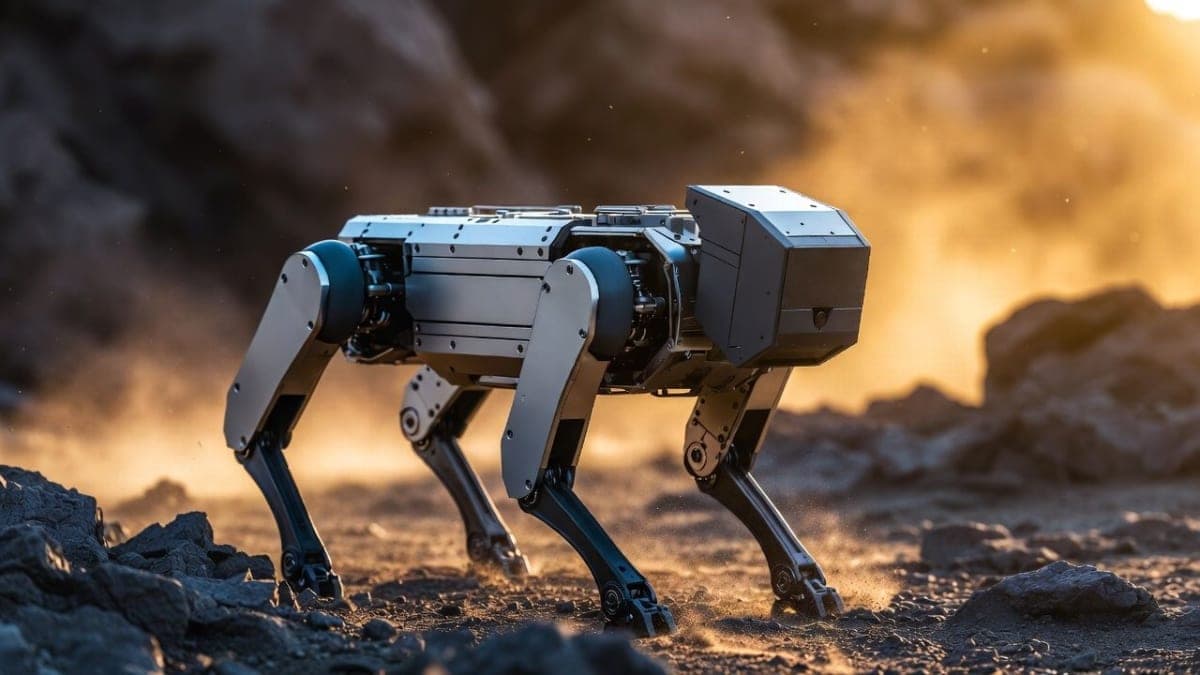
Unitree Robotics unveiled the As2 on February 24, a four-legged robot that weighs 18 kilograms, carries up to 15 kg while walking, and runs at speeds that would keep up with a casual jogger. The Chinese robotics company is selling it in three configurations (AIR, PRO, and EDU) and hasn't published a single price. Given that Boston Dynamics' Spot starts at $74,500 for the base kit and climbs past $175,000 in real deployments, the silence is strategic.
The Spot problem
Here's what makes the As2 interesting, and it's not the spec sheet. Unitree's product page lists the EDU variant's walking payload at 15 kg. Spot's payload capacity sits at 14 kg. That single kilogram difference doesn't matter much in practice, but it matters a lot in a press release. And Unitree knows it.
The comparison gets more uncomfortable for Boston Dynamics when you consider weight. Spot tips the scales at around 32 kg. The As2 manages its 15 kg payload at roughly half that body weight, which translates to a torque-to-weight ratio of about 5 N·m per kilogram. In one demonstration video, a 105 kg man stands on the robot. It holds. Whether that's a useful test or just good theater is debatable, but the structural confidence is real.
Three robots, one chassis
All three versions share the same mechanical platform: aluminum alloy frame, high-strength plastic panels, 12 degrees of freedom, industrial crossed roller bearings, and low-inertia PMSM motors. The electronics baseline is identical too, with an 8-core CPU, Wi-Fi 6, Bluetooth 5.2, an HD camera, and a speaker/microphone combo.
Where they diverge is where the money is. The AIR gets 65 N·m of joint torque, tops out at 3 m/s, and ships with an 8,000 mAh battery. No LiDAR, no GPS, no 4G, no IP54 rating. It is, frankly, the version that exists so Unitree can say the As2 "starts at" whatever price they eventually announce.
The PRO bumps torque to 75 N·m, adds LiDAR, GPS, 4G, IP54 dust and rain protection, and a 15,000 mAh battery with fast charging. Unitree claims over four hours of runtime unloaded and a 13 km range carrying 13 kg. Those numbers look good on paper, though runtime claims in robotics tend to assume flat terrain and moderate temperatures. Real-world performance on a muddy hillside in February? Probably less.
The one that actually matters
The EDU variant is the play. Same locomotion specs as the PRO but with 90 N·m peak torque, 15 kg walking payload, API access, an autonomous charging dock, and an optional NVIDIA Jetson Orin NX compute module. This is the only version you can actually program for custom tasks.
"Open secondary development" is how Unitree describes it, which is corporate-speak for "we want third-party developers to build the applications we can't." It's the same platform play that worked for Spot's SDK ecosystem, except Unitree is presumably going to price it at a level where university robotics labs don't need a grant application just to buy one.
What Unitree isn't saying
No prices. Every variant on the product page just says "Contact Sales." Unitree's earlier A2 quadruped, a 42 kg industrial unit launched in August 2025, followed the same pattern. The company's consumer Go2 line sells for a few thousand dollars, but the As2 sits in a weird gap between consumer and industrial that doesn't have established pricing norms.
The operating temperature range is -20 to +50°C, and all models get OTA updates through Unitree's UniStore platform. The company also mentions a 7-axis robotic arm as an optional accessory, though details on that are thin.
Boston Dynamics' Spot, for context, recently saw what a Fortune report described as surging demand from data center operators, with deployed pricing between $175,000 and $300,000. If Unitree can deliver comparable outdoor capability at even a third of that price, the industrial quadruped market looks different by the end of 2026.
The As2 is available for inquiry through Unitree's sales team now. No shipping timeline has been announced.