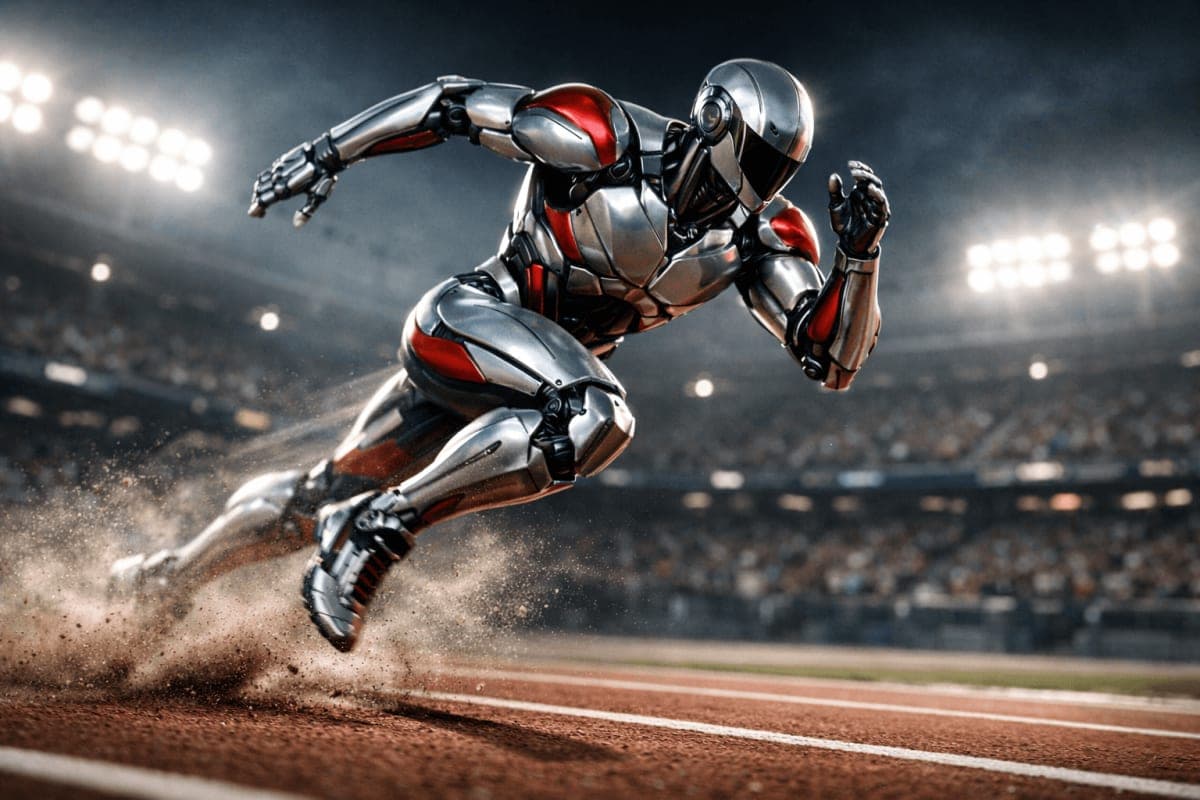
At the Yabuli China Entrepreneurs Forum on March 17, Unitree Robotics founder Wang Xingxing told a room full of business leaders that humanoid robots would run the 100-meter dash in under 10 seconds by mid-2026. That would put a machine within striking distance of Usain Bolt's 9.58-second world record, set in Berlin in 2009. Wang didn't claim Unitree's own robots would do it, specifically. He said the breakthrough would come from a Chinese-made humanoid.
Bold claim. But here's the thing: the gap is already smaller than most people realize.
The Bolt factor
In early February, Shanghai-based MirrorMe Technology unveiled a humanoid called Bolt (yes, named after that Bolt) that hit a peak speed of 10 meters per second in real-world tests. Standing 175 cm tall, weighing 75 kg, and built in collaboration with a Zhejiang University research institute and a firm called Kaierda, the robot matched the speed needed for a flat 10-second 100m. For context, Bolt the human peaked at around 10.44 m/s during his record run, and averaged roughly that pace across the full distance.
So we're talking about a 4.4% gap between a robot's current peak and the fastest human ever recorded. That's not nothing, but it is not the chasm it was even a year ago. The previous industry leaders, including Unitree's own H1, were clocking speeds around 3.3 m/s. Tesla's Optimus recently managed about 2.7 m/s. MirrorMe's result basically tripled the state of the art overnight.
The treadmill demo footage is impressive, though the founder of MirrorMe, Wang Hongtao, racing his own robot on adjacent treadmills feels more like a PR stunt than a peer-reviewed benchmark. And there's an obvious question the speed claims don't address: peak velocity on a treadmill is not the same as running an actual 100m on a track with a standing start, acceleration phase, and deceleration. A human who peaks at 10 m/s doesn't run a 10-second hundred.
What Wang is actually selling
The speed prediction got the headlines, but Wang's speech at Yabuli was really about something else: Unitree's commercial ambitions. The company claims it shipped over 5,500 humanoid robots in 2025, which would make it the world's largest shipper by volume. That number is disputed. Omdia's data from January put Shanghai rival AgiBot at 5,168 units and Unitree at 4,200. Unitree pushed back, insisting its actual shipments topped 5,500 with total production exceeding 6,500 units.
The squabble over who shipped more robots is, frankly, the more interesting story here. It tells you something about where this industry is. These aren't garage operations anymore. Rest of World reported that Chinese firms accounted for roughly 90% of global humanoid robot shipments in 2025. Tesla, Figure AI, and Agility Robotics each shipped about 150 units. One hundred and fifty.
Wang wants to ship 10,000 to 20,000 units in 2026. The cheapest Unitree model, the R1, starts around $5,900. The G1 that performed at the CCTV Spring Festival Gala (three years running now, a detail that probably matters more for brand recognition in China than any benchmark) starts at roughly $13,500.
So can a robot actually beat Bolt?
Maybe. But Wang himself acknowledged the harder problem isn't sprinting. It's generalization. Robots perform near-perfectly in controlled environments and fall apart when conditions change. Terrain variation, unexpected obstacles, weather. The gap between a treadmill demo and a construction site is vast, and Wang was refreshingly candid about it: he described the industry as still lacking its "ChatGPT moment" and estimated that true general-purpose capability is two to three years out.
I find this more credible than the sprinting claim, actually. Wang is essentially saying: we can make robots fast, we can make them cheap, but we can't yet make them smart enough to handle the real world. And he's right. A robot that runs 10 m/s on a flat surface but can't navigate a parking lot isn't commercially useful. Speed in this context is a party trick, not a product feature.
The plan to close that gap involves deploying thousands of robots in real environments to collect training data, up to 10 hours a day. It's the same data flywheel logic that drove self-driving car development, and it comes with the same unresolved questions about how much real-world data you actually need.
The US-China angle
This is all happening against a backdrop of growing anxiety in Washington. At a recent House Homeland Security Committee hearing, executives from Boston Dynamics and Scale AI called for stricter export controls on AI chips and restrictions on Chinese-made robots in government settings. Elon Musk, speaking at the World Economic Forum, said China would be Tesla's toughest competition and that he didn't see "any significant competitors outside of China."
Unitree is reportedly preparing for an IPO at a valuation around $7 billion. That's not Figure AI territory ($39 billion valuation on 150 units shipped, which, I'm sorry, what?) but it's backed by actual production volume in the thousands.
The real benchmark
Will a humanoid robot break 10 seconds in the 100m this year? Probably yes, on a treadmill or controlled track, by one of the Chinese labs. Will it matter commercially? Not directly. But Wang is making a bet that speed records translate into media attention, which translates into brand recognition, which translates into sales volume at price points that American competitors can't touch yet. And on that score, he's already winning.