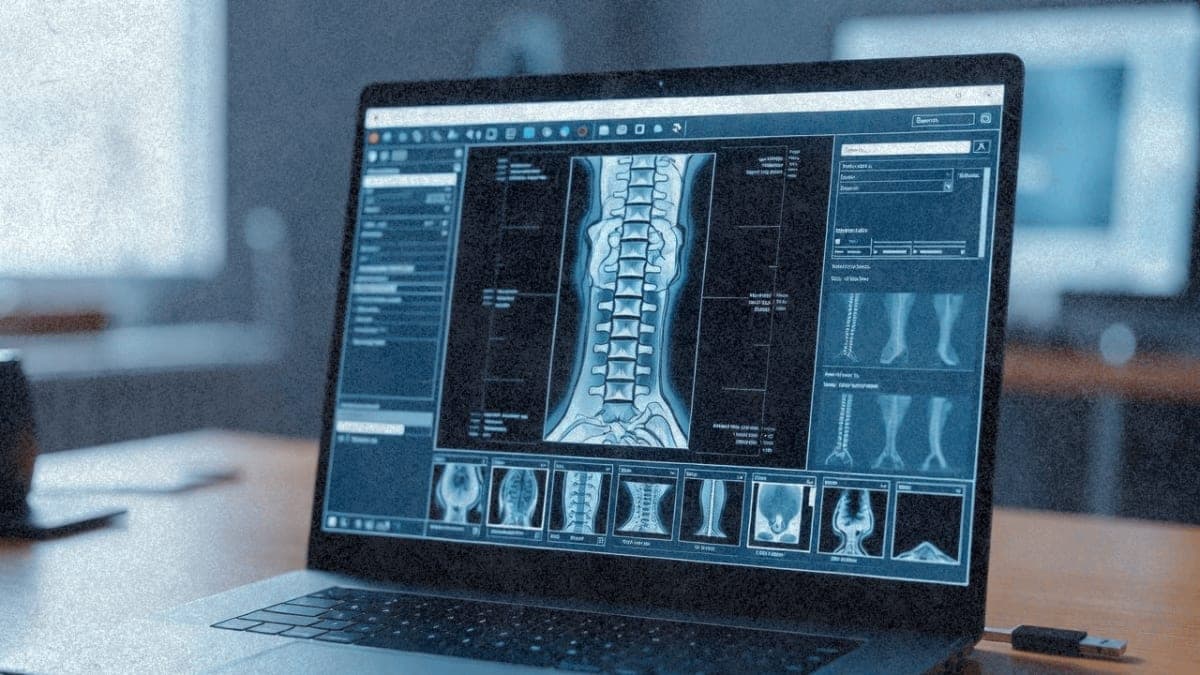
Shopify CEO Tobi Lutke used Anthropic's Claude to build a browser-based MRI viewer after his annual spine scan came with Windows-only viewing software. The tweet, posted January 11, 2026, has pulled 3.9 million views.
"Ran Claude on the stick and asked it to make me a html based viewer tool," Lutke wrote. "This looks... way better."
The DICOM problem
Anyone who's received medical imaging knows the drill. Your MRI or CT scan arrives on a USB stick or CD, bundled with proprietary viewing software that only runs on Windows. The programs look like they were designed in 2004 because many of them were. Commercial DICOM viewers exist, though most are aimed at radiologists, not patients trying to understand their own spines.
Lutke's approach bypassed all of that. Claude read the DICOM files directly from the USB stick and generated an HTML-based viewer that runs locally in any browser. The screenshot he shared shows a polished interface with body region navigation on the left, the scan in the center (a sagittal T2-weighted image of his spine, for those keeping track), and study metadata on the right.
The tool displays 95 images across the series, with brightness and contrast sliders. It organized reports by body region and pulled in radiology metadata automatically.
What this actually demonstrates
This isn't about MRI viewers specifically. Lutke has been publicly evangelizing AI usage since his internal memo last April made "reflexive AI usage" a baseline expectation at Shopify. Employees must now demonstrate why AI can't handle a task before requesting additional headcount. The company provides access to Microsoft Copilot, Cursor, and Claude.
Building personal tools with AI prompts sits firmly in that philosophy. Lutke described AI as a "thought partner, deep researcher, critic, tutor, or pair programmer" in the April memo. The MRI viewer is the pair programming angle taken to its logical endpoint: one prompt, functional software, no prior knowledge of medical imaging formats required.
The timing adds another layer. Anthropic announced Claude for Healthcare the same day, timed to the JPMorgan Healthcare Conference. That launch includes a partnership with HealthEx to let Claude Pro and Max subscribers connect their electronic medical records directly to the chatbot. The partnership lets users "consolidate medical records from more than 50,000 health systems" and ask Claude questions grounded in their actual health history.
Lutke's tweet wasn't coordinated with Anthropic's announcement, but the juxtaposition is useful. One shows the enterprise healthcare push. The other shows what happens when a technically literate user just wants to look at their own spine without installing decade-old Windows software.
The limitations nobody's discussing
There's a gap between "built a viewer in one prompt" and "this is how healthcare software should work." Medical imaging viewers used in clinical settings require FDA clearance. They need precise calibration for measurements. Radiologists rely on specific window/level presets to detect pathology that might be invisible at default contrast settings.
Lutke's viewer is fine for a patient reviewing their own scan. It would be wildly inappropriate for diagnostic use, and there's no indication he suggested otherwise. But the viral spread of the tweet glosses over that distinction. Building functional software quickly is not the same as building compliant software, or safe software, or software that handles edge cases gracefully.
The DICOM format itself is a mess of legacy specifications and vendor-specific implementations. A viewer that works perfectly on one hospital's export might choke on another's. Whether Claude's generated code handles compressed transfer syntaxes, multi-frame enhanced objects, or the dozen other DICOM quirks that commercial viewers have spent years debugging is an open question.
What happens next
Anthropic's healthcare push will likely accelerate these use cases. Claude for Healthcare features HIPAA-ready infrastructure for enterprise customers and native integrations to medical databases including ICD-10 codes and PubMed. Consumer features through HealthEx and Apple Health connectors are rolling out in beta.
Lutke's tweet is a data point, not a product announcement. He builds tools for himself regularly and shares the interesting ones. But 3.9 million views suggests appetite for AI that solves immediate, personal problems rather than abstract enterprise workflows.
Anthropic's HealthEx partnership launches today for Claude Pro and Max subscribers.