Larian Studios CEO Swen Vincke found himself in damage control mode this week after a Bloomberg interview about the studio's upcoming RPG Divinity ignited a firestorm over generative AI. The controversy stemmed from journalist Jason Schreier's characterization that Larian had been "pushing hard" on the technology, a phrase Vincke disputes and one that sent fans flooding social media with accusations of betrayal.
The phrase that launched a thousand angry posts
Bloomberg's article, published on December 16, included two paragraphs describing Larian's AI experimentation. Schreier wrote that under Vincke's leadership, Larian developers "often use AI tools to explore ideas, flesh out PowerPoint presentations, develop concept art and write placeholder text."
The backlash was immediate. Former Larian environment artist Selena Tobin, who worked on Baldur's Gate 3, posted on Bluesky urging the studio to "reconsider and change your direction, like, yesterday." Some fans on Reddit described the news as their "personal 9/11," which is the kind of hyperbole that makes covering gaming discourse exhausting.
What got lost in the initial outrage: Vincke explicitly stated in the same interview that no AI-generated content would appear in Divinity. "Everything is human actors; we're writing everything ourselves," he told Bloomberg. That nuance didn't travel as fast as the rage.
The transcript tells a different story
After the backlash intensified, Schreier posted a rough transcript of the AI portion of his interview on Bluesky. "If I had known the two paragraphs about genAI in my article today would be so controversial, I would have expanded them a bit," he wrote.
The full exchange is revealing. When Schreier asks whether generative AI speeds up production, Vincke's answer is more skeptical than "pushing hard" implies: "I'm not 100% sure if you're actually seeing speed-ups that much. You're trying more stuff. Having tried stuff out, I don't actually think it accelerates things."
He goes further: "There's a lot of hype out there. I haven't really seen: oh this is really gonna replace things. I haven't seen that yet."
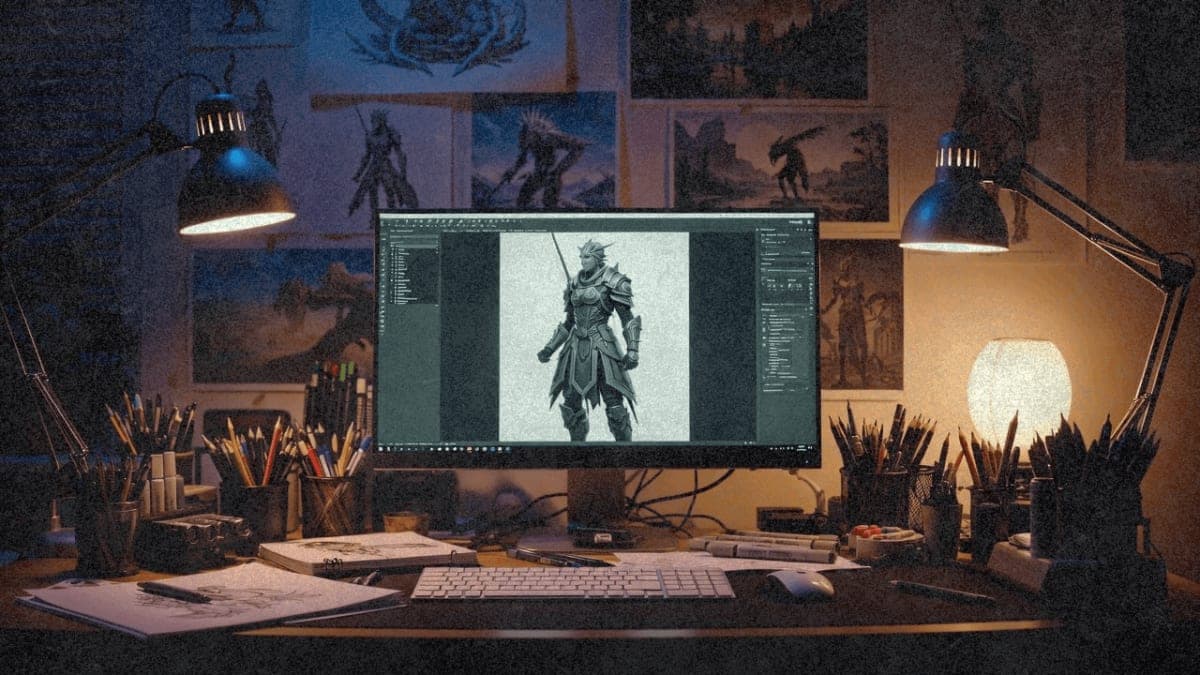
On concept art specifically, Vincke reveals something that got buried in the controversy: "We bought a boutique concept art firm at the moment that everybody was reducing them because they were going to AI, in our case it just went up." While other studios cut concept artists, Larian acquired a whole studio's worth of them.
When Schreier asks about placeholder dialogue, Vincke shrugs: "It depends on the scripter. Some scripters will probably use a chatGPT, some will write it themselves. It's really up to them."
The FOMO defense
The most quoted exchange from the transcript comes when Schreier presses on why Larian uses AI at all if it isn't providing efficiency gains.
"This is a tech driven industry, so you try stuff," Vincke replied. "You can't afford not to try things because if somebody finds the golden egg and you're not using it, you're dead in this industry."
That's the FOMO defense. Not exactly a ringing endorsement of the technology, but enough to infuriate critics who wanted Larian to take a principled stand against AI entirely.
Schreier pushed back, calling AI "poisonous, controversial to players, to artists, to creative people." Vincke's response was dismissive: "I think you would find the same argument back in the days for a lot of things, right? Anything that was has been automated has always considered..." The comparison to past automation controversies landed poorly with an audience that views generative AI as categorically different.
Vincke fires back on X
The CEO's initial response to the controversy arrived in all caps energy, even if the words were lowercase. "Holy fuck guys we're not 'pushing hard' for or replacing concept artists with AI," Vincke wrote on X. He noted that Larian employs 72 artists, including 23 concept artists, and is actively hiring more.
His distinction matters, even if it didn't satisfy critics: Larian uses AI for "very early ideation stages" and "rough outline for composition," which gets replaced with original work. Whether that counts as "developing concept art" depends on how you define the term. Vincke says it doesn't. Some former employees seem to disagree.
Publishing director Michael Douse jumped in with a longer defense, pointing out that Larian's stance on AI workflow had been public since April. "I'm not entirely sure we are the ideal target for the level of scorn," he wrote.
The bigger context
The timing of this controversy is notable. This year's Game Awards winner Clair Obscur: Expedition 33 faced scrutiny after AI-generated concept art reportedly appeared in its development process. Arc Raiders drew similar criticism for AI voice acting. Larian watched both studios absorb heat and still decided transparency was the right call.
Maybe they're right that speaking up is better than staying silent. Studios that hide AI use and get caught later face worse backlash. But the gaming community's current stance is essentially "any AI use is a betrayal," which makes honest disclosure feel like a losing proposition.
Vincke promised an AMA in January to address remaining questions about Divinity's development process. Whether that calms the controversy or reignites it probably depends on whether he can articulate a clearer line between AI experimentation and AI replacement than "we use it like Google."