
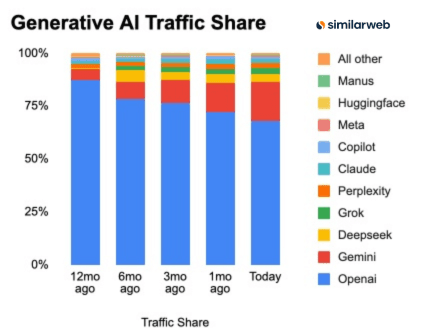
 Similarweb's latest snapshot of generative AI traffic, dated December 25, 2025, shows ChatGPT at 68% share, down from 87.2% a year ago. Google's Gemini now holds 18.2%, up from just 5.4%. On paper, it looks like Google took a cleaver to OpenAI's lead.
The reality is messier.
Absolute numbers tell a different story
ChatGPT's relative share collapsed because the market exploded beneath it. OpenAI is approaching 900 million weekly active users, according to The Information, up from 800 million reported in October. That's not a company bleeding customers. The internal target of 1 billion weekly users by year's end now looks plausible.
Gemini's gains, meanwhile, come largely from converting Google's existing ecosystem users rather than poaching ChatGPT loyalists. According to traffic analysis, roughly 76% of visits to gemini.google.com arrive as direct traffic, but that number obscures a critical detail: Google's AI Mode in Search funnels users directly from google.com. AI Overviews now reach 2 billion monthly users across 200 countries, per Alphabet's Q2 2025 earnings call. You can't opt out.
When someone searches on Google, sees an AI Overview, and follows up with a question, they land in Gemini-powered AI Mode whether they intended to or not. Every Android phone ships with Gemini as the default assistant. The 76% "direct" traffic figure doesn't capture users who arrived through a Google product they were already using for something else.
The passive adoption problem
This distinction matters for understanding what's actually happening. A user who downloads ChatGPT, creates an account, and starts a conversation is making an active choice. A user who gets an AI summary above their search results and taps "ask follow-up" is not.
Pew Research Center data from earlier this year found that when AI Overviews appear, only 8% of searches result in a click, compared to 15% when they don't. The AI response satisfies the query, or at least convinces users it did. Google's own metrics claim AI Overviews drive a 10% increase in search queries, but critics argue this conflates "more engagement with Google" and "more value for users."
Sensor Tower data from August through November 2025 shows Gemini's global desktop visits doubled while ChatGPT's rose about 1%. Gemini's monthly active users increased roughly 30% to 346 million over that period; ChatGPT's grew about 5% to 810 million. These trajectories suggest Google is winning the casual user while OpenAI retains the intentional one.
What's actually working for Google
It's not all distribution arbitrage. Gemini 3 Pro, released in November, writes well. The Nano Banana image generator went viral in late August with users turning selfies into hyperrealistic 3D figurines, adding what Google said was 13 million new Gemini app users in four days. Nano Banana Pro, built on Gemini 3, launched in late November with improved text rendering and infographic generation.
NotebookLM remains Google's most differentiated consumer AI product. No competitor offers an equivalent research assistant that synthesizes multiple documents into podcast-style audio summaries. The tool is included with Google AI subscriptions and available globally through mobile apps launched in May 2025.
The rest of the field barely registers. DeepSeek holds around 4%, Grok sits at 2.9%, Claude and Perplexity each hover near 2%, and Microsoft Copilot remains flat at 1.2% despite deep Windows and Office integration. Similarweb noted that overall daily visits across all AI tools actually dipped slightly in their latest report, suggesting the market may be maturing faster than the hype cycle anticipated.
What neither company controls
OpenAI's path to 1 billion users runs through markets Google already dominates. ChatGPT is banned in China, Russia, and Iran, immediately excluding over 1.5 billion potential users. Available markets contain roughly 7 billion people, so 1 billion weekly users represents about 14% penetration of the addressable population.
Google faces a different constraint: converting passive exposure into active loyalty. Users who encounter Gemini through AI Overviews or pre-installed Android assistants may not develop the habitual usage patterns that ChatGPT's intentional adopters demonstrate. Session durations and repeat visit rates will matter more than headline traffic share.
The 2026 question isn't whether ChatGPT or Gemini wins. It's whether passive, ambient AI usage becomes valuable enough to sustain Google's advertising model, or whether the users who deliberately seek out AI tools represent a disproportionate share of commercial value. OpenAI is betting on the latter with $12 billion in annualized revenue. Google is betting it can do both.