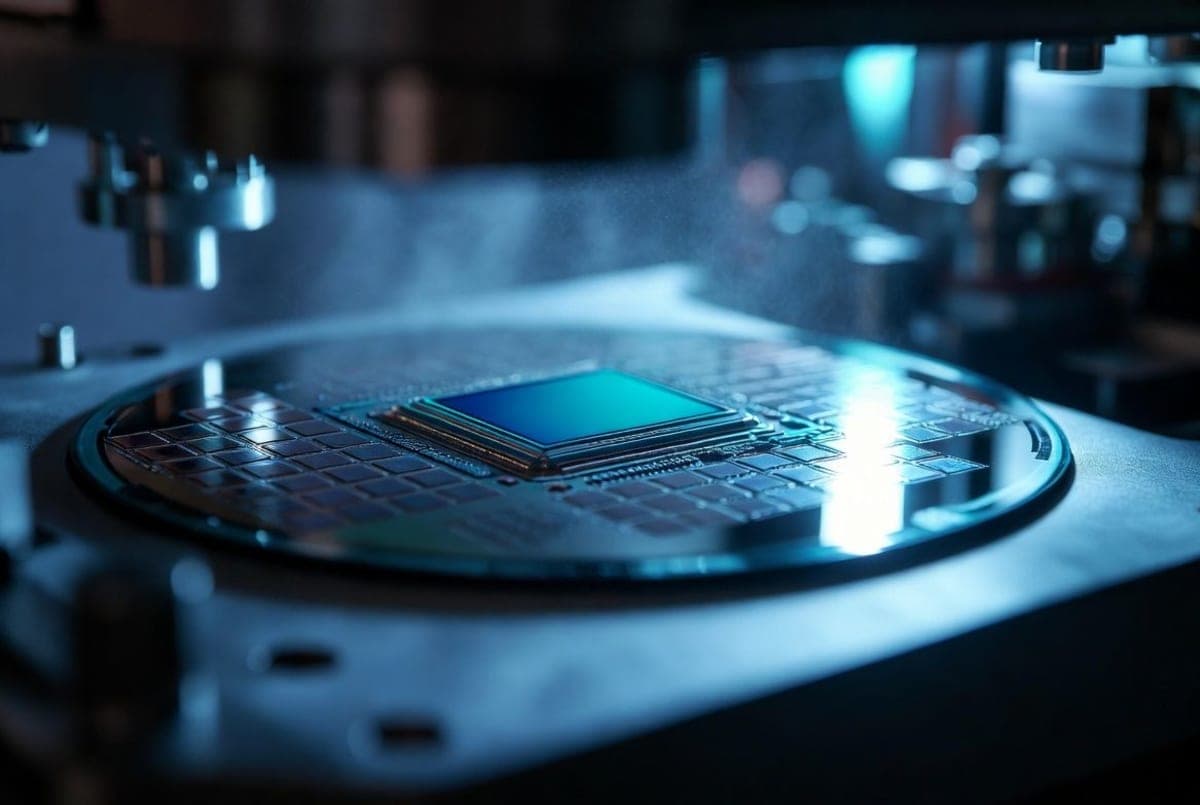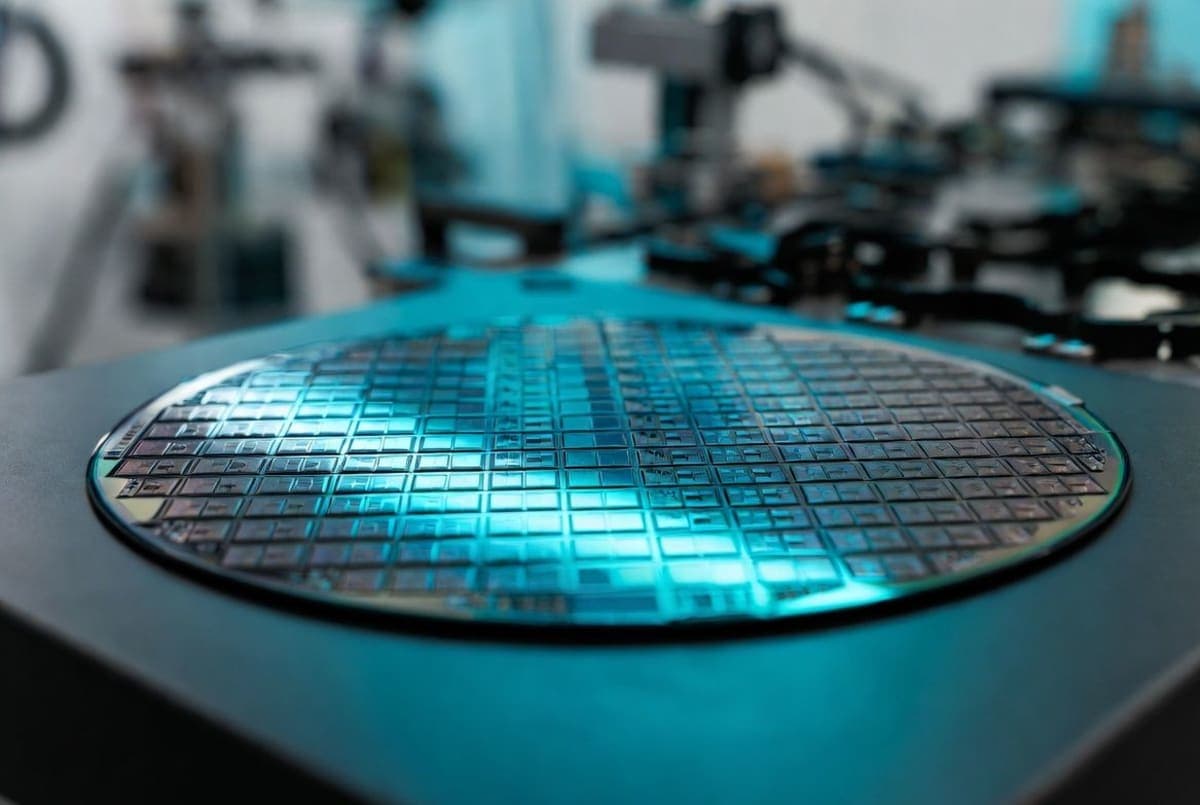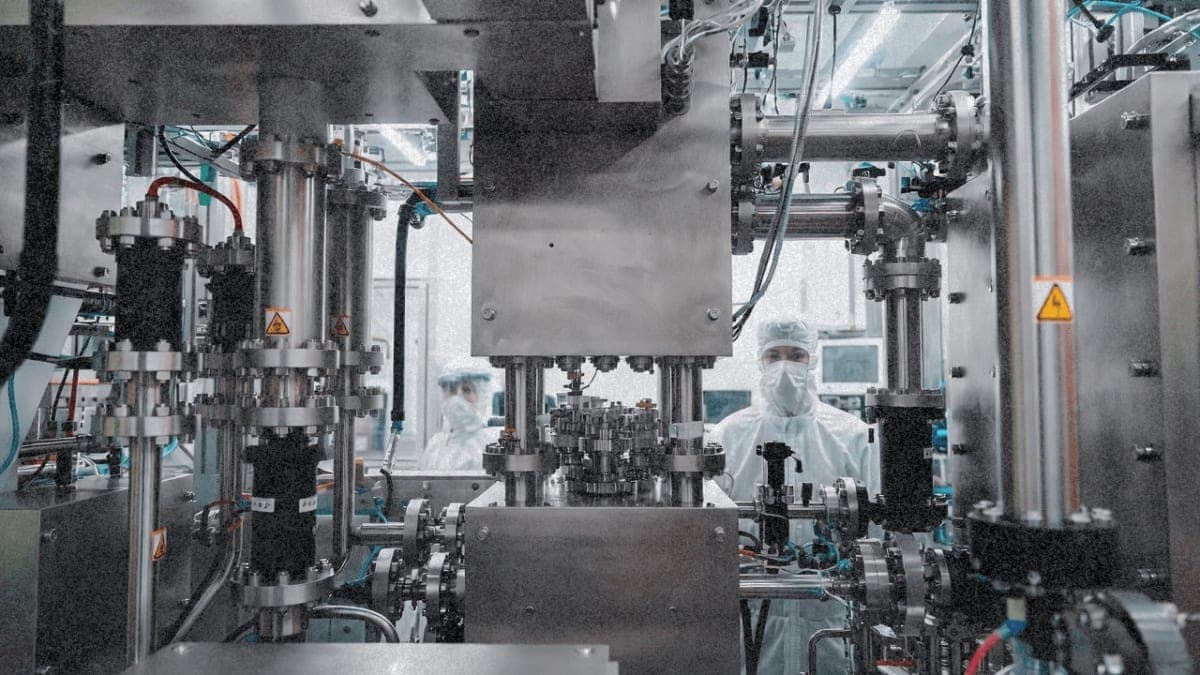
Chinese scientists completed a prototype extreme ultraviolet lithography machine in early 2025, generating the type of light needed to manufacture cutting-edge semiconductors, according to a Reuters investigation published December 18. The machine sits in a high-security Shenzhen laboratory and fills nearly an entire factory floor. It has not produced a single working chip.
What they actually built
The prototype can generate EUV light at 13.5 nanometers, which is the wavelength required to etch circuits onto silicon wafers for advanced processors. That's a genuine technical achievement, and it's the part of EUV technology that ASML CEO Christophe Fouquet was referring to in April when he said "it was 'always possible to generate some EUV light.'" The rest of his statement is worth remembering: "it would take many, many years for China to make an EUV machine."
The distinction matters. Generating EUV radiation requires vaporizing molten tin droplets with a laser about 50,000 times per second, creating plasma at temperatures exceeding 200,000 degrees Celsius. It's brutal physics, and Chinese researchers apparently cracked it. The plasma temperatures involved rapidly degrade components, but that's a known engineering challenge, not an unsolved mystery.
What the Shenzhen prototype cannot do is put that light onto a wafer and print usable circuits. According to Tom's Hardware's analysis, the Chinese lab "cannot even put the light on a wafer, save for printing lines and spaces, something ASML's tool could do in 2006." That was eleven years before ASML shipped its first production EUV system.
The optics problem
ASML doesn't make EUV machines alone. It relies on Carl Zeiss of Germany for mirrors so precisely manufactured that, if enlarged to the size of the Earth, their surface deviations would be less than the width of a hair. No other company has replicated this capability.
China's prototype trails ASML's machines largely because researchers have struggled to secure ultra-precision optical systems, according to sources cited by Reuters. The Changchun Institute of Optics has been developing domestic alternatives, but the report offers no indication they've matched Zeiss's tolerances. Export-restricted components from Japan's Nikon and Canon were reportedly used in the prototype, which suggests the optical subsystem remains a patchwork.
Reuters doesn't specify which optical components are the bottleneck. That ambiguity is telling. The report groups them "rather generally," making it uncertain whether China struggles with collector mirrors, illuminator optics, or projection optics, each of which presents distinct engineering challenges and requires different manufacturing capabilities.
How they got here
The project's existence owes a lot to one person. Lin Nan, formerly ASML's head of light source technology, now leads a team at the Chinese Academy of Sciences' Shanghai Institute of Optics. His team filed eight EUV light-source patents in eighteen months. That's an aggressive pace, and it tracks with someone applying deep institutional knowledge rather than starting from first principles.
Lin returned to China in 2021, part of a recruitment drive that began around 2019. Policy documents reviewed by Reuters indicate signing bonuses ranging from 3 to 5 million yuan (up to $700,000), along with housing subsidies. The campaign targeted semiconductor specialists working abroad, and it appears to have succeeded.
ASML has struggled to protect itself from this kind of knowledge transfer. In 2019, the company won an $845 million judgment against a former engineer in a trade secret case, but enforcement proved difficult when the defendant declared bankruptcy and later resumed operations in Beijing with state support.
Inside the Shenzhen facility, engineers worked under false names. One source told Reuters the project was classified under national security rules, with "strict instructions that no one outside the facility should know what was being built or who was involved."
The Huawei connection
Huawei plays a central role in coordinating a nationwide network of companies and state research institutes involving thousands of engineers, according to Reuters. The company has deployed staff to offices, fabs, and research centers across the country.
This makes sense given Huawei's predicament. Cut off from advanced chips by U.S. export controls, the company has been pushing the limits of what older lithography equipment can achieve. Its chipmaking partner SMIC managed to produce processors approaching 7-nanometer specifications using deep ultraviolet (DUV) tools, but that's essentially the ceiling for non-EUV production. Without access to ASML's machines or a domestic alternative, Huawei's hardware ambitions face a hard physical constraint.
Employees on semiconductor teams reportedly sleep on-site during the workweek and have restricted phone access. Teams are isolated from each other to prevent information leakage. The operational security suggests Beijing views this as more than a commercial project.
2028 or 2030?
The Chinese government has reportedly set 2028 as the target for producing working chips on the prototype. Sources close to the project believe 2030 is more realistic.
For context: ASML built its first working prototype of EUV technology in 2001 and didn't produce commercially viable chips until 2019. Nearly two decades and billions of euros in R&D. The company's statement to Reuters was diplomatic but pointed: "It makes sense that companies would want to replicate our technology, but doing so is no small feat."
China's timeline implies a five-to-eight-year sprint from a light-generating prototype to production-capable machines. That requires solving not just the optics but wafer handling, reticle stages, contamination control, and process tuning. Jeff Koch, a SemiAnalysis analyst and former ASML engineer, offered the most balanced assessment I found: "No doubt this is technically feasible, it's just a question of timeline. China has the advantage that commercial EUV now exists, so they aren't starting from zero."
The question is whether that advantage compresses decades into years, or merely into a different set of years.
What it means for export controls
Washington's semiconductor strategy rested on an assumption: without access to ASML's equipment, China would hit a technological ceiling around the 7-nanometer node. The Shenzhen prototype challenges that premise, even if mass production remains distant.
The Biden administration expanded export controls in 2022 to include older DUV equipment, not just EUV. The Trump administration says it's tightening enforcement. The Dutch Ministry of Defence is developing policies requiring "knowledge institutions" to screen foreign personnel for potential risks related to sensitive technologies.
None of which addresses the engineers who already left. ASML can restrict access to information inside the company, but it has no authority over alumni. Dutch intelligence warned in April that China "used extensive espionage programmes" to recruit "Western scientists and employees of high-tech companies." The Shenzhen project appears to be a case study in exactly that.
One source told Reuters the explicit goal: "China wants the United States 100 percent kicked out of its supply chains."
The FTC has until Q1 2026 to review implications for technology transfer agreements. ASML reports Q4 earnings in late January, where analysts will likely press for more detail on the company's exposure.