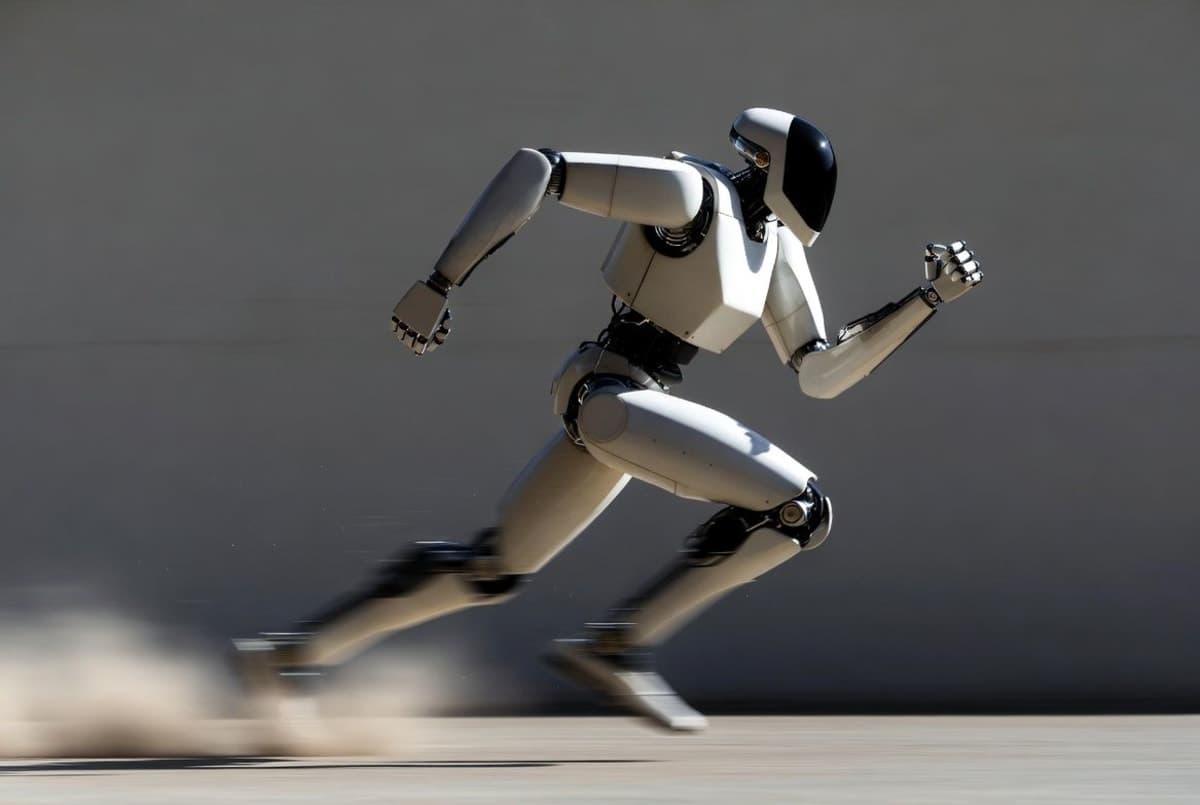
Unitree Robotics says its H1 humanoid robot has reached a top speed of 10 meters per second, or about 22.4 miles per hour. If true, the machine is now running within spitting distance of Usain Bolt's average speed during his 100-meter world record (10.44 m/s). That's a sentence nobody expected to write in 2026.
But there's a gap between a company claim and a verified benchmark, and this one is wide enough to drive a robot through.
The numbers don't add up easily
The H1's speed trajectory has been steep. When Unitree first demonstrated the robot's Evolution V3.0 in early 2024, the confirmed top speed was 3.3 m/s (about 7.4 mph), which set the record for a full-size humanoid. At the inaugural World Humanoid Robot Games in Beijing last August, Unitree's H1 topped out at 4.78 m/s during competition, with the company claiming internal tests had already broken 5 m/s.
Going from 5 to 10 m/s in under a year would represent a 100% speed increase. That kind of jump in bipedal locomotion is, to put it mildly, suspicious. The latest claim also describes a robot weighing 62 kilograms, which is 15 kg heavier than the H1's documented 47 kg spec sheet weight. Either this is a significantly modified machine, a different variant entirely, or something else is going on.
What we actually know
The verified record is easier to trust. Unitree's H1 swept four gold medals at the Beijing games: the 400-meter dash, 1,500-meter race, 100-meter hurdles, and the 4x100-meter relay. Robotics 24/7 reported the 1,500-meter time at 6 minutes and 34 seconds, which Unitree called a world record. For context, the human record is 3 minutes and 26 seconds.
"The performance of its H1 robots in the 1,500-metre race was 'meaningful,' as the model was the first humanoid the company ever made," is how CEO Wang Xingxing described it, which is either touching or corporate understatement depending on your mood.
The competition was real. 280 teams from 16 countries showed up with roughly 500 robots. Interesting Engineering noted that Unitree took home 11 medals total. Robots tripped over each other, flailed punches into empty air during kickboxing, and one H1 knocked down a human operator mid-race. So it wasn't exactly the Olympics, but the running performance was legitimate.
The Bolt comparison is fun, but misleading
Bolt's 10.44 m/s figure is his average speed across his entire 9.58-second world record run. His peak velocity, measured by laser between the 60 and 80-meter marks, was closer to 12.3 m/s (27.8 mph). So even if the H1 genuinely hits 10 m/s, Bolt at full stride would still pull away.
Also worth noting: Bolt was decelerating over his final 20 meters, celebrating before the finish line, and doing it on legs that get tired. The H1 doesn't get tired. It doesn't slow down to showboat. If these machines keep improving at their current rate, the average human sprinter (not Bolt, your average college athlete running maybe 8-9 m/s) is already slower.
More interesting than speed
The running obsession obscures what's actually happening at Unitree. The company disclosed in early 2026 that it shipped over 5,500 humanoid robots during 2025, which one analysis puts at roughly one-third of the entire global market. Western competitors like Tesla, Figure AI, and Agility Robotics reportedly shipped about 150 units each. Unitree has been profitable for five consecutive years with margins above 50%. The H1 starts around $90,000.
That production volume matters more than whether this particular robot can match Bolt's average or not. Speed records make for good social media posts. Shipping thousands of units to research labs at a price point that undercuts everyone else by 60% or more is the actual competitive advantage.
The second World Humanoid Robot Games are scheduled for Beijing in August 2026. If Unitree wants to prove the 10 m/s claim, that would be the place to do it.