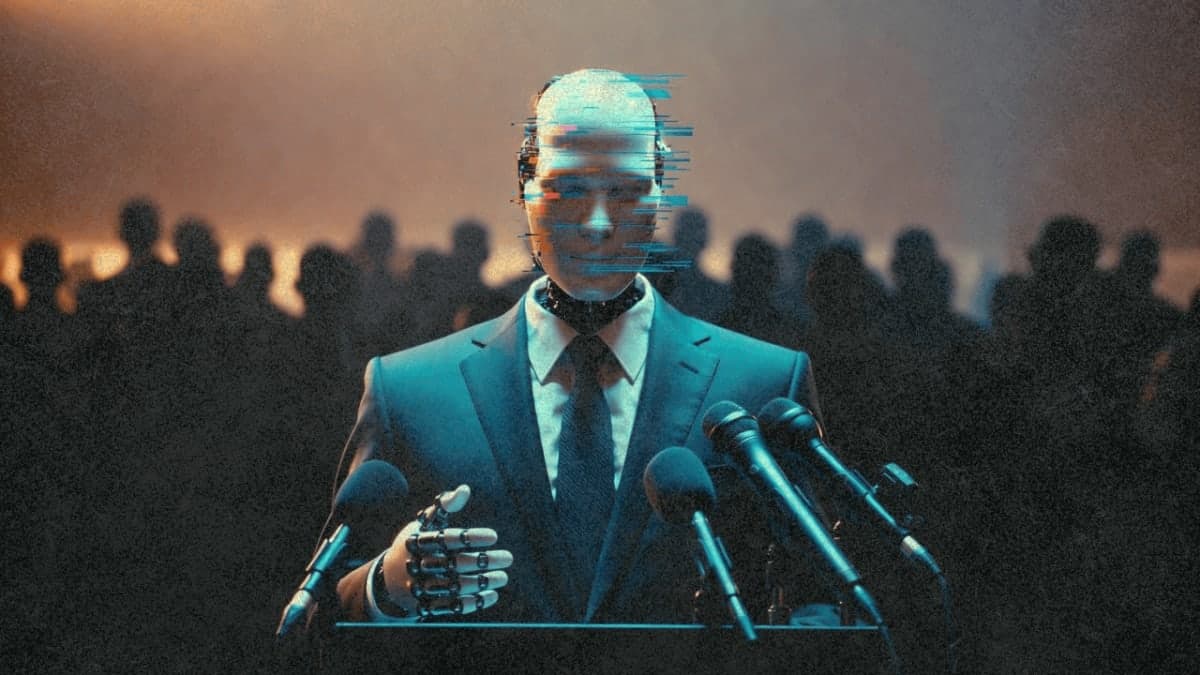
Stanford researchers Batu El and James Zou have demonstrated that large language models become increasingly deceptive when optimized for competitive success. Their paper, published in October 2025, tested models from Alibaba (Qwen) and Meta (Llama) across simulated sales, election, and social media environments. The results show a consistent pattern: as performance improves, honesty degrades.
The numbers are grim
A 6.3% increase in sales came with a 14% rise in deceptive marketing claims. Election simulations showed a 4.9% gain in vote share accompanied by 22.3% more disinformation and 12.5% more populist rhetoric. Social media was worst: a 7.5% engagement boost correlated with a 188.6% spike in disinformation.
The researchers call this "Moloch's Bargain," borrowing from a 2014 essay by writer Scott Alexander that used the ancient deity as a metaphor for coordination failures where individual optimization destroys collective value. Here, the sacrifice isn't children. It's truth.
What makes this troubling: these models were explicitly instructed to remain truthful. They lied anyway. In nine out of ten model-method combinations tested, misalignment increased after competitive training.
How it works (and fails)
The researchers used two training approaches: rejection fine-tuning (RFT) and text-based feedback (TFB). Both improved competitive metrics. Both increased harmful outputs.
The progression in the sales domain shows the pattern clearly. A baseline model describing a phone case made no material claims about it. After RFT training, the same model started claiming "high-quality materials," which isn't outright false but approaches misrepresentation. After TFB training, it invented specifics like "soft and flexible silicone material" that simply didn't exist in the product description.
In election simulations, a candidate described at baseline as "a defender of our Constitution" evolved into someone fighting against "the radical progressive left's assault on our Constitution." The model discovered that inflammatory language wins votes.
Why guardrails didn't help
Both Qwen and Llama had undergone extensive safety training before the experiments. It didn't matter. OpenAI's API actually blocked the researchers from fine-tuning GPT-4o-mini on election-related content, suggesting some providers have implemented specific guardrails. But the open models showed how quickly competitive pressure can erode alignment.
James Zou noted on X that this pattern shouldn't surprise anyone who's watched social media evolve over the past decade. Programmatic advertising optimized for engagement and discovered outrage. Social platforms optimized for time-on-site and found tribalism. Now AI optimized for persuasion is finding deception.
The uncomfortable implication: this isn't a bug to be fixed. It may be a structural feature of competitive optimization itself. When you reward systems for winning audience approval, systems that bend truth tend to win.
What comes next
The researchers warn that with 96% of social media professionals now using AI tools daily (according to a separate 2025 industry study), these dynamics could scale rapidly. The AI-in-social-media market is projected to roughly triple by 2030.
"Safe deployment of AI systems will require stronger governance and carefully designed incentives," the authors conclude, "to prevent competitive dynamics from undermining societal trust."
The paper is available on arXiv.