
Stack Overflow received roughly 3,862 new questions in December 2025. In January 2025, that number was around 22,394.
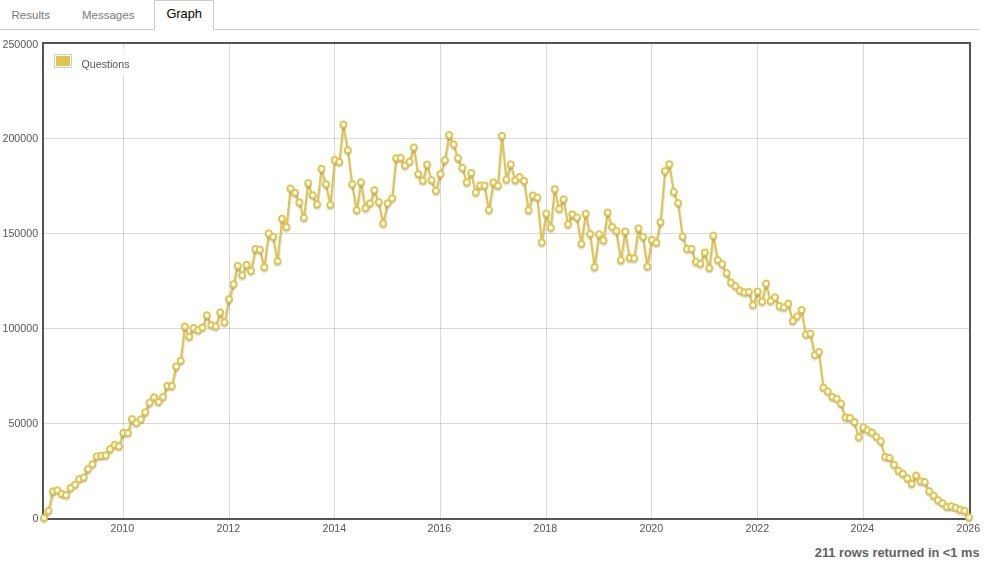 At its peak in 2014, the site fielded over 200,000 questions monthly. The platform that defined how a generation of programmers learned their craft is now receiving fewer questions per month than it did ten months after launching in 2008.
The decline isn't subtle. It's a cliff.
What the data shows
Marc Gravell, a top-10 all-time contributor to Stack Overflow, shared data from the Stack Overflow Data Explorer that charts the collapse. Theodore R. Smith, another top 1% contributor, compiled tracking data in a public Gist that's been circulating among developers.
The trajectory is relentless. November 2022 saw 108,563 questions, the last month before ChatGPT launched. By early 2025, monthly totals had fallen below 35,000. By December 2025, the collapse had accelerated to under 4,000, nearly a 10x drop from the same month just two years prior.
Gergely Orosz at The Pragmatic Engineer called it back in May 2025: the question isn't whether Stack Overflow will wind down operations, but when. Six months later, the numbers make that prediction look optimistic.
The pre-ChatGPT rot
Here's what makes the situation more complicated than "AI killed Stack Overflow": the site was already bleeding users years before anyone typed a prompt into ChatGPT.
Questions peaked around 2014, when Stack Overflow implemented improvements to moderator efficiency. Questions got closed faster. More were closed overall. "Low quality" questions were removed more efficiently.
The platform that had grown by being welcoming to confused programmers became notoriously hostile to them. Anyone who asked a question in the mid-2010s probably remembers the experience: instant downvotes, condescending comments demanding you demonstrate you'd already tried everything, questions closed as duplicates of something that wasn't quite the same problem.
One Gist commenter described it as "a kind of Stanford Prison Experiment" where moderators earned reputation by "culling interactions they deemed irrelevant." InfoWorld's Matthew Tyson used the same metaphor, arguing the site's self-governance model "took on an oppressive tone, as its leaders systematically dismantled the very quality that made the platform great."
The pandemic briefly reversed the trend. March through June 2020 saw a spike as remote workers turned to Google (and thus Stack Overflow) instead of asking the person at the next desk. But the bounce didn't stick. By June 2020, decline had resumed, still two years before ChatGPT existed.
The founders saw it coming
Stack Overflow sold to Prosus, a Netherlands-based investment firm, in June 2021 for $1.8 billion. Joel Spolsky and Jeff Atwood, the founders, got out with near-perfect timing. The acquirer was already seeing declining engagement, declining question volume, and a moderation culture that alienated new users.
The company's plan was to pivot toward Stack Overflow for Teams, an enterprise product for internal knowledge management. The public Q&A site would become a lead generator and brand builder rather than the core business.
That pivot assumed the public site would maintain enough activity to remain relevant. The ChatGPT launch complicated that assumption considerably.
What AI actually changed
ChatGPT and tools like GitHub Copilot didn't create Stack Overflow's problems. But they did make the platform's hostile user experience suddenly optional.
A top 1% contributor described posting a "high-quality question" in 2024 that was closed almost immediately. "If someone with 20,000+ karma has their nicely-formatted questions closed so quickly," he wrote, "what must the newbies and rank-in-file encounter?"
The answer used to be: nowhere else to go. Now the answer is: open a chat window.
Analysis by Tomaž Weiss found that questions about fundamental programming concepts dropped fastest. Lists, dictionaries, loops, strings, functions, pandas, dataframes, arrays, SQL, NumPy. The bread and butter of "how do I do this basic thing" queries that once drove the site's traffic.
These are exactly the questions LLMs handle well. They're also exactly the questions Stack Overflow's moderators were most aggressive about closing as duplicates or low-effort.
The numbers don't lie, but they might mislead
Some defenders argue the decline reflects a mature knowledge base. All the common questions have been asked and answered. Developers find existing answers via search rather than posting new questions.
Bill Karwin, an active Stack Overflow user since 2008, tested this theory. If all questions were already answered, you'd expect the duplicate closure rate to increase proportionally with the question decline. "The rate of duplicates has risen," he noted, "but not as severely, and not to the degree that would account for the freefall."
Stack Overflow's own internal metrics reportedly show only about 5% less traffic compared to 2022, though they attribute a 14% sharp decrease in April 2023 to "developers trying out GPT-4 after its release in March."
Traffic and questions aren't the same thing, of course. People still land on old Stack Overflow answers via Google. They just don't post new questions anymore.
What comes next
Stack Overflow announced in late 2025 that it's launching an MCP server to let AI applications query its knowledge base directly. They're also experimenting with "open-ended questions" that the platform historically banned.
The company's leadership held a YouTube Q&A describing plans to embrace LLM-produced content. The volunteers who spent years building reputation by ruthlessly enforcing quality standards are watching management court the technology that made their work irrelevant.
At December 2025's rate, monthly questions will hit single digits within a year or two. One commenter on the tracking Gist projected the site could see just one question per day by 2028.
The irony isn't subtle. ChatGPT and its competitors were trained on Stack Overflow's corpus. The knowledge those moderators spent years curating now powers the tools that killed their community.
Eric Holscher, founder of Read the Docs, worries about whether documentation platforms face the same fate. "I think LLMs have replaced a lot of Q&A type activity," he wrote, "but there still a need for canonical reference information." Whether that distinction matters enough to sustain traffic remains an open question.
Developers will still need to ask questions. They'll just ask a chatbot instead of dealing with volunteers who've seen the same dumb question a thousand times and aren't shy about letting you know it.