A research team spanning Meta's FAIR division and the University of Illinois at Urbana-Champaign has published a method for training AI coding agents that sidesteps the typical reliance on human-generated bug reports and pull requests. Their approach, called Self-play SWE-RL (SSR), trains a single language model to both inject bugs into codebases and then repair them, using only raw source code as input. The paper appeared on arXiv on December 21, 2025.
The human data bottleneck
Current AI coding assistants lean heavily on curated training sets: GitHub issues written by humans, pull requests reviewed by humans, test suites designed by humans. This dependency creates what the researchers call a "fundamental barrier to superintelligence," a phrase that does a lot of work in their paper and deserves scrutiny.
The argument goes like this: if an agent can only learn from human-generated examples, its ceiling is human-level performance. The SSR approach attempts to break this ceiling by having the model generate its own training curriculum through self-play, similar in spirit to how DeepMind's AlphaGo Zero learned Go by playing against itself rather than studying human games.
The system requires only "sandboxed repositories with source code and installed dependencies, with no need for human-labeled issues or tests." In practice, this means the researchers fed the model Docker images containing real codebases and let it explore.
How the bug injection works
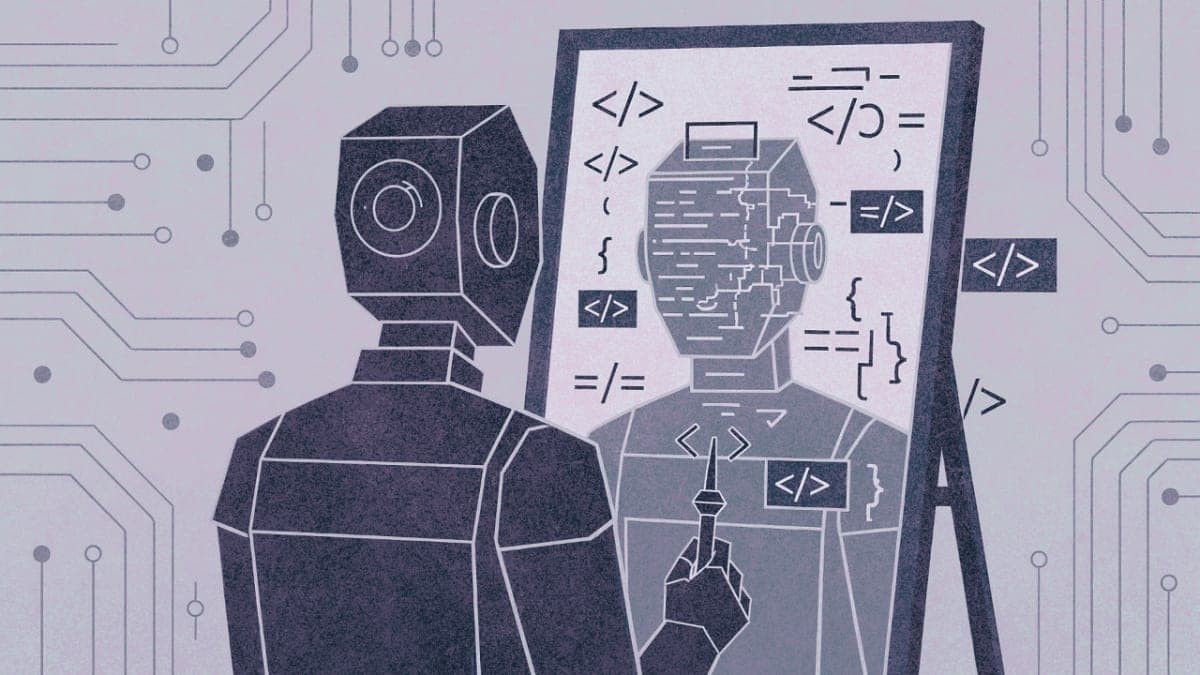
The core mechanism is adversarial self-improvement. A single LLM takes turns playing two roles: a bug injector that deliberately breaks code, and a solver that tries to fix what was broken. The bug injector produces artifacts including "a bug-inducing patch over code files" and "a test-weakening patch over test files" that hides the bug from existing test coverage.
This last detail matters. Real bugs often slip through because test suites have gaps. By training the injector to find and exploit those gaps, the researchers create more realistic training scenarios than you'd get from randomly corrupting code.
The injector uses two strategies: removing code hunks from the codebase, or selectively reverting historical changes using insights from git logs. The historical reversion approach is clever since it leverages the fact that real codebases contain a record of every meaningful change, any of which could theoretically be "undone" as a plausible bug.
What the numbers actually show
On SWE-bench Verified, a curated subset of 500 GitHub issues that human engineers confirmed are solvable, SSR achieves "notable self-improvement (+10.4 and +7.8 points, respectively)" compared to its baseline on both Verified and Pro variants.
The comparison that matters most: SSR versus a model trained on human-curated data with the same hyperparameters and environment. SSR "consistently outperforms the human-data baseline over the entire training trajectory." That's a strong claim, and the researchers are careful to note that evaluation happened on natural language issues the self-play agent never saw during training.
But context helps. SWE-bench Verified was created because OpenAI found that tasks in the original benchmark "may be hard or impossible to solve, leading to SWE-bench systematically underestimating models' autonomous software engineering capabilities." The benchmark has already been tuned to make AI look better.
And scores on SWE-bench have been climbing rapidly. As of early 2025, leading agents based on Claude 3.7 Sonnet solve around 33% of issues on the full benchmark. Top proprietary systems with scaffolding reportedly push past 70% on Verified. Where SSR lands in this hierarchy isn't entirely clear from the paper.
The superintelligence question
The paper's framing around superintelligence will raise eyebrows. The researchers describe SSR as "a first step toward training paradigms for superintelligent software agents," envisioning systems that "exceed human capabilities in understanding how systems are constructed, solving novel challenges, and autonomously creating new software from scratch."
This is a substantial extrapolation from "our self-play method beat a baseline on a bug-fixing benchmark."
The AlphaGo comparison is instructive but imperfect. AlphaGo Zero "became its own teacher" and "learned the game of Go from scratch, accumulating thousands of years of human knowledge during a period of just a few days." But Go has a fixed rule set, perfect information, and an unambiguous win condition. Software engineering has none of these properties.
Real codebases involve undocumented assumptions, business logic that only makes sense in context, and "correct" solutions that depend on unstated requirements. Whether self-play can navigate this messiness remains undemonstrated.
Who built this
The author list spans academia and industry. Lead author Yuxiang Wei is a PhD student at UIUC under Lingming Zhang, with a research focus on code generation and automated program repair. Wei has worked on previous projects including Magicoder and contributed to Meta's Code World Model. Co-authors include Gabriel Synnaeve and Sida Wang from Meta's FAIR CodeGen team.
This builds on earlier work. A related paper, SWE-RL, introduced training LLMs via reinforcement learning on GitHub pull request data and achieved 41.0% on SWE-bench Verified using Llama 3. SSR extends this by removing the requirement for human-generated issues entirely.
What's missing
The paper is light on failure modes. When does self-play training produce agents that confidently break things worse? The injector-solver dynamic creates a minimax game, but games have equilibria that may not correspond to useful engineering capabilities.
There's also the question of what "superhuman" even means in software engineering. Passing tests isn't the same as writing maintainable code. An agent that produces correct patches faster than any human could still generate solutions no team would want to merge.
The researchers acknowledge these limitations with a hedge: "Our results, albeit early, suggest a path." A path is not a destination.
The FTC is not going to file an injunction over this paper. But companies deploying AI coding assistants will watch whether self-play methods scale to real enterprise codebases with millions of lines of legacy code, integration tests that take hours to run, and requirements documented in Slack threads from 2019.