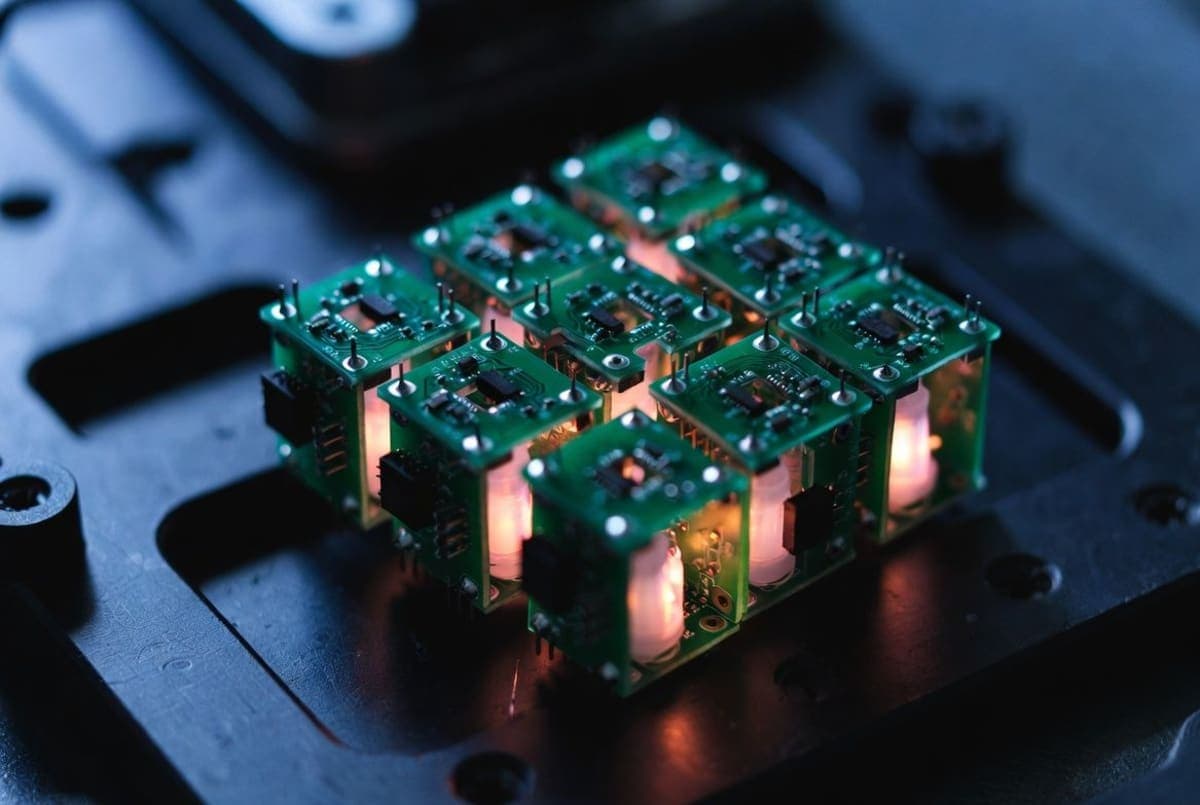
Researchers from the IT University of Copenhagen, Sakana AI, and Autodesk have built physical cubes that figure out what shape they collectively form without any of them knowing where they are. The technical report went up on arXiv, alongside a project page with hardware video.
Each brick is six FR4 circuit boards bolted into a cube, with a microcontroller, an LED, and pin headers on every face. Stack them into a plane, a guitar, a boat, a table. Every cube runs the identical Neural Cellular Automata network, talks only to whoever it is physically touching, and after enough rounds of message passing the whole assembly lights up with the same answer.
What actually happened on the bench
The team built four shapes in hardware, from 26 bricks for the guitar up to 197 for a round table. All four converged on the right class. Convergence took under 60 update cycles, roughly three minutes of wall time.
Four shapes. That is the entire physical result set, and the reported 100% success rate is calculated over those four. Simulation numbers look better (98.97% accuracy, 500-plus bricks) but simulation is where every modular robotics paper looks good. The interesting claim is not the accuracy figure. It is that the thing works at all on off-the-shelf microcontrollers with no positional information anywhere in the system.
The failure modes are the good part
Kill 5% of the modules and most shapes still classify. Push to 15% and the plane and the boat barely degrade. The guitar falls apart, because a guitar has a neck, and one dead brick in the neck severs the structure into two islands that can no longer reach consensus. Topology beats redundancy.
Out-of-distribution tests are mixed in the way you would want an honest paper to admit. A table with five randomly placed shortened legs still reads as a table. A boat with its bridge shoved off-center still reads as a boat. Shrink the table down and the collective calls it a chair, which the authors chalk up to compressed structural cues at low resolution. They did not bury that one.
Morphogens, sort of
Poke at the hidden channels and you find left-right and radial gradients forming early, plus an anterior-posterior axis in chairs. Cells in a chair start out convinced they are part of a table, then a signal propagating from the backrest talks them out of it. The paper frames this as morphogen-like patterning, echoing embryonic development, which is either a genuine structural parallel or the sort of biological analogy that AI labs reach for reflexively. Probably some of both.
The regeneration bit
Retrain the network to predict damage direction instead of shape class and each cell learns whether it is missing a neighbor and on which axis. Detection accuracy clears 90% across shape types. Start from a small seed cluster, add bricks wherever the existing ones point, repeat until nobody reports damage, and the structure rebuilds itself. In simulation. There is no actuation in the hardware, so a human is still doing the placing.
Two things worth correcting
Circulating summaries of this work claim publication in Nature and code on GitHub. Neither checks out. The paper is an arXiv preprint, and the project page says code is coming, without a date. If either changes, that is the news to watch for.