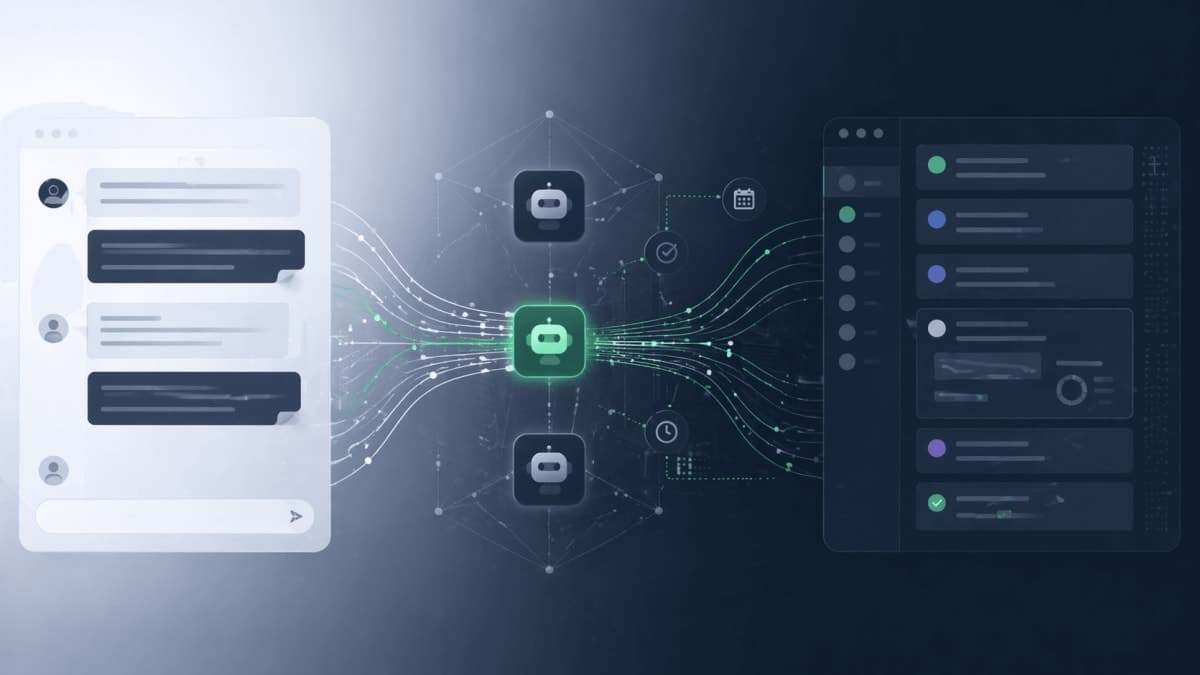
OpenAI launched workspace agents in ChatGPT on Wednesday, a research preview aimed at Business, Enterprise, Edu, and Teachers customers. The agents are powered by Codex, run in the cloud, plug into Slack, and are designed to be built once and shared across a team. Free until May 6, 2026; credit-based pricing kicks in after that.
Codex as the engine, Slack as the landing pad
The framing here matters. OpenAI is calling workspace agents an evolution of GPTs, which is corporate-speak for "we're replacing them." Custom GPTs, the customization layer OpenAI shipped at DevDay in November 2023, never really landed as a serious business tool. Workspace agents are the second attempt, and they look more serious: persistent memory, scheduled runs, Slack triggers, approval flows for sensitive actions, and admin controls that let IT set who can build, share, and use what.
They run on Codex, which is interesting on its own. Codex started life as a coding agent and has quietly become OpenAI's general-purpose cloud agent. A real business workflow is almost always a mess of code, API calls, and document handling, and a coding agent handles that mix better than a chat wrapper does. Whether users will care that their sales-ops bot is technically "Codex" is another question. Probably not.
The more interesting bet is Slack. OpenAI is shipping workspace agents into ChatGPT and Slack simultaneously, with "more surfaces" promised. Most enterprise work lives in Slack, not in a separate chat tab, and a scheduled agent that posts Friday reports into a channel is more useful than one that lives behind another login.
What's actually shipping
OpenAI's internal examples are the usual enterprise SaaS lineup: a Software Reviewer that checks procurement requests against policy and opens IT tickets, a Product Feedback Router that consolidates Slack and support channels into prioritized tickets and weekly summaries, a Weekly Metrics Reporter that pulls data on Fridays and drafts a narrative report. Plus a Lead Outreach Agent that qualifies inbound leads and writes personalized follow-ups. OpenAI says one of its own sales consultants built a Sales Opportunity agent end-to-end without engineering help, replacing roughly 5-6 hours of weekly reporting work per rep.
Those numbers come from OpenAI, about OpenAI. Grain of salt. But the shape is right. This is the kind of repetitive, bounded, multi-system work that actually suits an agent, as opposed to the "replace your analyst" fantasies that get pitched at conferences.
Templates ship for finance, sales, and marketing. Admins get a Compliance API for monitoring what each agent touches and when, role-based controls for who can create or share agents, and a kill switch. There's a built-in defense layer for prompt injection too, for when agents process external content. Which, fine. Prompt injection isn't solved. OpenAI's own team has said as much. A safeguard is not a cure.
Chasing Anthropic, from a different direction
This is a response to Anthropic. That's not quite how OpenAI would put it, but it's the shape of the launch. Anthropic shipped Agent Skills in October 2025, a modular capability system that works across Claude apps, Claude Code, and the API. Then came Claude Cowork, a desktop agent aimed at non-developers who want to hand off tasks rather than chat.
Anthropic's approach has been bottom-up: give individual power users something they can build with, and let the enterprise adopt it by osmosis. OpenAI is going the other way. Workspace agents are pitched to admins first, with organization-wide sharing, RBAC, compliance tooling, and Slack as the delivery channel. They're meeting teams where teams already work instead of asking them to move into yet another interface.
Both bets can be right. But the admin-first angle is smart for OpenAI. Anthropic's Skills are powerful if you already know what you're doing. Workspace agents are trying to be powerful even if you don't.
One wrinkle worth flagging: workspace agents are off by default for ChatGPT Enterprise customers at launch, requiring admin activation. They're also not available at all to Enterprise customers using Enterprise Key Management, per VentureBeat's reporting. For the companies most likely to care about the security posture, the product isn't actually shipping yet.
The pricing question
Credit-based pricing. That's the model starting May 6, 2026. OpenAI hasn't said what a credit costs or what a typical workspace agent run consumes, which is the kind of detail that tends to matter.
A scheduled agent that pulls data, builds a dashboard, and writes a narrative every Friday is going to rack up tool calls, model inference, and connector usage. Whether that costs $5 a week or $50 a week will determine what actually makes sense to automate. For bounded tasks, the math usually works. For the "let's run this against every deal, every customer, every ticket" pitch that shows up in OpenAI's sales materials, it may or may not.
I've seen this play out before with agentic tooling. The demo is impressive. The invoice is sobering. Enterprises that sign up during the free window should instrument their usage before the meter starts, not after.
What to watch
Two things. First, whether OpenAI ships the promised GPT-to-workspace-agent conversion tool cleanly, and how many of the existing enterprise GPTs survive the migration. OpenAI has already signaled it will deprecate the custom-GPT standard for organizations at some unspecified date, which leaves customers with working GPTs in an awkward holding pattern.
Second: May 6. That's when the credit meter turns on and we find out how much of this is genuinely cost-effective at scale. Until then, everyone gets to run the experiment on OpenAI's dime.