OpenAI on Monday began rolling out its first live test of advertising inside ChatGPT, showing sponsored content to a subset of free and Go tier users in the United States. The company confirmed the launch in a blog post that was heavy on principles and light on specifics about which brands are actually running.
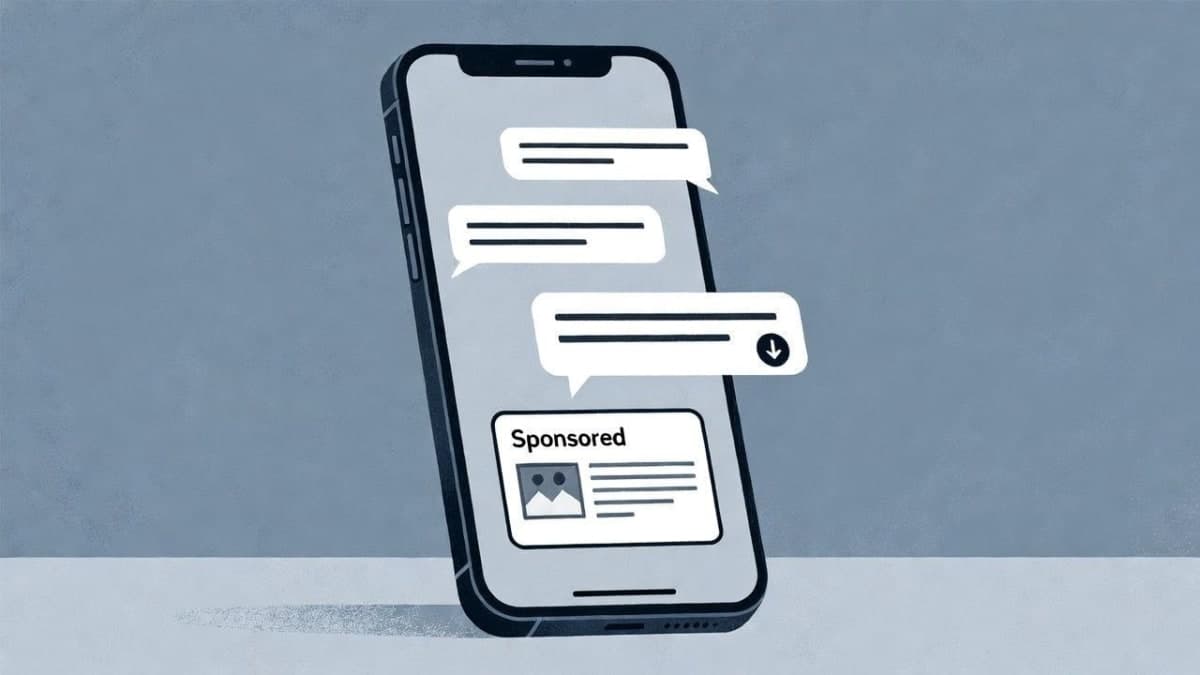
The ads appear below ChatGPT's responses, labeled as "Sponsored" and visually separated from the answer. Ask about recipes and you might see a grocery delivery pitch. Ask about travel and, well, you can guess.
The money part
OpenAI is not messing around with pricing. According to Adweek, the company confirmed a $200,000 minimum commitment for advertisers entering the beta, with some brands quoted up to $250,000. CPMs sit around $60 per thousand impressions, roughly triple what Meta charges on Facebook and Instagram.
That $60 CPM buys you impressions, not clicks, and the measurement is bare-bones: total views and total clicks. No conversion tracking, no purchase attribution, none of the granular data Google and Meta have spent decades building. Advertisers are paying a premium for access to high-intent conversational moments while flying partially blind on performance data. Whether that math works depends on how much you trust that someone asking ChatGPT about running shoes is closer to buying than someone scrolling Instagram.
What users actually get
The opt-out structure deserves attention because it tells you more about OpenAI's thinking than the trust-and-safety language does. Free users who don't want ads can flip them off in settings, but the tradeoff is fewer daily messages. No ads on an image-generation tool that costs real money to run, or fewer chances to use it. OpenAI is being transparent about this calculus, at least: ads subsidize usage.
Users on Plus ($20/month), Pro ($200/month), Business, Enterprise, and Education tiers see nothing. OpenAI also added Education to the ad-free list, which wasn't in the original January announcement. Whether that was always the plan or a late addition after complaints from schools is unclear.
Targeting works off your current conversation, past chats, and prior ad interactions. Users can toggle personalization off, delete ad data, or dismiss specific ads. No ads appear near health, mental health, or politics topics, and accounts identified as under 18 are excluded. Advertisers never see your conversations, OpenAI says, receiving only aggregate reporting.
Altman's long, awkward pivot
The timing is remarkable mostly for what came before it. In late 2024, Sam Altman told a Harvard audience that he "hates" ads and called combining them with AI "uniquely unsettling," according to CNN's reporting. By November 2025 he'd softened to "not totally against." By January 2026 he was posting on X that "a lot of people want to use a lot of AI and don't want to pay."
That trajectory from principled objection to active rollout took about 14 months. The financial pressure explains the speed: OpenAI committed to roughly $1.4 trillion in infrastructure deals last year, per CNBC, while running an annualized revenue rate around $20 billion. A source told CNBC the company expects ads to make up less than half of its revenue long-term, which is an interesting number because it suggests they're planning for ads to be a multi-billion-dollar line item eventually, not a rounding error.
The Super Bowl context
None of this happened in a vacuum. Last Sunday, Anthropic spent millions on Super Bowl spots mocking the exact scenario OpenAI launched the next day. The campaign featured actors playing robotic AI assistants who interrupt personal advice with absurd product pitches, tagged with "Ads are coming to AI. But not to Claude."
Altman called the ads "funny" but "clearly dishonest," then wrote what TechCrunch described as a "novella-sized rant" on X that escalated to calling Anthropic "authoritarian." That's a striking word choice over a cheeky Super Bowl commercial, and it suggests the ad question has become a genuine sore point for OpenAI's leadership. Altman argued that OpenAI serves free users at a scale Anthropic doesn't, which is true, though both companies offer free tiers with comparable paid plans ranging from $0 to $200.
Google's DeepMind CEO Demis Hassabis, for his part, told Axios at Davos that the ad launch from OpenAI felt early. He said Google has "no plans" for ads in Gemini. Given that Google makes nearly all of its revenue from advertising across every other product, that claim deserves some skepticism.
What happens next
OpenAI says it plans to expand to additional ad formats and buying models over time but gave no timeline for international expansion or changes to the current test. The company is explicitly framing this as a learning phase: "We're starting with a test to learn, listen, and make sure we get the experience right."
The real question isn't whether ads appear inside AI chatbots. That was always going to happen. It's whether the promise that ads won't influence responses can survive the incentive structure that advertising creates. OpenAI says it won't optimize for time spent in the app. History suggests that companies say a lot of things before advertising revenue becomes 30% of the business.
Interested advertisers can sign up at openai.com/advertisers/.