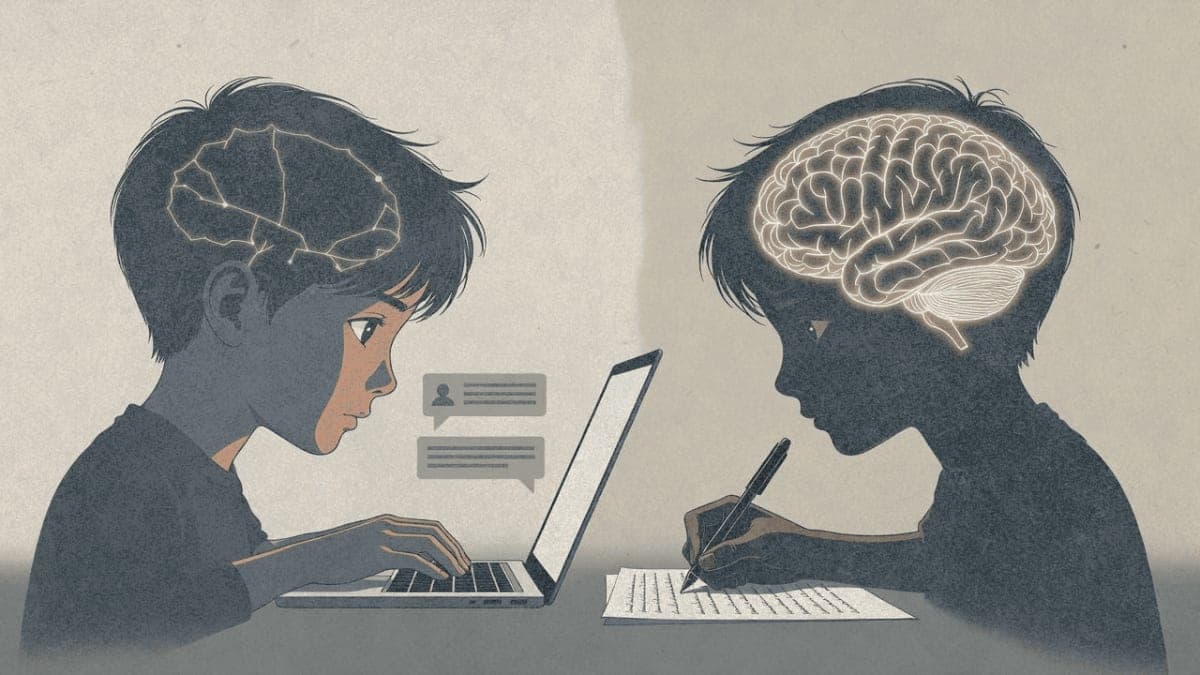
Researchers at MIT Media Lab strapped EEG headsets on 54 students and had them write SAT essays over four months. One group used ChatGPT, another used Google search, a third wrote with nothing but their own brains. The ChatGPT group showed the weakest brain connectivity of all three, and it got worse with each session.
The study, led by research scientist Nataliya Kosmyna and published as a preprint on arXiv in June 2025, introduces a term the researchers call "cognitive debt." The metaphor works like this: AI makes the task easier now, but you're paying interest on that convenience in the form of reduced critical thinking and memory later.
The numbers that matter
Over 80% of ChatGPT users in the first session couldn't accurately quote a single sentence from essays they'd written just minutes earlier. The brain-only group? Only 11% had that problem.
By their third session, many ChatGPT users had essentially given up on writing. The researchers describe a pattern where students prompted the AI, made minor edits, and called it done. One participant's approach, as quoted by Kosmyna, boiled down to asking ChatGPT to just produce the essay, refine a sentence, and finish.
The EEG data showed the brain-only group had the strongest and most distributed neural networks, with high activity in alpha, theta, and delta bands associated with creative thinking, memory load, and semantic processing. Search engine users landed somewhere in the middle. ChatGPT users consistently showed the weakest coupling between brain regions.
What happened when they switched
Here's where it gets interesting. In a fourth session, 18 participants switched conditions. ChatGPT users had to write unaided. Brain-only users got to try the AI.
The ChatGPT-to-brain group struggled. Their neural connectivity looked more like novices than practiced writers, despite having completed three previous essays. The researchers interpret this as evidence that earlier AI dependence had prevented them from developing the cognitive infrastructure needed for independent work.
The brain-to-LLM group, by contrast, showed a spike in brain activity across all frequency bands. Having already developed their own thinking, they appeared to engage more critically with the AI's output, comparing and integrating rather than passively accepting.
The quality problem
Human teachers who graded the essays described the ChatGPT-produced work as generic and, in their words, soulless. The AI group's essays clustered around similar ideas and language patterns. NLP analysis confirmed what the teachers sensed: within-group homogeneity was highest among ChatGPT users.
An interesting wrinkle: AI judges scored the ChatGPT essays higher than human teachers did. Whether that says more about the essays or about how AI evaluators are trained is a question the researchers don't fully explore.
Self-reported ownership of essays was lowest in the ChatGPT group and highest among those who wrote alone. Students using AI reported feeling disconnected from work they'd technically authored.
The limitations are substantial
The sample size was small, and only 18 people completed the crossover session. The study only tested GPT-4o, so the results can't be generalized to Claude, Gemini, or other models. The 20-minute time limit meant ChatGPT users spent part of their writing time interacting with the tool, giving the brain-only group more actual writing time. EEG can measure broad connectivity patterns but can't pinpoint activity in deeper brain structures like the hippocampus.
The study hasn't been peer-reviewed. Kosmyna has said she released it early because she believes the issue affects students now and didn't want to wait the eight-plus months peer review typically takes.
Some critics have pointed out that the experimental setup doesn't reflect how most people actually use AI for learning. Participants were paid $100 to write essays for science, not motivated by grades or genuine interest in the topics. The researchers themselves acknowledge this in their FAQ, asking media not to use terms like "brain rot" or "damage," language that has nonetheless dominated coverage.
What the researchers recommend
The study suggests that writing without tools first, then layering in AI assistance, preserves cognitive engagement better than starting with AI from the beginning. Students who developed their own ideas before using ChatGPT maintained stronger neural activity and memory recall.
Kosmyna's position isn't that AI should be banned from education. She's calling for research-informed guidelines on when and how to introduce these tools, particularly for younger users whose brains are still developing.
The paper runs to 200 pages and includes extensive supplementary data. The researchers have set up a dedicated project page at brainonllm.com with FAQs addressing common misinterpretations of their findings.
Whether "cognitive debt" becomes a lasting framework for understanding AI's effects on learning or fades as a provocative metaphor depends on whether future studies, with larger samples and peer review, can replicate these results.