Linus Torvalds, the man who wrote the Linux kernel at 21 and has spent three decades demanding precision from contributors, just admitted he used AI to write code he didn't bother to understand.
In the README for his latest hobby project, Torvalds describes how a Python visualizer came together: "It started out as my typical 'google and do the monkey-see-monkey-do' kind of programming, but then I cut out the middle-man, me, and just used Google Antigravity to do the audio sample visualizer."
That's not a misquote. The middle-man he cut out was himself.
The hobby horse nobody expected
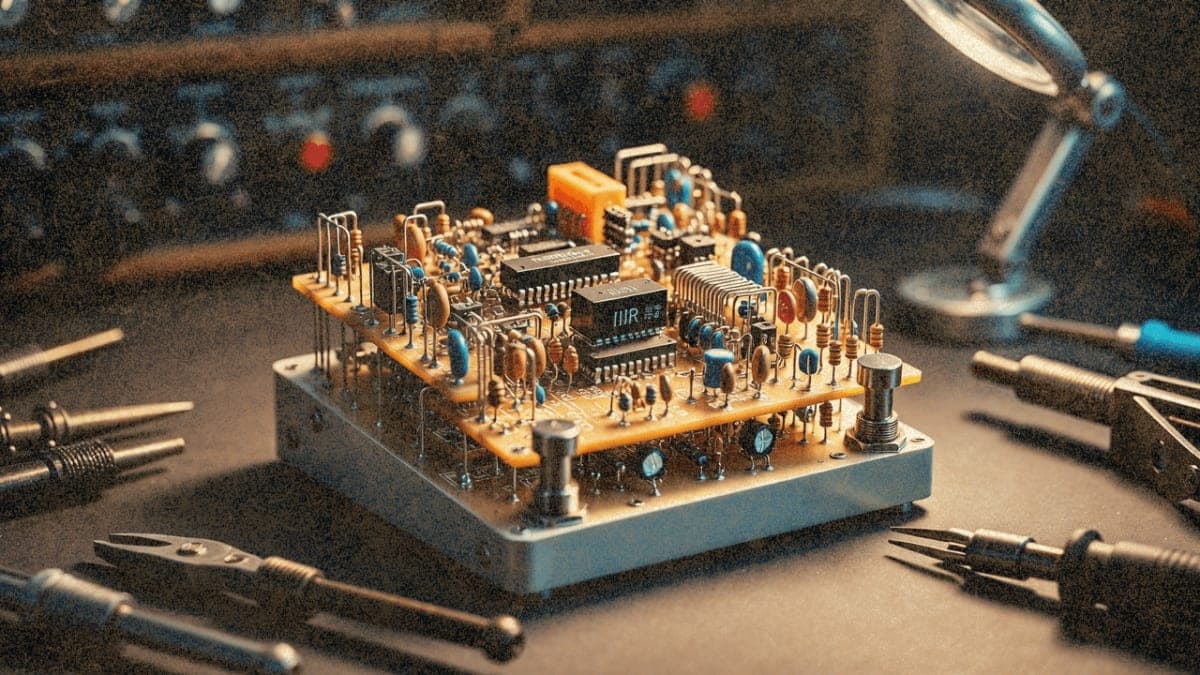
AudioNoise is a continuation of Torvalds' guitar pedal adventures, which started around Christmas 2024 when he got a new soldering iron and went deep on analog effects. The GuitarPedal repo documents his journey through actual hardware, complete with complaints about potentiometers and clicky footswitches.
This latest project strips out the hardware and focuses purely on digital signal processing. IIR filters, delay loops, basic DSP stuff. The C code handling the actual audio effects appears to be Torvalds' own work. But the Python visualizer? That's where Google Antigravity came in.
"I know more about analog filters, and that's not saying much, than I do about python," Torvalds writes. The self-deprecation is characteristically direct.
The timing is, let's say, notable
Here's where it gets interesting. Just days ago, Torvalds weighed in on the Linux kernel mailing list debate about whether to add AI-specific documentation for code submissions. His position was blunt: "There is zero point in talking about AI slop. That's just plain stupid."
His argument wasn't that AI tools are bad. It was that documentation won't stop bad actors, and turning kernel docs into an AI manifesto is "pointless posturing." He explicitly said he doesn't want kernel development documentation to take a stance on AI either way.
And now here he is, openly vibe coding a weekend project.
The cognitive dissonance isn't actually there if you read carefully. Torvalds has been consistent: AI tools are fine for things that don't matter. Hobby projects, prototyping, learning exercises. What he objects to is low-quality submissions to the kernel masquerading as legitimate contributions, regardless of what tool produced them.
But the optics are certainly something.
What is Antigravity, anyway
For those who missed it, Google Antigravity launched in November 2025 alongside Gemini 3. It's an "agent-first IDE" built by the team Google acquired from Windsurf earlier that year, a deal reportedly worth around $2.4 billion in talent and licensing.
The tool distinguishes itself from Cursor or GitHub Copilot by giving AI agents direct access to your editor, terminal, and browser. You can dispatch multiple agents to work on different tasks simultaneously. The Wikipedia article notes debate about whether it's technically a fork of VS Code or a fork of Windsurf, which is itself a fork of VS Code.
Varun Mohan, who leads the Antigravity project, noticed Torvalds' repo and posted on X: "Truly an honor to see one of my programming heroes, Linus Torvalds, using Antigravity to build part of his most recent project."
The legitimacy question
Andrej Karpathy coined "vibe coding" in February 2025, describing it as "fully giv[ing] in to the vibes" and "forget[ting] that the code even exists." The key characteristic isn't just using AI assistance. It's accepting AI-generated code without reviewing or fully understanding it.
By that definition, Torvalds was explicitly vibe coding. He didn't review the Python. He probably doesn't understand it in detail. He just wanted a visualizer and let the machine handle it.
And honestly? That seems fine for a personal audio toy. Nobody's going to die if the spectrogram renders weirdly.
But the symbolism matters. When someone with Torvalds' reputation for exacting standards publicly embraces the approach, it shifts the Overton window on what's acceptable in the development community. Not for production code, not for anything critical. Just for the category of things that don't need to be perfect.
What the project actually does
Since nobody seems to be covering the actual technical content: AudioNoise implements basic guitar effects in pure C. Phaser, flanger, echo, FM modulation. The code is "single sample in, single sample out with no latency," deliberately simple.
Torvalds explicitly says these aren't the "fancy AI emulate-a-cab kind" of modern pedal effects. They emulate analog circuits by modeling RC networks with digital all-pass filters. It's educational, not revolutionary.
The Python visualizer generates spectrograms and waveform displays from the processed audio samples. That's the part Antigravity wrote.
The kernel remains AI-free (mostly)
Whatever Torvalds does in his spare time, the Linux kernel itself isn't changing its approach. His position on the mailing list remains that AI-generated patches should be treated like any other submission: judged on quality, not origin. Documentation is "for good actors," and bad actors won't follow rules anyway.
At the Open Source Summit in Seoul in November, Torvalds described himself as "fairly positive" about vibe coding, but qualified it heavily. For learning, for prototyping, for getting computers to do things people couldn't otherwise do. Not for kernel development, where it would likely be "horrible, horrible" from a maintenance standpoint.
He also hasn't actually used AI for any kernel work. "I'm sure people are looking at it even for the kernel codebase," he said. But not him. Not yet.