Stripe is putting money behind an idea most pharma companies gave up on: making the common cold preventable. The payment firm, run by brothers Patrick and John Collison, is funding Intercept, a new $500 million nonprofit aimed at cutting transmission of colds and flu, with eventual ambitions to get rid of respiratory viruses entirely. Anthropic, the OpenAI Foundation, Flu Lab, Bill Gates, and a handful of Jane Street traders are also backing it, according to MIT Technology Review.
The plan splits into two tracks that have almost nothing to do with each other. One is drugs. The other is cleaning the air you breathe indoors.
Why nobody bothered before
The pitch starts with a number Stripe executive Nan Ransohoff keeps repeating: people spend roughly 5% of their lives fighting colds and flu. Take that figure with a little salt, since it is the kind of stat that sounds devastating in a fundraising deck and gets fuzzy when you ask how it was measured. Still, the underlying point holds. We treat sniffles as background noise.
Drug companies have a reason for ignoring them. Colds come from more than 200 different viruses, with rhinoviruses doing most of the damage, so a vaccine against any single one is a lousy business. Ransohoff frames it as an incentive gap rather than a science problem. "When pharma companies look at it, it's not as attractive as other things they could work on," she said, which is the sort of thing that sounds obvious once someone says it out loud.
The whole thing kicked off after she started talking to David Veesler, a structural biologist at the University of Washington who designed vaccines during COVID. He convinced her it was technically doable. "He effectively sort of nerd-sniped me," she said.
The science, such as it is
One idea getting attention: engineer virus-grabbing proteins you could spray up your nose to catch viruses before they take hold. Veesler points to RNA drugs, antibodies, and computational protein design as the toolkit that did not exist a decade ago. Whether any of it survives contact with a clinical trial is another question, and the nonprofit is honest that this is years out.
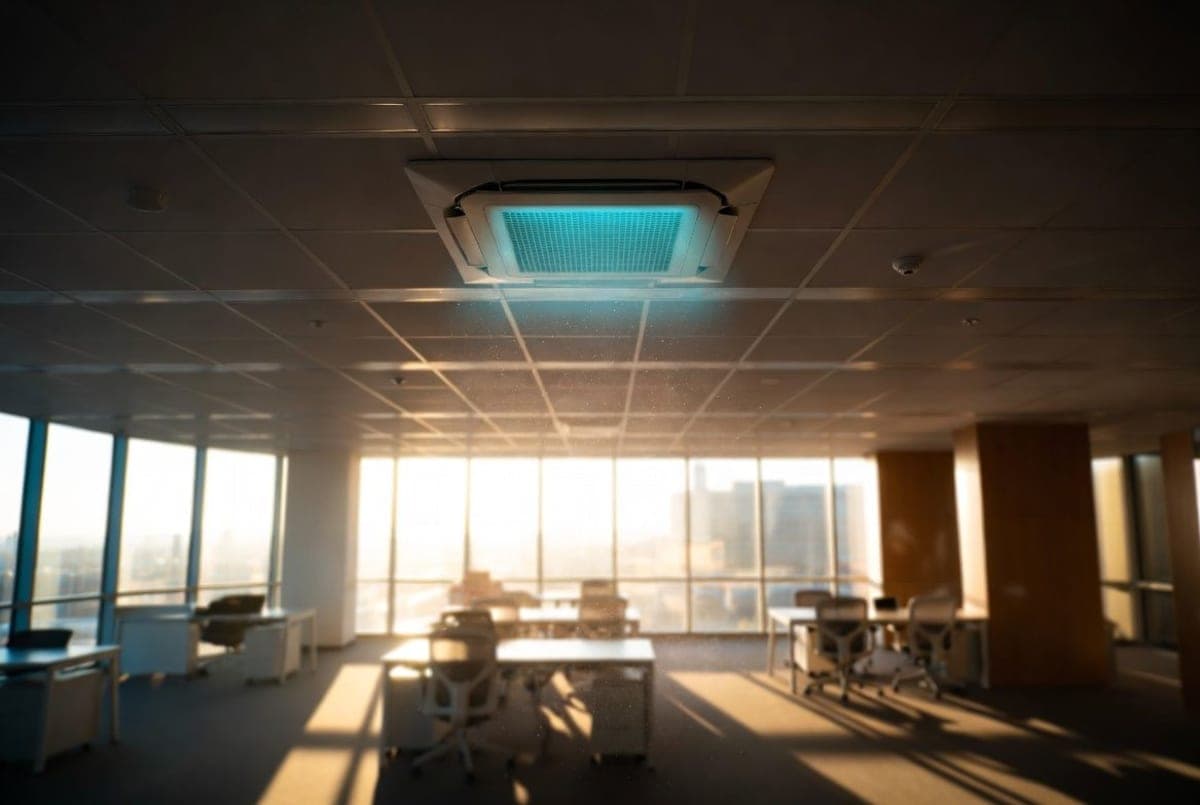
The air-cleaning track is the more interesting bet, partly because it sidesteps the 200-viruses problem entirely. Clean the air in a crowded room and you do not care which virus is floating in it. Intercept wants large-scale systems for schools and offices, leaning on technologies like strong ultraviolet light to inactivate airborne viruses. The germicidal UV research goes back decades and the lab results are solid: one 2022 study found portable UV devices knocked out common cold coronaviruses and SARS-CoV-2 on N95 surfaces. Scaling that to a real classroom full of moving people is the hard part.
Ransohoff's analogy is water treatment. Cities scrub impurities out of water before it reaches your tap, and a century ago waterborne disease was just something you lived with. The bet is that air can get the same treatment.
The honest math problem
Here is the part Intercept does not hide, to its credit. No single tool fixes this. Even a pill or spray that gave over 90% protection against over 90% of respiratory viruses would not be enough, because realistic vaccination-style uptake tops out around 60%. That leaves too many gaps for population immunity. So the strategy is layered by necessity, not ambition.
The advisor list reads like a COVID-response reunion. Per the nonprofit's own launch post, advisors include Moncef Slaoui, who ran Operation Warp Speed, and Peter Marks, a former top FDA official. That is either reassuring or a sign of how niche this expertise still is, depending on your read.
So when does anything happen
Not soon. Intercept's own horizon is four to seven years to push its technologies through late-stage medical testing, after which it hopes commercial players step in to manufacture at scale. The symposium that started all this ran last August at Stripe with about 40 scientists and investors. When surveyed beforehand on why this field might fail over the next decade, the top answer was not technical feasibility. It was money. Which, conveniently, is the one thing Intercept just showed up with.