Midjourney, the San Francisco company best known for generating images from text prompts, announced a healthcare division on June 18, 2026, along with a full-body ultrasound scanner it says will eventually image your entire body in 60 seconds. The hardware runs on licensed semiconductor chips from Butterfly Network. The current prototype takes about 20 minutes and has been used on roughly a dozen people.
So what did they actually build?
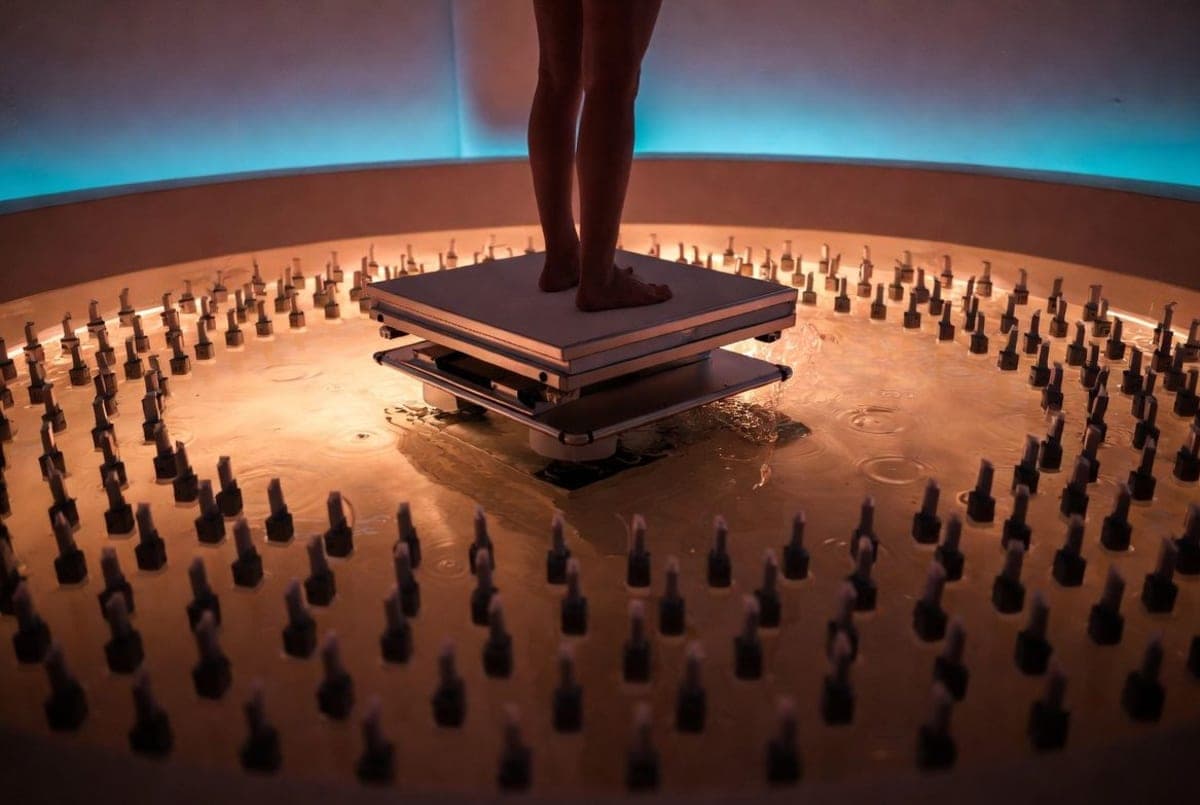
The thing uses ultrasound computed tomography, USCT, which is not a Midjourney invention. You step onto a platform that lowers you into a shallow pool of warm water, and a ring of transducers fires sound waves through your body from every angle while recording the echoes. A computing cluster reconstructs that into a 3D map. The technique has been studied since the 1950s and recently got FDA clearance for breast screening. Whole-body USCT covering the torso and legs is the part nobody has pulled off before.
CEO David Holz said at the launch that the scanner is "in many ways superior to even MRI machines," without radiation or magnets. That claim has not been checked by anyone outside the company, and the framing of this as an MRI replacement is Midjourney's, not a verdict from any radiologist.
The chip is the real story
The hardware leans entirely on a deal Midjourney signed with Butterfly in November 2025, an exclusive license worth up to $74 million over five years, including $15 million upfront and $10 million annually. Butterfly's contribution is the genuinely hard part: it swapped the piezoelectric crystals in conventional probes for capacitive micromachined transducers built straight onto standard CMOS chips, the same process that makes computer processors.
The scanner uses 40 of these modules, around 8,960 active channels, plus roughly 2 petaflops of compute. Butterfly's own figures put about 500,000 sensors and two-plus petaflops across the imaging modules, so the half-million-sensor number floating around describes the chip array, not some standalone ring of detectors. The system spits out about 17 gigabytes of raw acoustic data per second, which Midjourney likens to 500 hours of HD video every second.
"Not even using any AI in this yet, just really cool hardware and software." That is Holz, per Bloomberg, which is a refreshingly honest thing to admit at your own AI company's medical launch.
That data firehose is exactly why 60 seconds is still aspirational. The bottleneck is moving data from the transducers to the reconstruction cluster fast enough. Midjourney wants second-generation hardware within 12 months and a third generation with fully custom silicon by 2028.
It cannot diagnose anything yet
Here is the part the headline number skips. The scanner has no FDA clearance for diagnosis. Midjourney is launching it as a maker of "body composition maps," muscle, fat, bone, organ volume, which sidesteps regulation under the FDA's general wellness lane, the same path Prenuvo and Ezra used for consumer whole-body MRI. Holz says the company has started FDA conversations and will submit results over time to chase diagnostic clearance, starting with that 2028 third-gen machine.
The published scan gallery is real. Cross-sections sit beside MRI images of the same tissue, and one comparison showed a 0.93 correlation with MRI fat-fraction measurement. Whether full-body resolution and artifact levels hold up clinically is a question no independent institution has answered.
Spas, not hospitals
Midjourney is routing around clinics entirely. The plan is a chain of "Midjourney Spas," with the first opening at the end of 2027 in Union Square, San Francisco, a roughly 25,000 square foot space with 10 scanners alongside saunas and cold plunges, running 24 hours a day. The scan is pitched as a side effect of a wellness visit. The original brief I was handed said the first locations open "next year," but every source points to late 2027 for San Francisco.
The long game is enormous and a little hard to take at face value: more than 50,000 scanners worldwide by 2031, with capacity for one billion scans a month. At published incidental-finding rates of 20 to 40 percent for whole-body imaging, that volume would flag anomalies in hundreds of millions of healthy people monthly, most of them benign, all of them needing someone to interpret or notify. Midjourney's pitch that early scanning could "avoid 30% of all deaths" has no peer-reviewed support behind it.
Midjourney has no outside investors and says it will fund the first spa itself. The San Francisco waitlist is open now at midjourney.com/medical, with the spa targeted for the end of 2027 and the custom-silicon third-generation scanner slated for 2028.