Intel put its Clearwater Forest server processor on stage at MWC 2026 in Barcelona this week, formally marketing it under the Xeon 6+ brand and giving the industry its clearest look yet at the chip most people are treating as a referendum on whether Intel's 18A manufacturing node actually works. Up to 288 Darkmont E-cores in a single socket, 12 channels of DDR5-8000 memory, and commercial launch slated for the first half of 2026. That's the official story. The unofficial story involves some benchmark math worth a closer look.
What Intel 18A actually means here
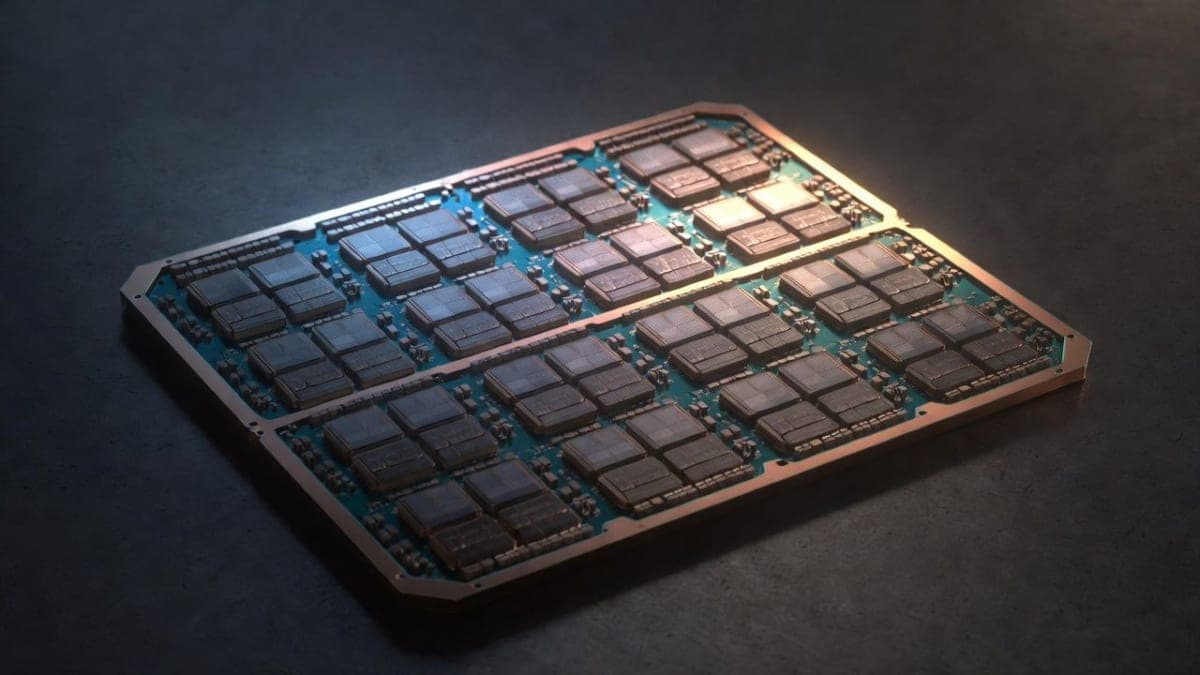
The chip's architecture is a multi-tile design: 12 compute tiles fabricated on Intel 18A, three active base tiles on Intel 3, and two I/O tiles on Intel 7. Foveros Direct 3D handles the stacking between compute and base tiles, with EMIB providing 2.5D connections across the package. The result is a single-socket part with up to 576 MB of last-level cache and a 300W to 500W TDP range. It fits the LGA 7529 socket, the same one used by the existing Xeon 6900P Granite Rapids processors, which matters to OEMs who don't want to redesign server platforms.
Intel 18A introduces two technologies the company has been talking up for years: RibbonFET, a gate-all-around transistor design, and PowerVia, backside power delivery. The company claims up to 15% better performance per watt and 30% improved chip density versus its previous Intel 3 node. Whether those numbers hold in a real 288-core production part is something independent reviewers haven't verified yet. Intel says commercial systems are coming in the first half of this year. We'll find out then.
The benchmark comparison that got challenged
Here's where it gets interesting. At Intel Tech Tour in October 2025, Intel's slides promoted Clearwater Forest as offering "2x more cores" than Sierra Forest and "1.9x higher performance" against the Xeon 6780E. The 2x core claim is technically accurate, but only if you compare against the Xeon 6700E series, which topped out at 144 cores. Intel omitted the Xeon 6900E series, which also shipped at 288 cores, from the entire presentation. According to Phoronix coverage of the event, this omission was noticed and criticized by attendees.
The "1.9x higher performance" against the 144-core Xeon 6780E is underwhelming if you think about it for a second. Clearwater Forest has twice the cores and faster memory. Less than 2x performance improvement with 2x the cores suggests the per-core gains aren't as clean as the IPC headline implies.
When pressed, Intel provided a different comparison: 288-core Clearwater Forest at 450W versus 288-core Sierra Forest at 500W. That yields 17% higher performance and 30% higher performance per watt while drawing 10% less power. Those numbers are credible and actually useful. Ericsson's independent testing, cited during the MWC 2026 showcase, found a 38% reduction in runtime rack power and over 60% gain in performance per watt versus a dual-socket Xeon 6780E platform. That last figure still compares a single new socket against a legacy two-socket setup, so the ratio needs context.
Why telecom, why now
Intel is positioning this explicitly at 5G network infrastructure and early 6G deployments. The pitch is consolidation: one Clearwater Forest socket replacing multiple older servers, cutting rack power and floor space. Kira Boyko, Product Line Director for Intel's E-core Xeon products, told reporters at Intel Tech Tour that OEMs specifically asked for socket compatibility with Granite Rapids so they could drop the new chip into existing server designs without a platform redesign. That request shaped the spec.
The 96 PCIe 5.0 lanes and 64 CXL 2.0 lanes per socket target the disaggregated infrastructure these operators run. In a two-socket configuration, you get 576 Darkmont cores total per chassis, which is the density argument Intel is making to cloud providers weighing ARM-based alternatives from Ampere and AWS's Graviton line.
What Intel hasn't shown yet: a full SKU table, pricing, or independent benchmark results on production silicon. The H1 2026 window is running short. Once systems actually ship, the 18A story gets tested against real workloads rather than carefully constructed slide comparisons.