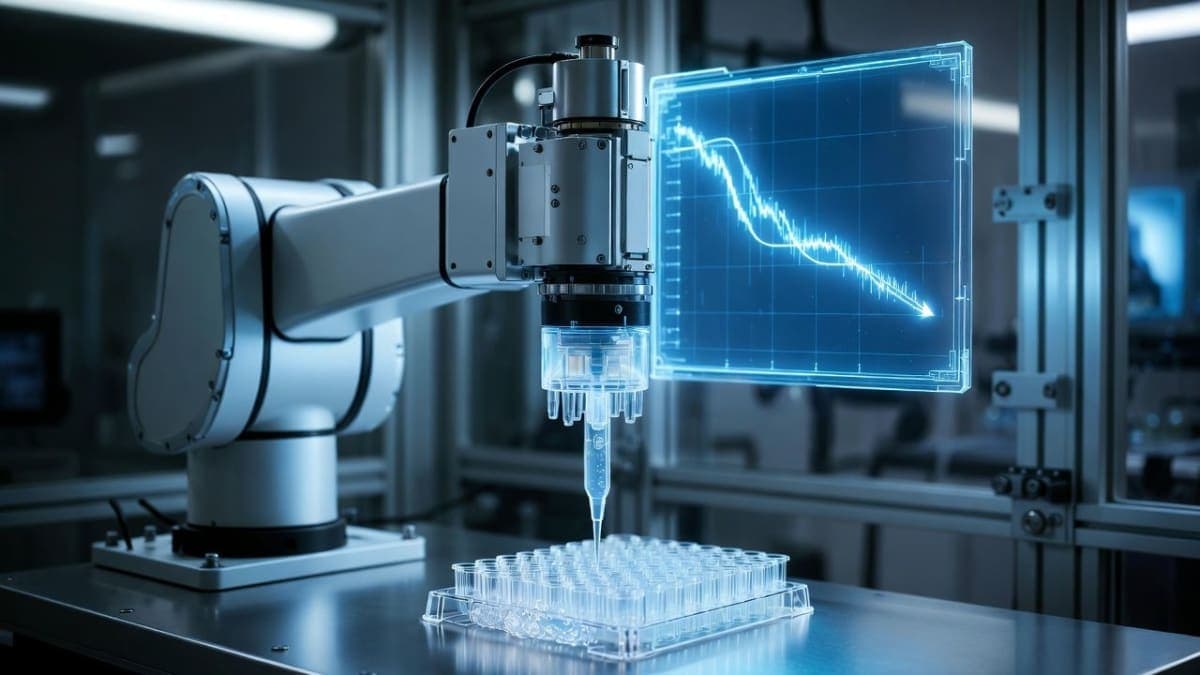
OpenAI and Ginkgo Bioworks announced that GPT-5, connected to a fully automated cloud laboratory in Boston, reduced the cost of producing a benchmark protein by 40% over six rounds of closed-loop experimentation. The system tested more than 36,000 unique reaction compositions across 580 automated plates, with human involvement limited to reagent prep and oversight.
The results are detailed in a preprint posted to bioRxiv and on OpenAI's site. Ginkgo is already selling the optimized reaction mix through its reagents store, which tells you more about the company's confidence in these numbers than any press release could.
How the loop actually worked
GPT-5 designed batches of experiments in 384-well plate format. Ginkgo's Reconfigurable Automation Carts, modular robots that handle liquid dispensing, incubation, and fluorescence measurement, executed them. Data came back. GPT-5 analyzed results, generated new hypotheses, and proposed the next round.
Every design passed through a Pydantic validation layer before anything ran, checking plate layout, reagent availability, volume constraints, and replication. This prevented what the team calls "paper experiments," designs that read fine but can't physically execute on robotic hardware. The Pydantic model is being released open-source.
Six rounds. Six months total. But here's a nuance the headline obscures: GPT-5 hit the 40% cost reduction benchmark after just three rounds, roughly two months in. The remaining three rounds refined and extended those gains, pushing protein yield up 27% alongside the cost drop.
What "$422 per gram" actually means
The protein in question is superfolder green fluorescent protein (sfGFP), a standard benchmark. Previous state of the art, established by Northwestern University researchers, sat at $698 per gram in total reaction component costs. GPT-5's optimized compositions brought that to $422, with a 57% improvement in reagent costs specifically.
A few caveats worth absorbing. That $422 figure reflects total reaction component costs under specific plate-based experimental conditions, not fully burdened manufacturing costs. And the system struggled early: deviations between replicates on the same plate exceeded 40% in initial rounds, as reported by The Decoder. Ginkgo staff had to manually adjust reagent concentrations and stock solutions to get variability down to a median of 17%. "Fully autonomous" is doing some heavy lifting in the press materials.
The real performance jump came in round three, when GPT-5 gained access to a computer, the internet, and a preprint of Northwestern's prior best results. Before that, it was working from what it knew from training data alone.
Smart brute force, not scientific insight
"This is AI doing real experimental science: designing experiments, running them, and learning from the results," said Ginkgo CEO Jason Kelly, which is one way to frame it. Another: GPT-5 is a sophisticated search algorithm exploring a combinatorial space that's too large for human teams to cover manually.
Cell-free protein synthesis involves balancing dozens of interacting components: DNA templates, cell lysates, energy sources, salts, polyamines. Small changes matter, but predicting which direction they'll push results is often unintuitive. Human researchers have chipped away at optimizing these reactions for years, but progress has been incremental because exploring the space thoroughly is exhausting.
Joy Jiao, OpenAI's life sciences research lead and co-corresponding author, framed it more carefully: "This success points to how AI systems can augment the experimental workflow, contributing to hypothesis generation, testing, and refinement based on real-world data." Augment is the right word. GPT-5 found novel reaction compositions that nobody had tested, and some of them worked well, but the system also surfaced something more useful about the underlying cost structure: with lysate and DNA now dominating expenses, maximizing yield per unit of those expensive inputs became the highest-leverage strategy. That's not a discovery so much as an accounting insight a model happened to stumble into through sheer volume of experimentation.
What came before
This builds on OpenAI's earlier work with biosecurity startup Red Queen Bio, announced in December 2025, where GPT-5 optimized a molecular cloning protocol and improved efficiency by 79x. That project still relied on human scientists to physically run the modified protocols. The Ginkgo collaboration closes more of that gap, with robots handling execution, though experienced operators still managed reagent preparation and protocol adjustments when things went sideways.
Reshma Shetty, Ginkgo co-founder: "We expect more and more experiments to be run on autonomous labs where reagent and consumables costs dominate the cost of an experiment." Which is also a pitch for Ginkgo's cloud lab business model, where selling compute time to AI-driven experimental design makes the whole infrastructure more attractive.
So what's next
The preprint has not yet undergone peer review. Ginkgo and OpenAI say they plan to apply the same approach to other biological workflows. The optimized sfGFP reaction mix is available now at reagents.ginkgo.bio for anyone who wants to validate the results independently.