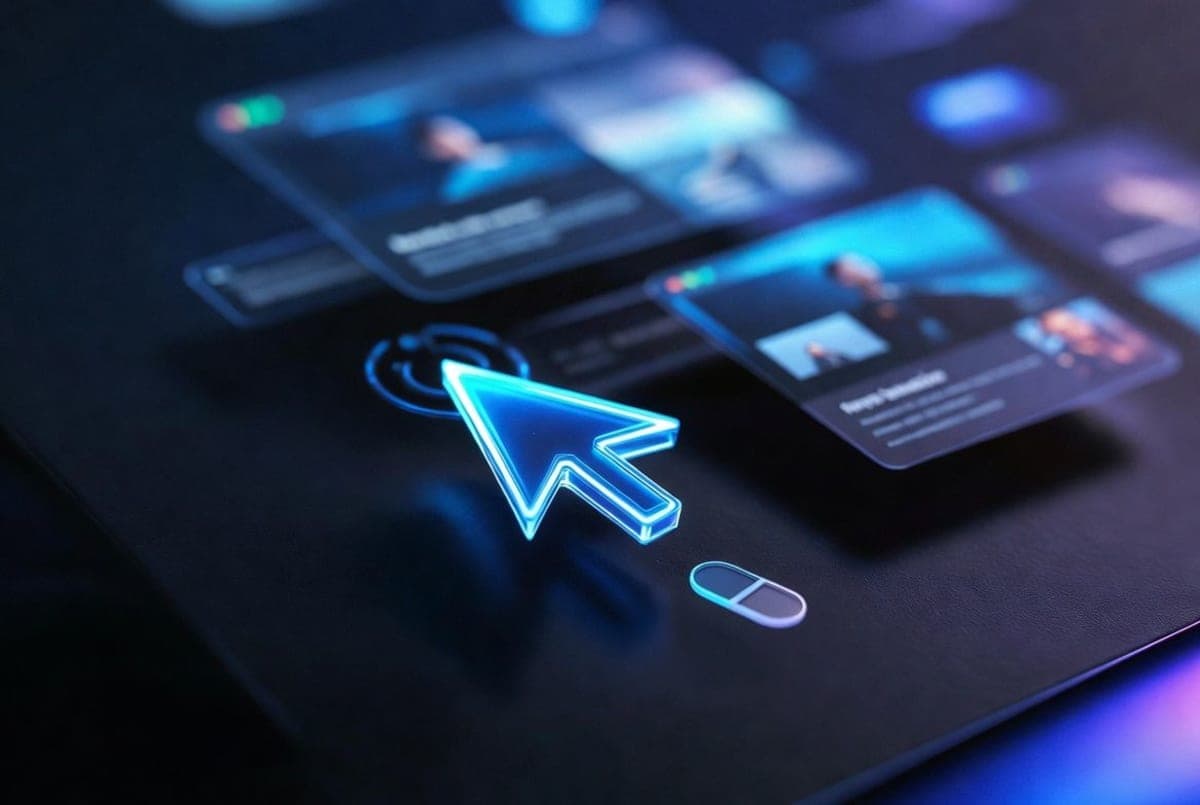
Google DeepMind on Tuesday published a blog post outlining an AI-enabled mouse pointer that captures the visual and semantic context around the cursor, letting users issue short voice commands like "fix this" or "move that here" without writing prompts. The feature is rolling out today inside Gemini in Chrome, with experimental demos available in Google AI Studio, and a version called Magic Pointer landing on Googlebook laptops this fall.
The pitch
The pointer has barely changed in over half a century, the DeepMind research blog argues, which is true if you ignore right-click, scroll wheels, trackpads, and multi-touch. Authors Adrien Baranes and Rob Marchant lay out four principles for what they call an AI-enabled pointer, but the core idea collapses to one thing: instead of writing a long prompt to describe what you're looking at, you point at it.
Hover over a table and ask for a pie chart. Highlight a recipe and say "double the ingredients." Point at a paragraph in a PDF and request a bullet summary you can paste into an email. The cursor becomes the context window, and short speech does the rest.
"Our goal is to address a common frustration: because a typical AI tool lives in its own window, users need to drag their world into it." That's DeepMind's framing, which doubles as a quiet admission that the chatbox-in-a-sidebar model isn't where Google wants to be.
What you can actually try
Two demos are live on AI Studio: one for image editing and one for finding places on a map, both driven by pointing plus voice. Inside Gemini in Chrome, you can select products on a webpage and ask Gemini to compare them, or point at a spot in a photo of your room and ask it to visualize a new couch there. Whether the comparison output is actually useful is a separate question, and one the blog post doesn't try to answer.
The real story is Googlebook
The pointer announcement is timed to a much bigger Google move. The same day, the company unveiled Googlebook, a new laptop category replacing Chromebook positioning, built around Gemini and shipping this fall from Acer, ASUS, Dell, HP, and Lenovo. Magic Pointer is its marquee software feature.
So this is more of a product launch in a research-blog wrapper than the other way around. Google needs an answer to Apple's on-device intelligence and Microsoft's Copilot+ PCs, and the answer it's settled on is a laptop where the operating system is the assistant and the cursor is the prompt. Whether anyone asked for that is the open question.
What's missing
The blog post offers no latency numbers, no accuracy benchmarks, and no detail on whether pointer context capture happens locally or in the cloud, which matters for both speed and privacy. A caption under the demo reel notes that video sequences are "shortened throughout," which is the kind of disclosure that usually means the unshortened version is slower.
Gemini in Chrome users get the pointer feature starting today. Googlebook hardware ships this fall.