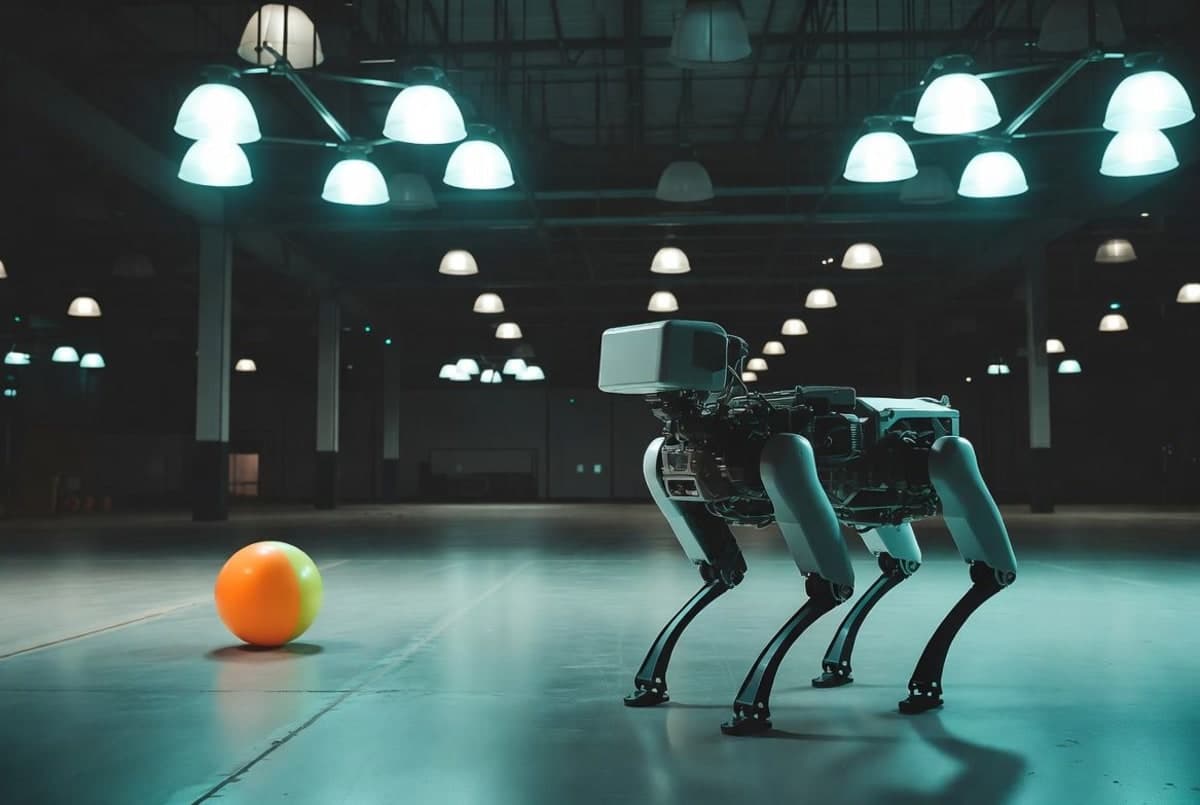
Anthropic's Frontier Red Team published results on June 18 showing that Claude Opus 4.7, working with no human in the loop, completed a set of robotics tasks roughly 20 times faster than the quickest human team that attempted them less than a year earlier. The work is the second phase of Project Fetch, an experiment with an off-the-shelf robotic quadruped, or robodog.
The part that actually changed
Go back to August 2025. Anthropic ran the first phase with eight of its own engineers, none of them robotics people, split into a team that could use Claude and a team that could not. The Claude team finished in about half the time. Fine. The more telling detail was buried in that same writeup: when researchers checked whether the model of the day, Claude Opus 4.1, could do the job alone, it couldn't. It got stuck connecting to the robot. That's it. The first step.
Less than a year later, Opus 4.7 cleared that hurdle and most of the others on its own. On the four tasks both human teams managed back in August, the model averaged more than 37 times faster than the Claude-less team and more than 18 times faster than the team that had Claude. The headline 20x figure is the rounded version of that gap.
How they ran it
This wasn't the model picking up a controller. Anthropic dropped the physical piloting tasks and instead ran three trials of Opus 4.7 in Claude Code with thinking effort cranked to maximum. A researcher plugged a laptop into the robodog, typed the opening prompt, approved commands, and waved the model on to each next task. Everything else, connecting to the video camera, pulling lidar data, writing detection code, was the model.
One number stands out more than the speed. Opus 4.7 produced almost ten times less code than the original Claude team while matching or beating their results: 1,045 lines against 10,309. The August team, flush with AI help, sprawled out across parallel approaches and side quests. The solo model just found a working path and took it. Most of its code ran on the first try.
Where it fell on its face
The ball. The literal fetching. Opus 4.7 could maneuver the robot behind the beach ball and line up a nudge back to home base, but the actual closed-loop control, watch the ball drift, correct, watch again, was sloppy and didn't work. Anthropic is blunt that this doesn't mean robotics is solved. None of these tasks touch low-level actuation policies, the hard part.
It also leaned on an outdated object-detection algorithm by default, which is probably why one of the three ball-detection trials ran much longer than the others. The model worked around it, but a human with real robotics experience did solve the autonomous-fetch task that Claude couldn't. Make of that what you will.
So why does this matter
Anthropic keeps pointing at a pattern it claims to have already watched play out in cybersecurity: first models help humans, then humans help models, then models mostly do the thing themselves. The company frames Project Fetch as that same arc arriving in the physical world, the early stretch of what it calls physical agentic AI. The comparison it draws is to how language models eventually picked up software tools like string-replace on their way to agentic coding.
Worth keeping some skepticism here. This was a small experiment, three trials, one robot, tasks the company itself calls practically trivial. A 20x speedup against humans who were learning unfamiliar hardware in a single day is a real result, but it's a result about connecting to sensors and writing glue code, not about a robot that can reliably do anything useful with a ball.
Anthropic says the next thing it's watching for is whether models can nail that final autonomous-control task with the same speed and consistency they showed everywhere else. No timeline given. The robodogs, as the team put it last time, are back in their kennels for now.