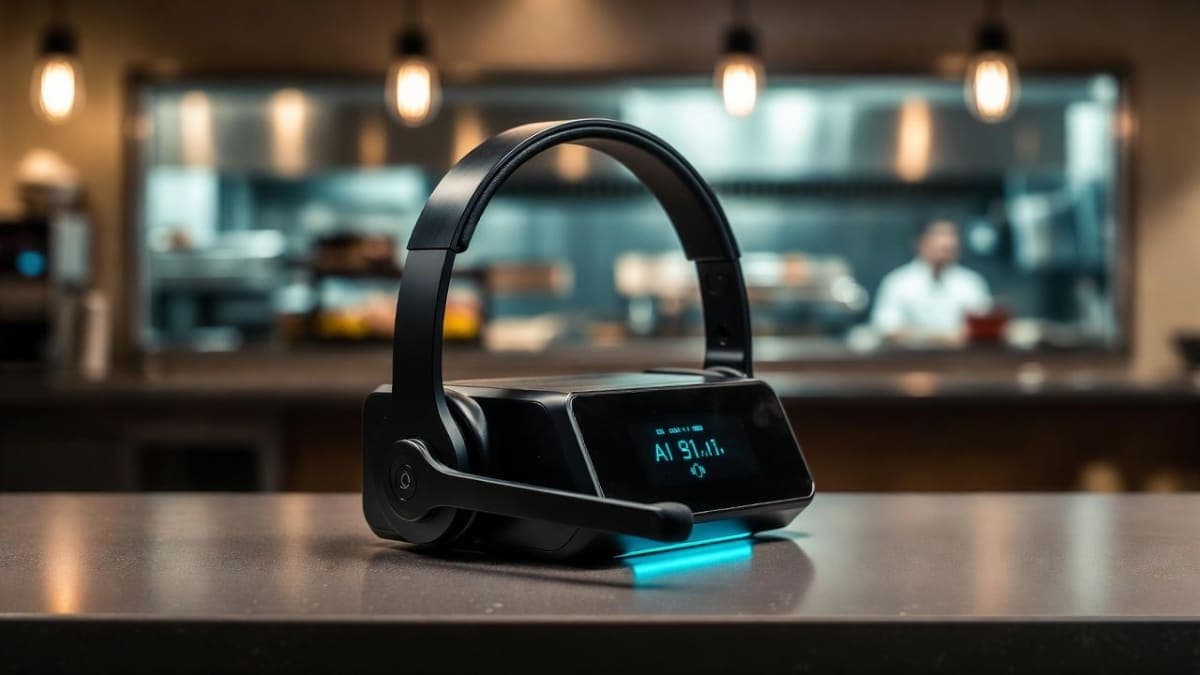
Burger King is testing an AI voice assistant that lives inside employee headsets and scores workers on friendliness. The system, called Patty, runs on an OpenAI base model and is currently active in 500 US restaurants, with plans to reach all roughly 6,600 domestic locations by the end of 2026. Parent company Restaurant Brands International announced the rollout on February 27.
The pitch from Burger King's executives is familiar: Patty helps with operations. Employees can ask it how many bacon strips go on a Whopper or how to clean the shake machine. When inventory runs low or equipment breaks, the system automatically pulls affected items from self-service kiosks and the mobile app within 15 minutes. All useful stuff, and if the story ended there, nobody would be writing about it.
The friendliness score
But Patty also listens to every drive-thru interaction from the moment a car pulls up until it drives away. The AI scans for keywords: "welcome to Burger King," "please," "thank you." Managers can then pull up friendliness metrics for a given shift or location.
"One of the ways that we started this was, you know, picking certain keywords," Thibault Roux, Burger King's chief digital officer, told The Verge. That qualifier, "one of the ways," is doing a lot of work. Roux also confirmed the company is iterating on capturing conversational tone, not just specific phrases. So the system that currently checks whether you said "thank you" will eventually judge how you said it.
Burger King insists none of this is punitive. "It's not about scoring individuals or enforcing scripts," the company said in a statement to the AP. "It's about reinforcing great hospitality and giving managers helpful, real-time insights so they can recognize their teams more effectively." Recognize could mean a lot of things. The statement also includes the line, "We believe hospitality is fundamentally human," which is a curious thing to say while deploying an algorithm to quantify it.
Where the data goes
As Privacy Guides noted, the system is cloud-based and powered by OpenAI, meaning employee microphone inputs are being sent to external servers for processing. There are no mentions of on-device processing, trusted execution environments, or any of the privacy protections you might expect when a company is recording its workers' speech in real time. Burger King hasn't publicly addressed what happens to the audio data after processing, how long it's retained, or whether employees can opt out.
That gap matters. Fast food workers, many of them young and hourly, are not typically in a position to push back on workplace surveillance. The company frames Patty as optional coaching, but a manager armed with shift-level friendliness data has a new tool for performance reviews whether the company intends that or not.
Fast food's mixed AI track record
Burger King isn't the first chain to try this. McDonald's tested automated drive-thru ordering with IBM and abandoned the partnership in 2024 after the system became something of a public joke. Wendy's and Taco Bell ran similar experiments with mixed results. Yum Brands, which owns KFC and Taco Bell, partnered with Nvidia in 2025 to build AI tools across its portfolio.
Burger King is also piloting AI-driven order-taking at about 100 locations separately from Patty. Roux acknowledged customer readiness is uneven: "Not every guest is ready for this."
The BK Assistant platform, which Patty sits on top of, connects drive-thru microphones, kitchen equipment, inventory systems, and point-of-sale terminals into one cloud-based layer. The web and app versions of BK Assistant are expected to reach all US restaurants by the end of 2026. Whether Patty's headset component expands at the same pace remains unclear.