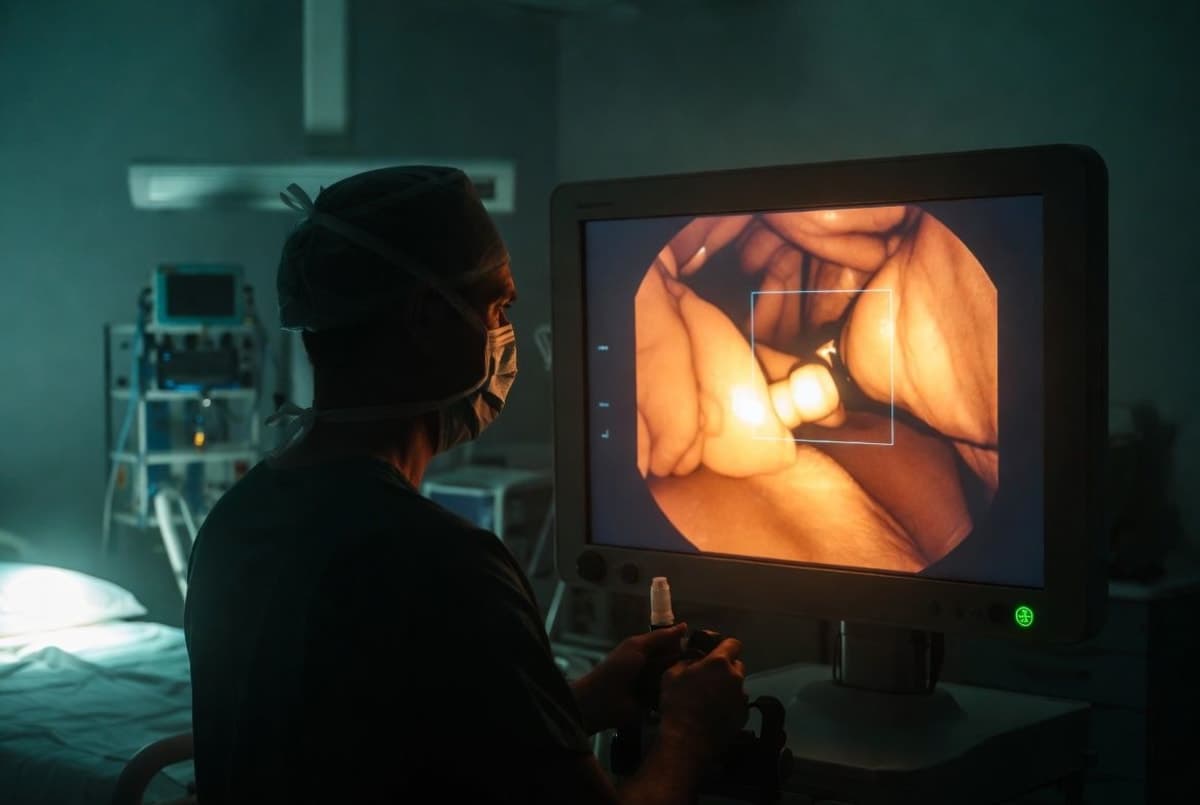
Doctors who got used to an AI assistant during colonoscopies got measurably worse at the procedure when the machine was switched off. That is the uncomfortable finding at the center of a Nature report published June 18, which pulls together early evidence that leaning on AI tools erodes the skills professionals spent years building.
The colonoscopy data comes from four endoscopy centers in Poland. Nineteen experienced specialists, each having done at least 2,000 colonoscopies, were given a real-time tool that flags adenomas, the precancerous lesions that colonoscopy exists to catch. The detection rate on standard, non-AI colonoscopies fell from 28.4% before the tool arrived to 22.4% after, according to the Lancet study. That is a six-point absolute drop, roughly a fifth of the original detection rate, gone.
What that number actually means
A caveat the cheerleaders skip: this was a retrospective, observational comparison of two three-month windows, not a clean before-and-after on the same patients. Plenty could shift over six months. But the authors looked for confounders and the effect held, and the direction is hard to explain away. These are not trainees. They are people who have done this thousands of times.
The study authors put it bluntly, writing that constant exposure to AI can leave clinicians "less motivated, less focused, and less responsible" when they have to decide without it. Co-author Yuichi Mori, at the University of Oslo, is more measured and says more studies are needed to confirm the pattern. He is right to hedge. One study at four centers is a signal, not a verdict. He also admits there is no fix yet, calling deskilling a problem the field will be chewing on for a decade.
The mechanism is the interesting part. A skill stays sharp through friction. You look, you doubt, you second-guess, you stay on the hook for the next call. Once a box lights up around the suspicious tissue, the eye stops hunting and starts confirming. The work quietly changes from finding to agreeing.
Coders, same story
Computer science shows the same shape. Researchers at Anthropic ran a controlled trial with 52 software engineers learning Trio, an asynchronous Python library none of them knew. Everyone could search the web; half also got an AI assistant. On a quiz covering code they had written minutes earlier, the AI group scored 17% lower, what the team frames as nearly two letter grades.
Speed barely moved. The AI group finished a little faster, but the gain did not clear statistical significance, per the arXiv preprint. So the headline trade looks less like "faster but dumber" and more like "about the same speed, and you understood less."
The split inside the AI group matters more than the average. Engineers who used the assistant to ask conceptual questions did fine. The ones who handed over code generation and waited for output did badly, with the steepest drops in debugging. Passive delegation is the part that hurts. Asking the machine "why" seems survivable; asking it to "just make it work" is where comprehension leaks out.
Worth flagging: this is a preprint, the sample is 52 mostly junior engineers, and the task ran minutes not months. Whether the gap matters six months into a real codebase is exactly what the study cannot tell you.
So what do you do about it
Not much, yet, if you want an evidence-backed answer. The honest read is that both fields just got their first hard data and neither has a remedy. The colonoscopy authors gesture at keeping clinicians engaged; the coding researchers point at active, question-driven use over blind delegation. Both are reasonable. Neither is tested.
The Anthropic preprint is public now for anyone who wants to poke at the methodology. The deskilling question is moving fast enough that the next round of studies, the ones that follow workers over months rather than minutes, are the ones to watch.