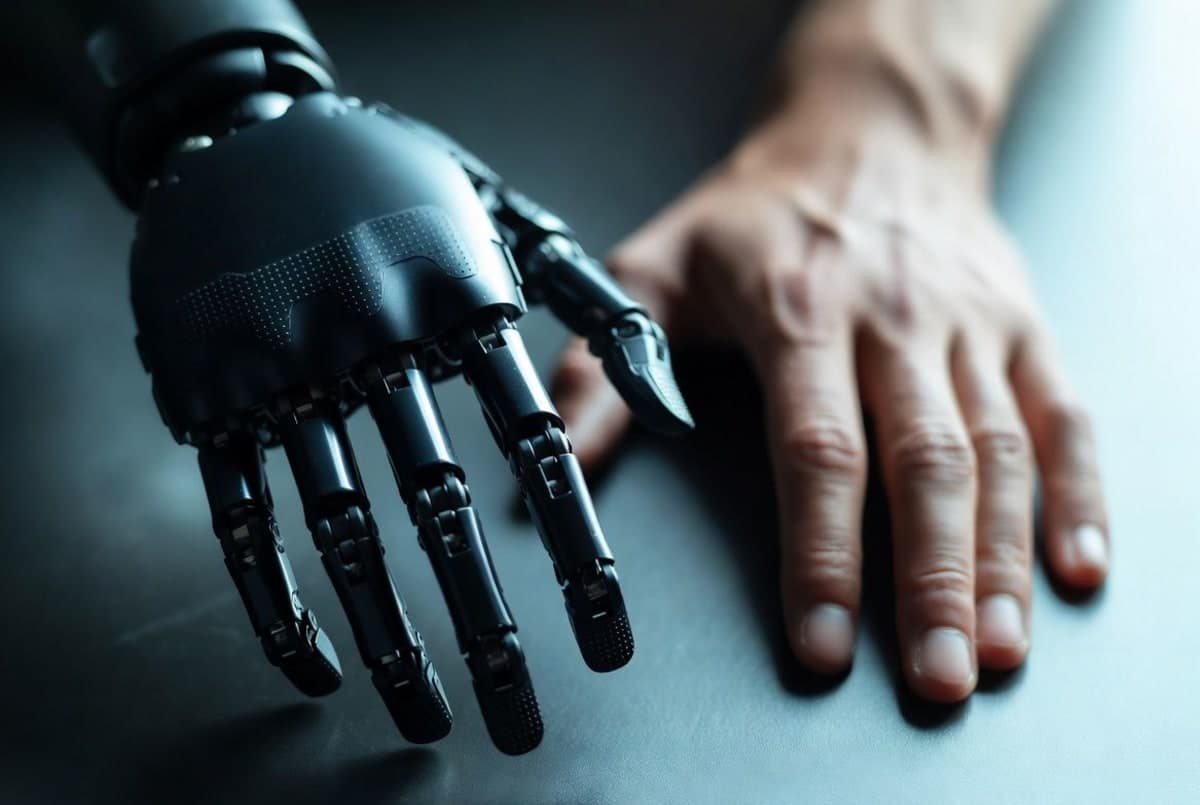
Xiaomi's robotics division posted a technical breakdown of a redesigned bionic hand for CyberOne, the humanoid robot it first showed in 2022. The hand is 60% smaller than the previous version, shrinking from 228x105x64mm to 187x88x36mm. That makes it roughly 1:1 with an adult human hand, and the sizing isn't cosmetic: when human operators teleoperate a robot for training data collection, mismatched proportions corrupt the dataset. Xiaomi calls this the "isomorphism problem" and says the new hand eliminates it.
Active degrees of freedom jumped 83% to between 22 and 27, approaching the range of a biological hand. Tactile sensor coverage now spans 8,200 square millimeters across the palm, finger pads, and phalanges. That density lets the robot manipulate objects by touch alone, without relying on vision. Xiaomi says it can tighten screws and hold a feather without crushing it. Training data comes from sensorized gloves worn by human operators, feeding directly into the company's TacRefineNet framework and its Xiaomi-Robotics-0 vision-language-action model.
The standout detail: bionic sweat glands. Micro-pumps push liquid through 3D-printed metal channels in the forearm, evaporating 0.5 ml of water per minute to dissipate around 10 watts of heat. It's the same principle as human perspiration, applied to prevent motor overheating during sustained gripping. Previous hand iterations failed before 10,000 grasping cycles. This one reportedly cleared 150,000.
Xiaomi disclosed earlier this month that CyberOne hit a 90.2% success rate installing nuts on its EV assembly line over three continuous hours. That's notable for a humanoid but far short of the 99%+ factories demand. The updated hand is designed to close that gap. CEO Lei Jun has said he expects humanoid robots deployed across Xiaomi's production lines within five years.
Bottom Line
The redesigned hand survived 150,000 grasping cycles (up from under 10,000) and uses evaporative cooling to sustain high-force grips in factory conditions.
Quick Facts
- Hand volume reduced 60%, now 187x88x36mm
- 22-27 active degrees of freedom (83% increase)
- 8,200 mm² tactile sensor coverage
- 150,000 grasping cycles durability (previous: under 10,000)
- Evaporative cooling dissipates ~10W via 0.5 ml/min water