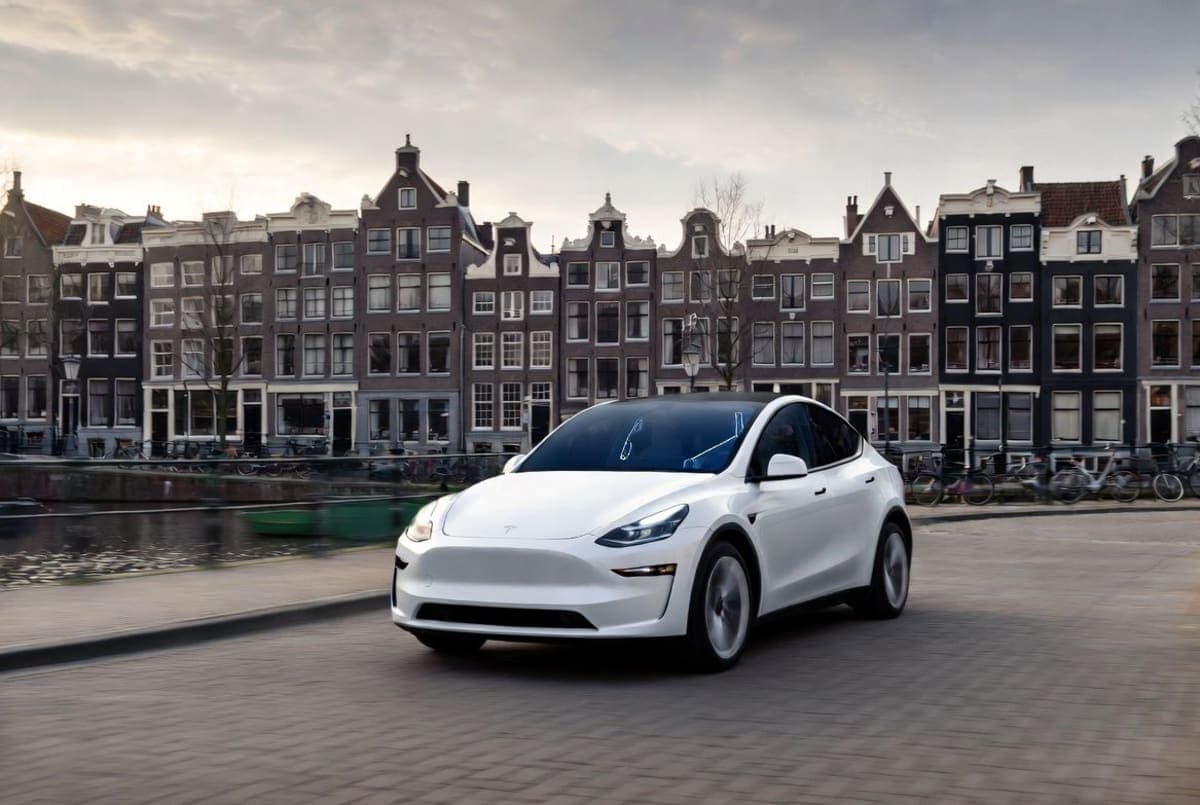
The Dutch vehicle authority RDW granted Tesla a type approval for FSD Supervised on April 10, making the Netherlands the first European country to let the system operate on public roads. The approval covers highways and city streets, came after more than 18 months of track and road testing, and is valid only in the Netherlands for now.
Within 24 hours, Tesla started pushing the software to Dutch owners with AI4 hardware via an over-the-air update. Fast, by any regulatory standard.
But the RDW's own statement spends more time explaining what FSD Supervised isn't than what it is. And that's where things get interesting.
Not self-driving. Not autonomous. Not even the same software.
The RDW was blunt: vehicles using FSD Supervised "are NOT autonomous or self-driving." Their caps, not mine. Drivers must keep their eyes on the road and hands available to grab the wheel at any moment. Reading a newspaper while driving? Explicitly prohibited. If the car detects the driver isn't paying attention, it escalates warnings and eventually locks FSD out temporarily.
This is UN Regulation No. 171 territory, the DCAS framework that governs Level 2 driver assistance systems. The same regulatory category as cruise control with lane keeping. The approval also relies on an Article 39 exemption under EU vehicle regulations, a workaround for technologies that don't fit neatly into existing rules.
And then there's the software itself. The RDW stated that the European FSD version "is NOT comparable" to what runs on American Teslas. Different software versions, different functionalities, built to satisfy different regulatory requirements. Europe demands pre-approval via type certification before anything touches public roads. The US lets Tesla self-certify and push OTA updates whenever it wants, with regulators checking in after the fact.
So what Dutch drivers are getting is functionally a different product wearing the same brand name.
"No other vehicle can do this"
Tesla Europe's announcement on X included the claim that "no other vehicle can do this." The RDW's own statement contradicts that in the next breath, noting that BMW already holds a European approval for motorway hands-off driving with lane changes, and Ford received European Commission approval for BlueCruise across 15 countries back in mid-2024.
There are real differences. Ford's BlueCruise only works on pre-mapped highway stretches called "Blue Zones." Tesla's system handles city streets, residential roads, roundabouts, traffic lights, the whole thing. That's a genuine capability gap. But framing a Level 2 driver-assist system as something no other vehicle can match, while ignoring that BMW and Ford already have hands-off approvals in Europe, is the kind of marketing that got Tesla into trouble with French regulators over misleading advertising.
The NHTSA problem
Here's the part that makes the timing awkward. Back in the US, the same FSD software stack is under three concurrent federal investigations. NHTSA opened a probe in October 2025 after identifying 58 incidents where FSD-equipped vehicles ran red lights, crossed into oncoming traffic, or entered wrong-way lanes. By December, the complaint count had climbed to 80.
That investigation has since been escalated to an Engineering Analysis, the step that typically precedes a recall, now covering roughly 3.2 million vehicles. The focus: whether FSD can safely handle reduced visibility conditions like fog and sun glare, after the agency identified crashes including one fatal pedestrian strike. Tesla has struggled to deliver the data NHTSA requested, securing two deadline extensions and at one point telling the agency it had 8,313 records requiring manual review and could only process about 300 per day.
The RDW would argue this is irrelevant. Different software, different regulatory regime, different testing. And they'd be right, technically. But it complicates the narrative that FSD is a mature, validated system ready for global deployment.
Why the Netherlands and not Norway?
This is the genuinely surprising part. Norway is Tesla's European stronghold. The company held a 19.1% market share there in 2025, roughly one in five new cars sold. The Model Y alone accounted for over 27,000 registrations, the highest single-model figure in Norwegian history. In March 2026, Tesla briefly captured over 50% of all Norwegian car sales.
But Norway isn't an EU member state. It's part of the European Economic Area, which means it often aligns with EU vehicle regulations but follows its own national procedures. The RDW's approval creates a pathway to EU-wide recognition through the European Commission, something a Norwegian approval couldn't do. Tesla picked the Netherlands strategically: the RDW is considered one of Europe's most technically rigorous vehicle authorities, and an approval there carries weight with other member states.
The UNECE's new draft regulation on automated driving systems, adopted in January 2026, also helped clear the way. It replaced prescriptive hardware requirements with a safety-case approach, giving Tesla's camera-only architecture a legal pathway that didn't exist before. That regulation is expected to be formally adopted in June 2026.
What happens next
The RDW plans to file with the European Commission for EU-wide recognition. All 27 member states would then vote on whether to accept it. Tesla says it expects approval by summer 2026. That's Tesla's projection, and the company has a documented history of announcing European approval timelines that regulators subsequently deny. In November 2025, Tesla's European social media account claimed the RDW had committed to a February 2026 approval date. The RDW publicly denied this and asked Tesla fans to stop calling their offices.
Germany's KBA, France, and Italy could move relatively quickly through national recognition, potentially within weeks. Smaller or more cautious member states might take months. And the EU-wide harmonization track, which would eliminate the need for country-by-country approval, depends on a European Commission vote that hasn't been scheduled yet.
For Dutch Tesla owners with AI4 hardware, FSD Supervised is already arriving. For everyone else in Europe, the wait continues, though the gap just got a lot narrower.