SpaceX announced that it has acquired xAI, creating a combined entity valued at $1.25 trillion. The deal, structured as a share exchange, values SpaceX at $1 trillion and xAI at $250 billion, according to CNBC, which reviewed the transaction documents.
Musk posted a memo on SpaceX's website calling the merged company "the most ambitious, vertically-integrated innovation engine on (and off) Earth." The stated goal: building data centers in orbit to power AI workloads using solar energy.
The orbital pitch
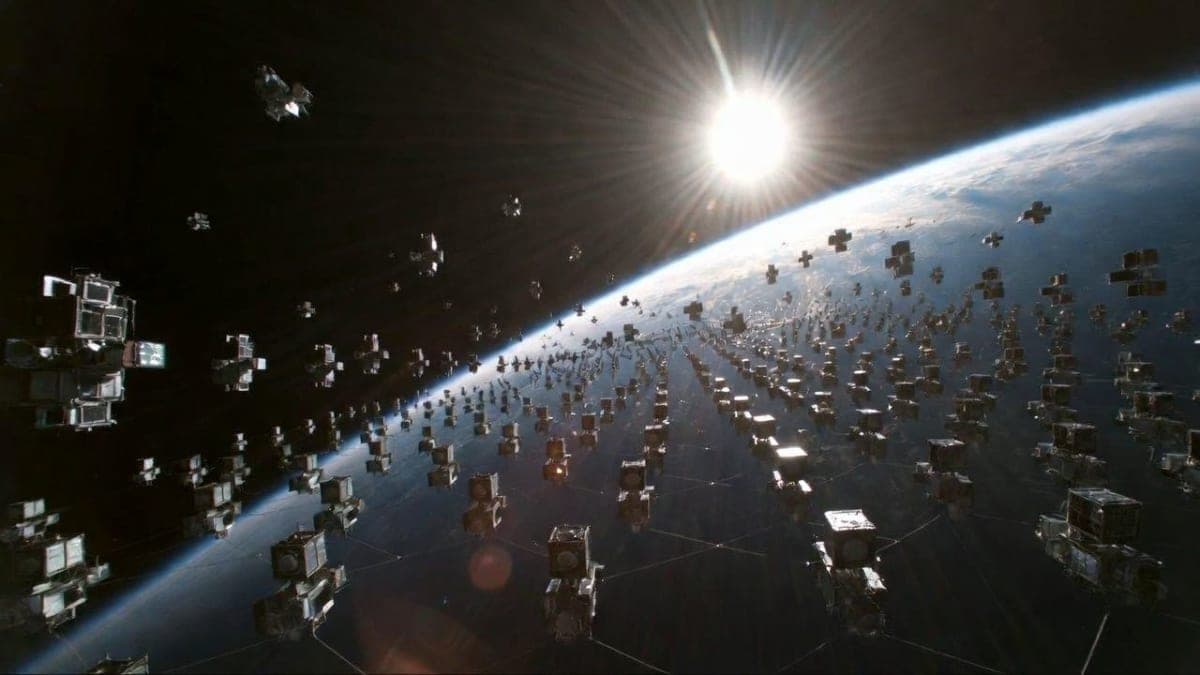
Three days before the merger announcement, SpaceX filed with the FCC for permission to launch up to one million satellites functioning as orbital data centers. The filing describes satellites operating between 500 and 2,000 kilometers altitude, designed to "directly harness near-constant solar power with little operating or maintenance costs."
"Launching a constellation of a million satellites that operate as orbital data centers is a first step towards becoming a Kardashev II-level civilization," the filing states. That's the kind of language that either excites or exhausts you, depending on your relationship with Musk's announcements.
The math Musk is selling: launch a million tons of satellites annually, each generating 100 kilowatts of compute power per ton, and you get 100 gigawatts of AI capacity per year "with minimal ongoing operational or maintenance needs." He's projecting that within two to three years, space-based compute will be the cheapest option available.
Industry analysts are skeptical. Kimberly Siversen Burke at Quilty Space told Via Satellite that orbital data centers "remain speculative" as a near-term revenue driver, citing unproven economics, hardware degradation, latency issues, and limited use cases.
What xAI actually needs
The orbital vision is years away. xAI's problems are immediate.
The company burned through $7.8 billion in cash in the first nine months of 2025, according to Bloomberg. That's roughly a billion dollars a month, spent building out infrastructure in Memphis and buying Nvidia chips while generating modest revenue. xAI's Q3 revenue hit $107 million, which sounds like progress until you remember the quarterly loss was $1.46 billion.
Tim Farrar at TMF Associates put it bluntly: the merger is about money. "People are throwing tens of billions of dollars at AI companies right now, and in six months or 12 months time, they might have changed their mind about it," he told CNBC. "Getting the money is feasible" now but may not be forever.
SpaceX, by contrast, generates real revenue. Around 80% comes from launching its own Starlink satellites, according to Reuters. The company was valued at $800 billion in a December secondary share sale and has been preparing for a potential IPO this June that could value it at $1.5 trillion, per the Financial Times.
The IPO question
SpaceX had reportedly been targeting a mid-June IPO, timed to coincide with Musk's birthday and a planetary alignment. The merger complicates that timeline.
The combined company would need to convince public investors that the AI cash furnace and the space data center vision are worth the premium. Some investors are apparently nervous. A PitchBook analyst told Axios that while some see a strategic platform play, others are thinking "Hmmm."
"If it was a clean SpaceX IPO, everyone is super stoked," one investor told Axios. "If it's a multimerger combination of companies, they're curious and eager and mostly trust Musk, but they're like 'Hmmm.'"
What's actually included
The deal brings together:
SpaceX: Falcon 9, Starship, Starlink (around 9 million subscribers, 9,000+ satellites in orbit), and substantial NASA and Department of Defense contracts.
xAI: The Grok chatbot, a 200,000-GPU data center in Memphis, and X (the social platform formerly known as Twitter, which xAI acquired last year for $33 billion in an all-stock deal).
So Grok, Twitter, Starlink, and the rockets that might someday carry data centers to orbit are now one company. Gwynne Shotwell, SpaceX's longtime president and COO, will presumably help manage this sprawl.
Tesla and SpaceX have already invested $2 billion each in xAI. Tesla also sold $430 million worth of Megapack batteries to xAI in 2025 to power the Memphis data center. Whether Tesla eventually folds into this structure remains an open question. Bloomberg reported that SpaceX considered a Tesla merger as an alternative to the xAI deal, with some investors pushing for it.
The pattern
This isn't the first time Musk has arranged a merger between his own companies to rescue one that's losing money. In 2016, Tesla acquired SolarCity, his cousins' debt-laden solar company, in a $2.6 billion deal that drew shareholder lawsuits and legal scrutiny.
The difference now is scale. And the regulatory environment has shifted. FTC Chair Andrew Ferguson replaced Lina Khan, who was known for blocking big tech deals. NASA administrator Jared Isaacman, who took over in January, previously flew on SpaceX missions and has supported expanding the agency's contracts with the company.
SpaceX's FCC filing for the million-satellite constellation requested waivers from standard deployment milestones. The company wants to skip the typical requirement that half of a constellation be deployed within six years.
The IPO, if it happens, would be the largest in history. The orbital data centers, if they work, would reshape how AI infrastructure operates. The xAI acquisition, for now, keeps the AI company funded while Musk figures out which of his visions he can actually execute.