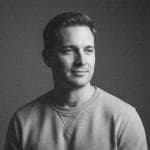
Sid Sijbrandij got diagnosed with osteosarcoma in November 2022. A six-centimeter tumor growing out of the T5 vertebra in his upper spine, rare for a 45-year-old, and the kind of news that rearranges everything. Surgery removed the cancerous vertebra and fused his spine with titanium. Then came radiation and chemotherapy so aggressive he needed four blood transfusions to survive it.
The cancer came back in 2024 anyway.
His doctors' message, as Sijbrandij later recounted to journalist Elliot Hershberg, amounted to: you've exhausted the standard of care, maybe there's a trial somewhere, good luck. For the co-founder of a $6 billion public software company, a man who'd built GitLab from a Dutch home office into one of the largest fully remote organizations in the world, this was not an acceptable answer.
The engineering reflex
What Sijbrandij did next reads like a startup playbook applied to oncology. He stepped down as GitLab CEO in December 2024, handing the role to Bill Staples, and redirected his time and money toward keeping himself alive. He assembled what Hershberg calls a "SWAT team" of concierge medical services, scientific advisors, and computational biologists. He recruited Jacob Stern, a former director at 10x Genomics, to essentially become the CEO of his care.
And he started treating his body like a codebase.
The framework boils down to three principles. First, what Sijbrandij calls "maximal diagnostics," which means running every available test as frequently as possible: single-cell RNA sequencing, bulk DNA and RNA sequencing, circulating tumor DNA tests from multiple providers, organoid cultures grown from his own cancer cells, and pathology stains to confirm the genomic findings in actual tissue. Second, developing ten or more personalized treatments in parallel, ranging from repurposed drugs to therapies designed from scratch for his specific tumor biology. Third, testing these in parallel rather than the standard sequential approach, iterating quickly and measuring response with diagnostics rather than waiting for the cancer to progress before trying something new.
The 1,000-plus page Google Doc tracking his medical interactions in 2025 alone, which he calls "Sid Health Notes," has a familiar feel. GitLab's internal handbook, maintained through the company's own version control system, runs over 3,000 pages. The man likes documentation.
Where does AI actually fit?
Here's where I want to pump the brakes slightly on the narrative. The social media version of this story, the one making the rounds, tends to collapse into "billionaire uses AI to cure his cancer." That's not quite right, and Sijbrandij himself seems careful about the distinction.
AI served as a tool within a much larger operation. According to his OpenAI Forum talk in March 2026, he used ChatGPT to help track and interpret his health data, feeding it scans, blood tests, and tissue sample results. The AI helped him build what the OpenAI event description calls "a personal research and development loop" to connect dots, spot changes, and surface relevant literature. It let him ask sharper questions of his medical team and coordinate care across a sprawling network of hospitals, researchers, and biotech companies across multiple countries.
But the thing that actually shrank his tumor? That was a radioligand therapy he flew to Germany to receive, an experimental treatment targeting FAP, a fibroblast-related gene his single-cell sequencing data had flagged as overexpressed. The targeting compound first delivered a diagnostic payload (his tumor lit up on imaging), then a therapeutic one using Lutetium-177, the same warhead found in approved radiotherapies like Pluvicto. He was quarantined for two days afterward and had to collect his urine for two weeks as the isotopes flushed out.
The radiotherapy worked well enough that the tumor became surgically operable again. And here's the number that caught my attention: when his cancer recurred, only 19% of infiltrating immune cells were T cells. After the combined assault of radiotherapy, a checkpoint inhibitor, a neoantigen peptide vaccine, and an oncolytic virus, that number jumped to 89%.
The money question
Sijbrandij is a billionaire. He co-founded a company that IPO'd on the NASDAQ in October 2021. He can afford to hire computational biologists, fly to Germany for experimental treatments, assemble scientific advisory boards, and file individual patient IND applications with the FDA (five so far, all approved within 48 hours, according to Hershberg's reporting).
He has started a venture called Even One Ventures to try scaling this approach for others, and he's published his diagnostic data (including 25TB of Google Cloud buckets) at osteosarc.com, true to his "radical transparency" ethos. The gesture is genuine. But I'm not sure how many cancer patients have the bandwidth to parse single-cell RNA sequencing data, even if it's freely available.
Hershberg draws a comparison to Magic Johnson's HIV treatment in the early 1990s, which was exceptional at the time but foreshadowed therapies that eventually became widely available. Maybe. The personalized neoantigen vaccine Sijbrandij is now taking (an mRNA-based therapy customized to his tumor's specific antigens) does resemble the approach Moderna published strong clinical results for in melanoma. And the FDA has been signaling openness to new regulatory pathways for personalized therapies, including the "plausible mechanism pathway" proposed after the first personalized CRISPR therapy was administered to an infant in Philadelphia in mid-2025.
But the gap between "possible" and "accessible" is measured in dollars right now, not years. Sijbrandij himself puts it bluntly: it costs $1 billion to get a drug approved, but $1 million to dose a single person with a personalized therapy. That ratio keeps getting worse.
What he's doing with the rest of his time
Somehow, while orchestrating all of this, Sijbrandij co-founded Kilo Code, an open-source AI coding agent that raised $8 million in seed funding in December 2025 and has since crossed 750,000 downloads. He still runs Open Core Ventures and the Sijbrandij Foundation. He travels with his wife Karen.
"He says he's working part-time, but there are messages and thoughts and ideas that come out 24/7," Kilo CEO Scott Breitenother told AI Native Dev. "His definition of part-time, and a normal human's definition of part-time, is very different."
His cancer is currently undetectable. His motto is "Stay Paranoid." He has backup therapies ready, including personalized cell-based treatments equipped with genetic logic gates, in case it returns. He wants every detail public. He wants other patients to follow this path.
Whether most of them can is the harder question, and it's one that Sijbrandij's radical transparency, for all its admirable openness, can't fully answer. The regulatory maze he describes, the hospitals that won't release tissue samples, the IRB "vetocracy" that blocks experimental treatments, those barriers exist independently of AI or money. They're structural, and they've been killing patients for decades.
Sijbrandij's remission is real. The science behind it is real. The systemic change required to make any of this available beyond a handful of wealthy, technically literate, extremely determined patients? That part's still just a pitch deck.