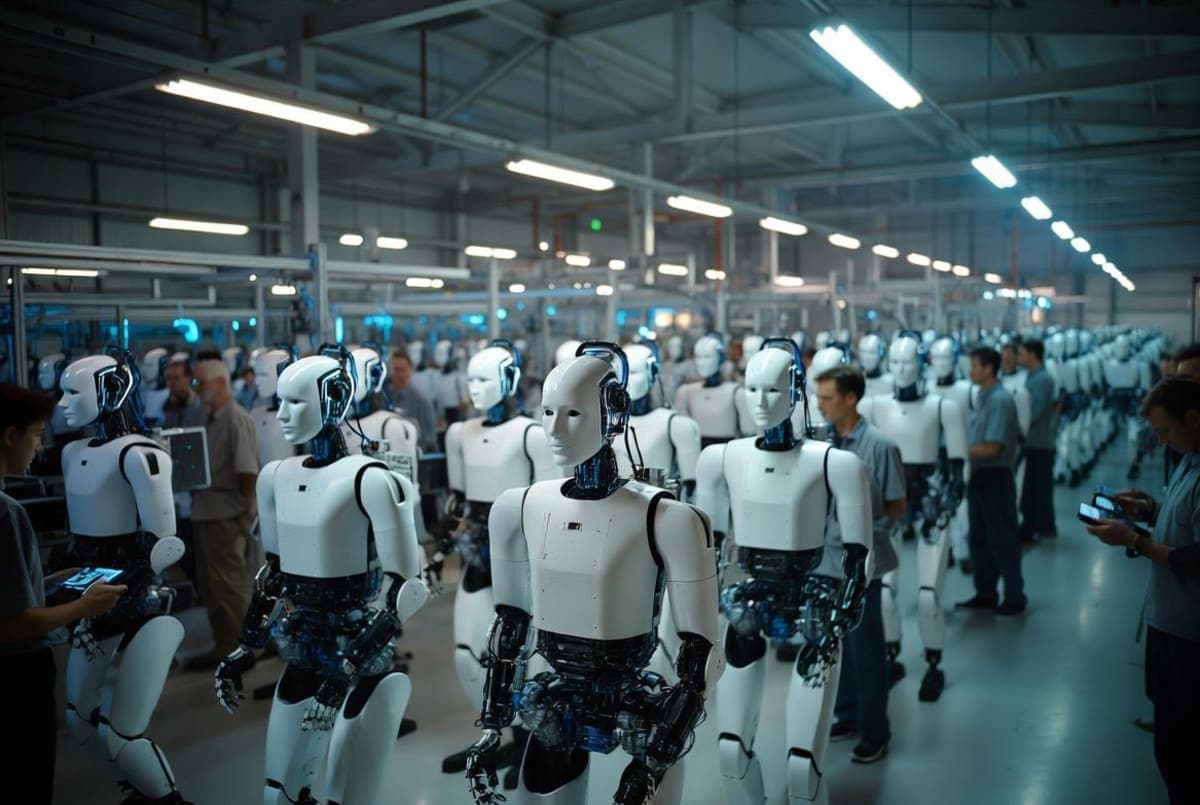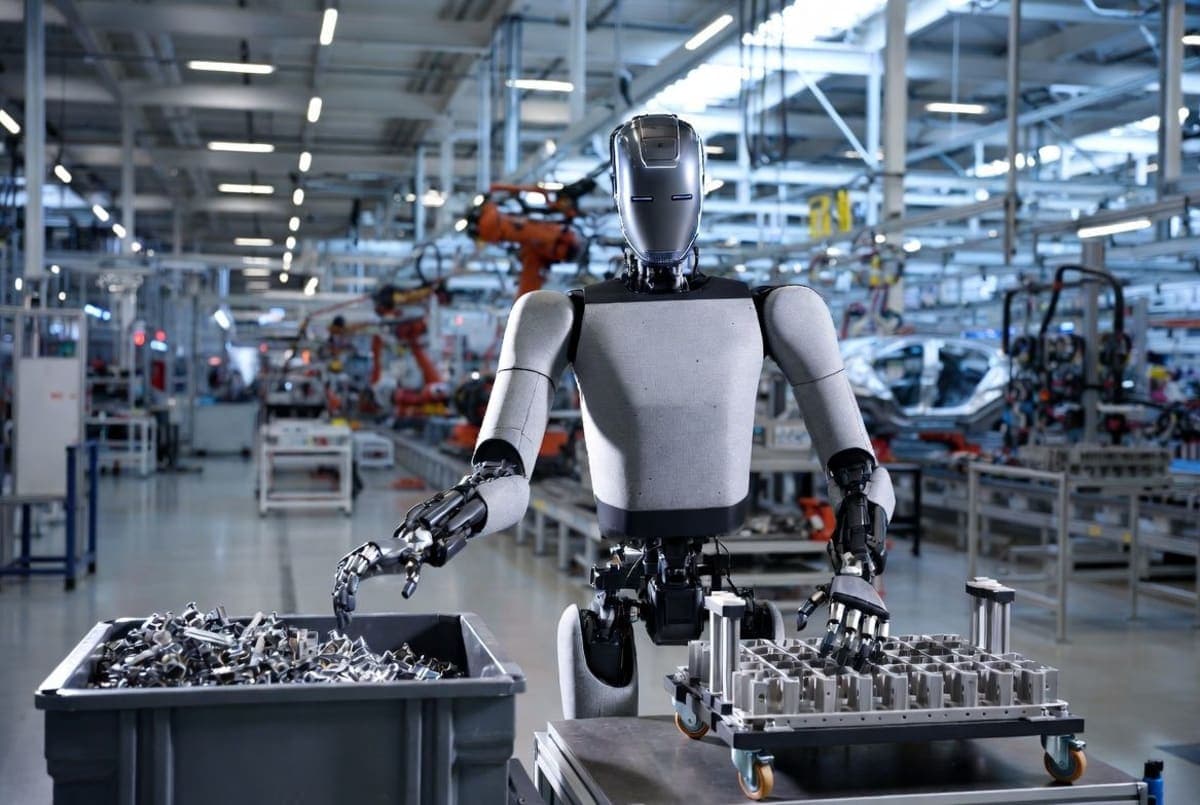
Something shifted in 2025. Not the breathless kind of shift that venture capital decks love to proclaim, but something more prosaic and therefore more interesting: robots started showing up to work. Amazon crossed a million deployed units in its warehouses. Waymo's ghostly Jaguars began cruising freeways at 65 mph. A Norwegian startup opened preorders for a home humanoid that costs less than a used Camry. And in China, a robotics company started selling humanoids for under $6,000.
The numbers tell one story. The reality on factory floors and public roads tells another, messier one. Both are worth examining.
The valuation explosion nobody can explain
Figure AI's September funding round landed like a depth charge in the startup world. The company, barely three years old, secured over $1 billion at a $39 billion valuation, making it one of the most valuable private companies in existence. That's a fifteen-fold increase from its $2.6 billion valuation just a year earlier. Parkway Venture Capital led the round, with Nvidia, Intel Capital, and Brookfield Asset Management piling in.
The bet is straightforward enough to articulate. Figure believes humanoid robots will eventually handle physical labor in factories, warehouses, and homes. So does everyone else racing in this space, which is why cumulative funding since 2017 has reached $9.8 billion, according to Yole Group. But Figure's valuation suggests investors think it has cracked something its competitors haven't.
What exactly? The company points to Helix, its proprietary vision-language-action model that can supposedly teach robots to interact with unfamiliar objects without manual programming. CEO Brett Adcock has been vocal about Figure exiting its collaboration with OpenAI earlier this year, claiming the company's AI is now built entirely in-house. Whether that's a competitive advantage or a risky bet on unproven technology depends on whom you ask.
The skeptic's case isn't hard to construct. Rodney Brooks, who founded iRobot and knows something about shipping actual robots, predicted in his 2025 forecasts that "we are a long way off from being able to for-real deploy humanoid robots which have even minimal performance to be usable." Deployment at scale, he noted, always takes longer than anyone imagines. Figure's robots are testing at BMW's Spartanburg plant, but that's a pilot program, not a production line.
China's price war begins
While American startups chase multi-billion-dollar valuations, Chinese manufacturers are doing something more disruptive: they're making humanoids cheap.
Unitree Robotics unveiled its R1 humanoid in July at a starting price of $5,900. That's not a typo. The 55-pound robot features 26 joints, runs on multimodal AI for voice and image interaction, and can perform cartwheels and handstands. TIME named it one of the best inventions of 2025.
The R1 lacks hands, which limits its practical utility, but that's somewhat beside the point. At less than a third of Tesla's projected Optimus pricing (which Musk has said could reach under $20,000 only at massive scale), Unitree is democratizing access to humanoid hardware. Developers and researchers who couldn't afford $50,000 platforms now have options.
Unitree's manufacturing economics tell part of the story. Goldman Sachs reported that humanoid manufacturing costs declined 40% year-over-year, far exceeding the 15-20% annual decline analysts had expected. Current production costs range from $30,000 to $150,000 depending on configuration. At scale, the floor keeps dropping.
The Chinese government is accelerating this trend. Beijing's March 2025 Government Work Report explicitly identified embodied AI as a core investment priority alongside quantum technology and 6G. The Ministry of Industry and Information Technology's plan calls for mass production of humanoids by 2025 and global supply chain dominance by 2027. China recorded over 610 robotics investment deals in the first nine months of 2025 alone.
This isn't just industrial policy as usual. Galbot, a Shanghai-based company that partners with CATL, Bosch, Toyota, and Hyundai for factory deployments, raised $300 million in December at a $3 billion valuation. UBTECH secured a $1 billion strategic financing facility. The capital is flowing, and the deployment timelines keep compressing.
When autonomy hit the highway
Waymo's November expansion to freeway driving marked a milestone that the company had been inching toward for over a decade. Its robotaxis now cruise U.S. 101 in the Bay Area, Interstate 10 in Phoenix, and various Los Angeles freeways, with speeds up to the posted limit.
The expansion coincided with a geographic land grab. Waymo ended 2025 operating in five U.S. markets (up from three at the end of 2024) and announced plans for eleven more cities in 2026, including Dallas, Detroit, Miami, and its first overseas market: London. The company crossed 450,000 weekly paid rides and logged over 100 million driverless miles on public roads.
But the freeway milestone was more technically significant than the expansion announcements suggest. Principal software engineer Pierre Kreitmann noted that critical events happen less often on freeways, which paradoxically makes them harder to validate. Rare scenarios, like high-speed merges or vehicles flipping over, occur too infrequently to gather sufficient training data from public roads alone. Waymo leaned heavily on closed-course testing and simulation to bridge the gap.
The safety record has been largely clean, though not perfect. A Waymo hit and killed a locally known bodega cat in San Francisco in October. Another vehicle drove through an active police standoff in Los Angeles. And in December, the company issued a software recall after Texas officials reported that robotaxis illegally passed school buses at least 19 times since the school year started.
Tesla's ghostly experiment
Tesla's robotaxi program in Austin operated in a different register entirely. The company began testing Model Y vehicles with no occupants in mid-December, a step that CEO Elon Musk had been promising would come "in three weeks" for months.
By the end of December, Tesla was offering unsupervised rides to select passengers, though the fleet remained tiny, with about 25 to 30 vehicles by most counts. Musk had claimed in July that Tesla's robotaxi service would cover "half of the population of the U.S." by year's end. That target quietly revised down to roughly doubling the Austin fleet to around 60 vehicles.
Tesla reported seven collisions in its Austin robotaxi fleet as of mid-October, though the company declined to include narrative descriptions in its NHTSA filings, making it impossible to assess severity. The company hasn't applied for permits to conduct driverless testing in California, where Waymo already operates at scale.
The toaster that finally arrived
Amazon's Zoox launched public robotaxi rides in Las Vegas in September, offering free trips on the Strip using its distinctive, purpose-built autonomous vehicle. Unlike Waymo and Tesla, which retrofitted existing car designs, Zoox built its vehicle from scratch: no steering wheel, no pedals, bidirectional wheels, and carriage-style seating for four passengers.
The robot looks like a toaster on wheels, which is exactly the point. "You can shoehorn a robotaxi into something that used to be a car. It's just not an ideal solution," co-founder Jesse Levinson told CNBC. Zoox expects to start charging for rides in Las Vegas in early 2026, pending regulatory approval, and has opened a waitlist for San Francisco.
The Las Vegas deployment covers the Strip and surrounding areas, with pickups limited to designated locations like Resorts World, Luxor, and Topgolf. It's more limited than Waymo's anywhere-to-anywhere service, but Zoox is betting that its purpose-built approach will prove more economical and rider-friendly at scale.
A million robots in the warehouse
While humanoids grabbed headlines, the quieter revolution happened on warehouse floors. Amazon announced in October that it had deployed its one millionth robot, a figure that approaches its roughly 1.2 million warehouse workers. Three-quarters of Amazon's global deliveries now involve robotic assistance of some kind.
The robots range from simple guided carts to sophisticated systems like Vulcan, which uses force sensors and AI to handle items with a sense of touch, and Proteus, a fully autonomous mobile robot that navigates open warehouse areas alongside human workers. Amazon also released DeepFleet, a generative AI model that coordinates robot movements across fulfillment centers, improving fleet efficiency by 10%.
The deployment economics are stark. At Amazon's Shreveport facility, equipped with next-generation robotics, package processing speeds run 25% faster than older sites. The average number of workers per fulfillment center has dropped to 670, the lowest in 16 years. Packages handled per worker have surged from 175 in 2016 to 3,870 in 2025.
Amazon claims automation complements rather than replaces human labor, pointing to 700,000 employees retrained for robotics-adjacent roles. Whether that holds as the robot fleet approaches parity with the human workforce remains an open question.
The home humanoid arrives
1X Technologies opened preorders in October for NEO, priced at $20,000 and positioned as "the world's first consumer-ready humanoid robot designed to transform life at home." The 66-pound robot can lift 154 pounds, fold laundry, organize shelves, and respond to voice commands via an integrated large language model.
There's a catch, naturally. For chores NEO doesn't know how to perform, owners can schedule a "1X Expert" to remotely guide the robot through unknown tasks. Human teleoperators can view through the robot's cameras, a privacy consideration that may give potential buyers pause. The company plans to deploy a limited number of units in homes for research before scaling to broader sales in 2026.
Two weeks after the preorder launch, 1X announced a partnership with EQT, the Swedish private equity giant, to potentially deploy up to 10,000 NEO robots across EQT's 300-plus portfolio companies between 2026 and 2030. The pivot from home use to industrial applications was jarring but perhaps inevitable. Consumer humanoids remain a hard sell; logistics and manufacturing are easier.
China's robotaxi ambitions go global
Chinese autonomous vehicle companies spent 2025 aggressively expanding beyond their home market. Baidu's Apollo Go service, which has completed over 17 million rides across 15 Chinese cities, struck partnerships with both Uber and Lyft for international deployments.
The Uber deal will bring thousands of Baidu's sixth-generation robotaxis to markets in Asia and the Middle East, with initial deployments expected in late 2025. The Lyft partnership targets Europe, with trials planned for Germany and the UK by 2026. Apollo Go has already launched in Dubai and Abu Dhabi and is planning an expansion to Switzerland.
The scale of China's domestic operations is striking. Baidu reported 250,000 fully driverless weekly rides as of late October, matching Waymo's disclosed figures from earlier in the year. The company says it has achieved per-vehicle profitability in Wuhan, where it operates over 1,000 vehicles.
This matters because profitability has remained elusive for the entire robotaxi industry. If Baidu's unit economics hold up in international markets with different labor costs and regulatory requirements, the competitive dynamics could shift dramatically.
What actually changed
The 2025 numbers are impressive: $39 billion valuations, million-robot fleets, $5,900 humanoids. But the more interesting question is what changed in practice rather than on paper.
Three developments stand out. First, robotaxis crossed the freeway threshold, which removes one of the biggest friction points for widespread adoption. A ride-hailing service that avoids highways can't serve airports efficiently or compete on longer urban routes. Waymo's freeway expansion makes it a legitimate alternative to human-driven services in a way it wasn't before.
Second, humanoid pricing collapsed faster than anyone expected. Goldman Sachs had forecast 15-20% annual cost declines; the actual figure was 40%. Unitree's $5,900 R1 may lack hands and practical utility today, but it establishes a price floor that will pull the entire industry downward.
Third, deployment actually happened. Not everywhere, not at the scale the hype cycle promised, but in enough places to generate real-world data and real-world failures. Waymo's school bus incidents, Tesla's crash reports, and Amazon's workforce displacement all provide information that press releases and pilot programs cannot.
The skeptics remain skeptical, and for good reason. Rodney Brooks' observation about deployment timelines applies to everyone in this space. Figure's $39 billion valuation is a bet on a future that hasn't arrived yet. Tesla's robotaxi ambitions have consistently outrun its capabilities. And the home humanoid market may not exist in any meaningful sense for years.
But the machinery of robotics is now in motion at industrial scale. Amazon has a million robots. Waymo has a quarter million rides per week. Chinese manufacturers are cranking out humanoids like smartphones. What happens next depends less on breakthroughs than on the grinding work of deployment, regulation, and customer adoption.
The robots are no longer coming. They're here. The question is what we do with them.