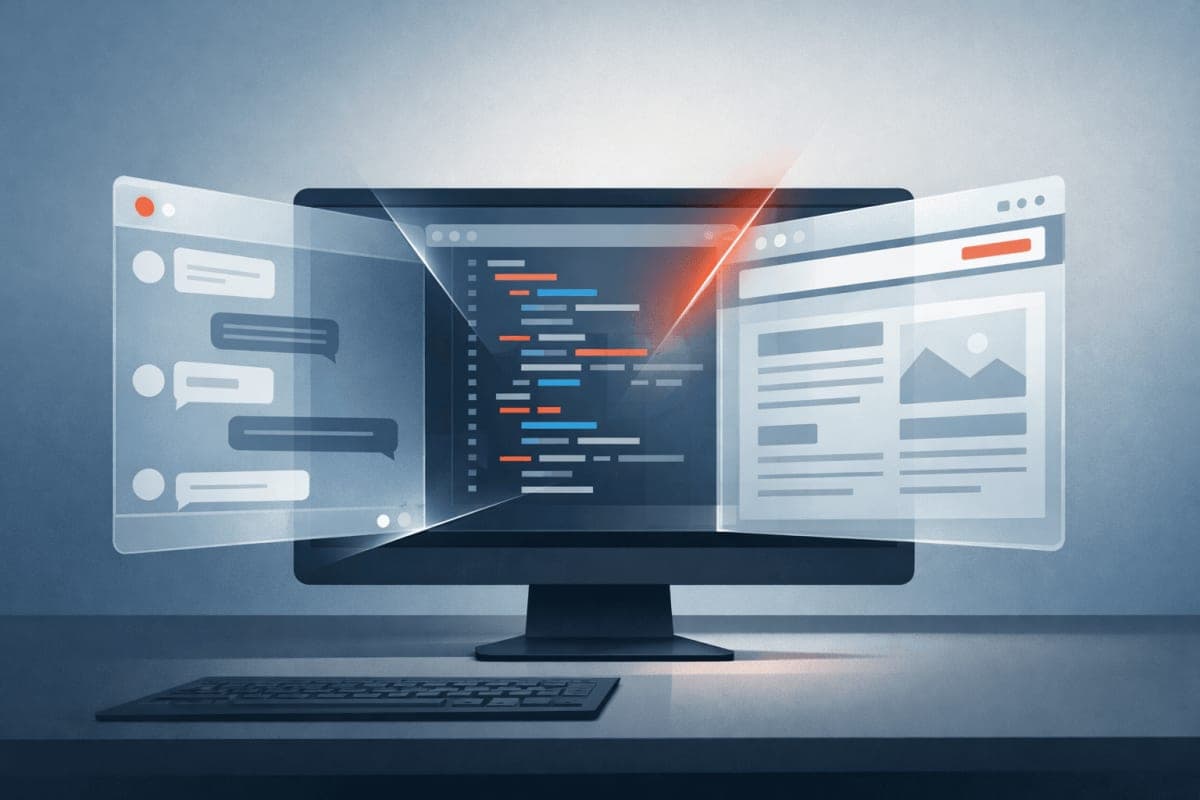
OpenAI confirmed on Thursday that it is folding its ChatGPT desktop app, the Codex coding platform, and its Atlas browser into a single desktop application. The company is calling it a "superapp." Internally, they're calling it a code red.
The Wall Street Journal reported the move on March 19, citing an internal memo from Fidji Simo, OpenAI's CEO of Applications. Simo, who previously ran Instacart, didn't mince words with employees: the company had been spreading itself across too many apps and stacks, and that fragmentation was costing them quality. Greg Brockman, the company's president, will temporarily oversee the technical restructuring while Simo handles sales and distribution for the new product.
The mobile ChatGPT app stays unchanged. This is a desktop-only play, at least for now.
The Anthropic problem
Strip away the product-simplification framing and this is a competitive reaction. Simo told employees at an all-hands meeting that Anthropic's rise was a "wake-up call" and warned them not to get distracted by "side quests." That last phrase stings a bit, given that OpenAI spent much of 2025 launching Sora, acquiring Jony Ive's hardware company, and shipping standalone desktop apps that apparently nobody at the company thinks worked well enough.
The numbers back up the urgency. Anthropic's annualized revenue sat at around $9 billion at the end of 2025 and had reportedly approached $20 billion by early March. Claude Code alone hit $2.5 billion in annualized revenue by February 2026, more than doubling since the start of the year. For a product that launched publicly in mid-2025, that trajectory is hard to dismiss.
And here's the part that probably keeps Sam Altman up at night: OpenAI's share of enterprise AI spending fell from roughly 50% to about 27% over the past year, according to the Journal's reporting. Anthropic's share climbed to 40% over the same stretch. OpenAI still dominates consumer AI with 800-plus million weekly ChatGPT users, but consumer scale hasn't translated into enterprise revenue the way the company needs it to.
What actually gets merged
The three products going into the blender each arrived separately over the past several months. ChatGPT Atlas, an AI-native browser with a built-in sidebar and agent mode, launched for macOS in October 2025. The dedicated Codex app followed on February 2, 2026, positioning itself as a multi-agent command center for developers with Git worktree support. The rationale for running three separate desktop products was never obvious to users, and apparently it wasn't obvious to OpenAI's own teams either.
The consolidation will happen in stages. First, OpenAI plans to expand Codex's capabilities beyond coding into broader productivity tasks. Then ChatGPT and the Atlas browser get folded in. Simo framed this as pairing "the strongest AI consumer app and brand with the strongest agentic app" to bring agentic capabilities to a wider audience. The pitch makes sense on paper. Whether it produces a coherent product or just a bloated one is another question entirely.
The Astral play
On the same day as the superapp announcement, OpenAI also revealed its acquisition of Astral, the startup behind widely-used Python developer tools uv, Ruff, and ty. The Astral team will join Codex after the deal closes. It is a pretty transparent move: Anthropic acquired Bun, the JavaScript runtime, back in December 2025. Both companies are now buying up developer infrastructure to lock in their coding platforms.
Codex has over 2 million weekly active users and has seen 3x user growth since January, according to OpenAI. Those aren't bad numbers. But Claude Code's revenue growth makes Codex look like it is playing catch-up, and the Astral acquisition reads like an attempt to make the Codex ecosystem stickier before developers settle into Anthropic's toolchain permanently.
Does consolidation fix the problem?
Superapps have a mixed track record in Western markets. WeChat made the concept work in China. Facebook tried and mostly failed. The theory (one app, shared context, no switching between tools) is appealing, especially for developers who might want to go from researching a topic in a browser to handing off a coding task to an agent without losing context.
But the thing Simo is actually admitting in that memo is an organizational problem, not a product architecture problem. OpenAI shipped too many things, quality suffered, and internal teams couldn't coordinate across fragmented codebases. Merging the products doesn't automatically fix the coordination issues that created the fragmentation in the first place. It just gives everyone a single codebase to argue about.
The competitive picture is also more complicated than "consolidate and win." Anthropic didn't get to 40% enterprise market share by building a superapp. It got there by going narrow and deep on coding and enterprise workflows, with fewer products that worked well. Sherwood News published a timeline comparison of both companies' product releases that makes the contrast stark. OpenAI shipped constantly. Anthropic shipped selectively.
There's also the IPO angle. Both companies have floated going public by the end of the year. A messy product portfolio is harder to explain to investors than a unified platform story. The superapp rewrite might be as much about the S-1 narrative as it is about user experience.
What's still unclear
OpenAI hasn't given a timeline. Employees were told they'd receive specifics in the coming weeks. Windows support remains an open question (Atlas launched macOS-first). And nobody has explained what happens to Sora or the Jony Ive hardware project within this new "focus" framework, though Simo's "side quests" line doesn't bode well for either.
Sam Altman, Mark Chen, and Simo have reportedly been reviewing OpenAI's full product lineup over the past several weeks to figure out what to cut. That review is still ongoing. The superapp announcement is the first public result, but probably not the last.
Anthropic, for its part, isn't standing still. The company just closed a $30 billion Series G round at a $380 billion valuation. It has the cash and the momentum. OpenAI has the consumer brand and 900 million users it hasn't figured out how to monetize at enterprise scale. The superapp is a bet that cramming everything into one window will solve that. I'm not sure it will, but I understand why they're trying.