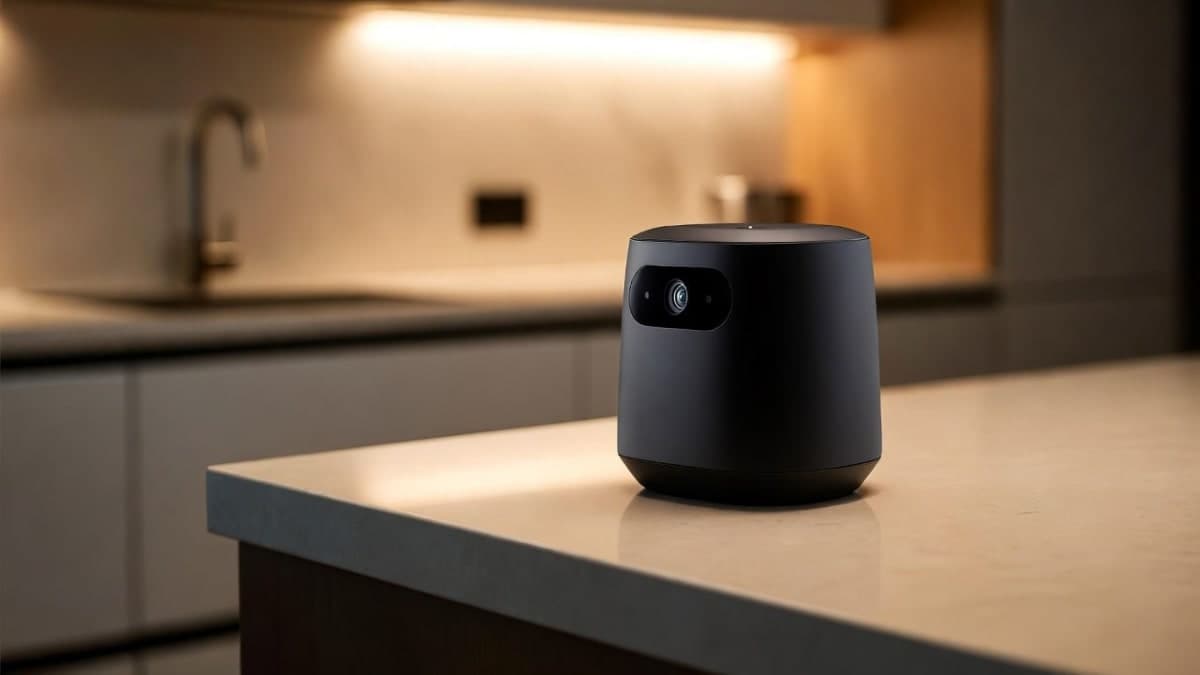
OpenAI is building a smart speaker with a camera in it. Let that sink in for a second. According to The Information, the company has over 200 employees working on a family of AI-powered devices, and the first one out the door will be a home speaker priced between $200 and $300, slated for release no earlier than February 2027.
The speaker will include a camera capable of scanning its surroundings, identifying objects on a nearby table, and picking up on conversations happening in the room. It will also feature a facial recognition system similar to Apple's Face ID, letting users authenticate purchases by looking at the thing. In an internal presentation, employees were told the device would observe users and proactively suggest actions to help them achieve goals. The example given: suggesting an early bedtime ahead of a morning meeting.
I'm going to need a minute with that one.
The $6.5 billion design bet
This is, of course, the product of OpenAI's acquisition of io Products, the hardware startup founded by former Apple design chief Jony Ive. OpenAI announced the deal in May 2025 and completed the merger that July, paying $6.5 billion in an all-stock transaction for a company with 55 employees. Ive's design firm LoveFrom remains technically independent but has taken over design and creative responsibilities across OpenAI. Former Apple designers Evans Hankey, Tang Tan, and Scott Cannon all joined OpenAI as part of the deal.
Sam Altman told employees the device would be "the coolest piece of technology that the world will have ever seen." Which is exactly what you'd expect him to say, and exactly the kind of claim that should make you reach for the nearest grain of salt.
An always-on camera in your kitchen
The privacy question here isn't subtle. Amazon has spent over a decade navigating public anxiety about Echo devices that listen, and those don't have cameras pointed at your dinner table. Google's Nest Hub has a camera, but it's positioned as a video calling device, not an ambient observer. OpenAI is proposing something more aggressive: a speaker that actively watches, listens, identifies faces, and then tells you what to do about it.
As recently as October 2025, the Financial Times reported that the hardware project was wrestling with exactly these issues. The always-listening capability, the team decided, wouldn't require a wake word. Internal debates about how to handle sensitive user data had apparently gotten heated. One source described the challenge of fine-tuning the assistant's responsiveness as proving "more difficult than expected."
And the compute problem hasn't disappeared either. One person close to the project put it bluntly to the FT: Amazon and Google have the server infrastructure for their home assistants, but OpenAI is still scrambling to get enough compute for ChatGPT itself. Adding millions of always-on devices streaming audio and video to the cloud seems, well, ambitious.
The Ive situation
There's friction behind the scenes. 9to5Mac reports that OpenAI staffers have complained about LoveFrom being slow to revise designs and secretive about its process, even with people on the same hardware team. The split structure (LoveFrom designs the products, OpenAI engineers build them) has created the kind of organizational tension you'd expect when a fiercely independent design studio is embedded inside a fast-moving AI company. Integrating the io team with OpenAI's existing hardware group has also reportedly been messy.
Ive gets the final call on almost all design choices. That's a lot of authority for someone whose firm technically sits outside the company.
What else is in the pipeline
The speaker is just the opening move. OpenAI has a broader hardware roadmap that includes earbuds codenamed "Sweetpea" (which OpenAI's chief global affairs officer Chris Lehane confirmed at Davos in January was targeting a second-half 2026 launch), a pen-shaped stylus called "Gumdrop" aimed at handwriting-to-ChatGPT transcription, smart glasses that won't reach mass production until 2028, and a smart lamp that may or may not ever ship. Foxconn has reportedly won at least one assembly contract, with manufacturing expected in Vietnam or the US after OpenAI shifted away from Chinese manufacturer Luxshare.
The earbuds are actually further along than the speaker. But the speaker is being framed as the anchor product, the thing that puts ChatGPT in your living room.
The graveyard of AI gadgets
It's worth remembering what's happened to previous attempts at dedicated AI hardware. Humane's AI Pin launched to brutal reviews, overheated, got its charging case recalled, and the company eventually shut down service entirely, leaving buyers with expensive paperweights. Rabbit's R1 shipped rough and never found its audience. These weren't products from small unknowns; they had real backing and real hype.
OpenAI has two advantages those companies didn't: a genuinely useful AI model and Jony Ive. But having the best AI in the world doesn't automatically translate into a product people want sitting on their kitchen counter, watching them make breakfast, and reminding them to go to bed.
Apple, for its part, is working on its own camera-equipped home hub device expected this year, along with a rumored AI wearable pin. Google is refreshing its Home Speaker line with Gemini integration. The market OpenAI is trying to enter in 2027 will look very different from the one it started planning for.
Foxconn has been told to prepare for mass production of five OpenAI devices by the fourth quarter of 2028. That's a lot of hardware for a company that, as of today, has never shipped a physical product. The $200 to $300 price point puts the speaker in HomePod territory, which is reasonable, but the real cost will be whatever infrastructure OpenAI needs to keep millions of these devices processing in real time. Nobody outside the company seems confident they've figured that part out yet.