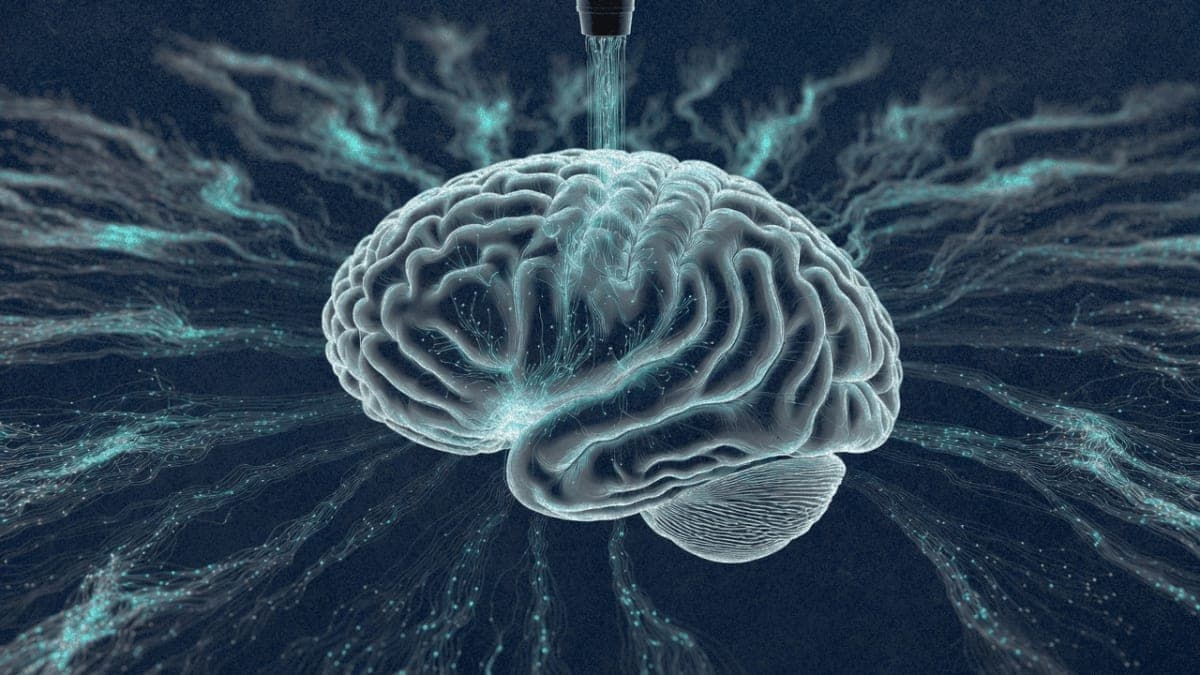
OpenAI has invested in Merge Labs, a brain-computer interface startup co-founded by its own CEO Sam Altman, the company announced Thursday. The $252 million seed round, with OpenAI writing the largest single check, values the research lab at $850 million. Other investors include Bain Capital and Valve co-founder Gabe Newell.
The ultrasound bet
Merge Labs is chasing a fundamentally different path than Neuralink, which requires surgically implanting electrodes into brain tissue. Instead, the company plans to use ultrasound combined with engineered proteins to read neural activity without cutting into the brain itself.
The scientific team brings credibility to an otherwise audacious pitch. Mikhail Shapiro, a Caltech chemical engineering professor and Howard Hughes Medical Institute Investigator, joins alongside Tyson Aflalo and Sumner Norman, who co-founded the nonprofit Forest Neurotech. Forest spent years developing ultrasound-based BCIs and recently demonstrated functional brain imaging in humans using compact ultrasound-on-chip technology. That work now feeds directly into Merge.
Current electrode-based implants can only reach a few millimeters into the brain and read from neurons in their immediate vicinity. Ultrasound, by contrast, can penetrate centimeters deep. As Norman told Core Memory: the technology can see huge portions of the brain while maintaining resolution down to around 100 microns.
But there's a catch. Distance from neurons means weaker signals. Merge plans to address this by introducing molecular reporters, proteins engineered to fuse with neurons and amplify the signals they produce in ways that ultrasound can detect more cleanly. The approach draws on Shapiro's published research developing what he calls the ultrasound analogs of fluorescent proteins used in optical imaging.
The delivery problem
The company isn't saying how these proteins would actually reach the brain. Gene therapy seems the obvious candidate, ferrying genetic instructions into neurons so they produce the signal-enhancing proteins themselves. But current gene therapies can't spread broadly enough across the adult brain, and manufacturing costs would run into hundreds of thousands of dollars per patient. Merge acknowledges on its website that fully realizing its vision demands thinking in decades rather than years.
OpenAI framed the investment around human-AI interaction. Brain-computer interfaces could create what it called a natural, human-centered way for anyone to seamlessly interact with AI. The company said it would collaborate with Merge on scientific foundation models and AI tools to accelerate research.
Altman versus Musk, again
The investment deepens competition between Altman and Musk, whose Neuralink raised $650 million at a $9 billion valuation in June 2025. Neuralink now has implants in five patients with severe paralysis who can control computers using their thoughts. The FDA granted its Blindsight vision-restoration device Breakthrough Device status.
Merge is betting that surgery-free interfaces are the only path to mass adoption. Neuralink's approach requires a robot to remove a piece of skull and thread ultra-fine electrodes into brain tissue. Even with miniaturization, that's a hard sell beyond patients with urgent medical needs.
Altman has been publicly skeptical of implants. At a press event last year, he said he would not sew something into his brain that would kill neurons. His preferred vision: think a thought, have ChatGPT respond to it, read-only.
The rest of the founding team includes Alex Blania and Sandro Herbig, both currently leading Tools for Humanity (the company behind World's eye-scanning orbs). Neither plans to leave their current roles. Merge operates out of a Bay Area facility with several dozen employees already working across labs painted in what Shapiro described as a loud green meant to keep energy high.
Medical trials come first. Consumer applications, if they ever arrive, remain years away.