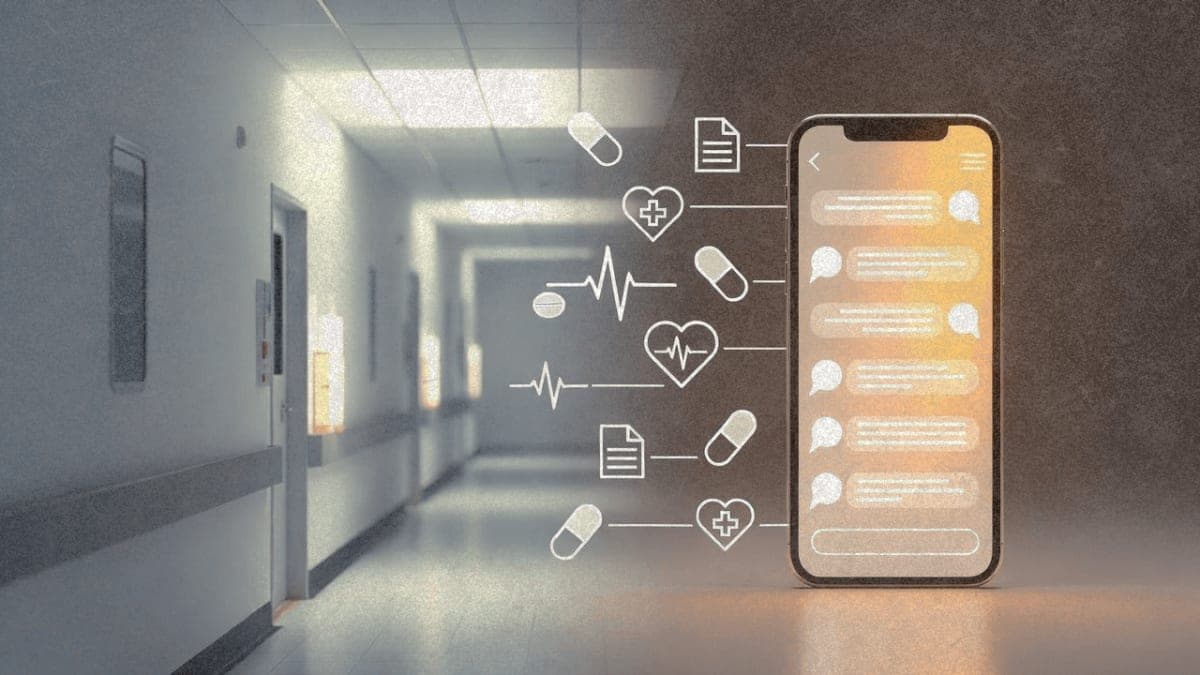
OpenAI unveiled ChatGPT Health on January 7th, a dedicated space in the chatbot where users can upload medical records and connect wellness apps. The company says 230 million people already ask ChatGPT health questions every week. Now it wants to formalize that relationship, with Apple Health syncing, MyFitnessPal integration, and access to actual electronic health records through a partnership with b.well.
The announcement was led by Fidji Simo, OpenAI's CEO of Applications. She opened with a story.
The kidney stone that sold a product
Last year, Simo says, she was hospitalized for a kidney stone and developed an infection. The resident prescribed a standard antibiotic. Simo, who had already uploaded her medical history to ChatGPT, asked the chatbot to check the prescription. It flagged that the antibiotic could reactivate a serious prior infection. The resident, she said, was relieved.
It's a good story. It's also a story from someone with very specific context. Simo cofounded the Metrodora Institute, a $35 million clinic in Salt Lake City focused on neuroimmune disorders. She has POTS, a chronic condition that took three years to diagnose. She's spent years navigating a fragmented healthcare system and knows how to advocate for herself. Most patients don't have that background. Or that Substack.
The question is whether ChatGPT Health actually helps the average user, or whether it helps users who already know what to ask.
What it does
Users can connect medical records from U.S. healthcare providers through b.well, which operates a network of 2.2 million providers and 320 health plans. Apple Health, MyFitnessPal, Weight Watchers, and Function (a lab testing startup) are also supported. The idea is that ChatGPT can then ground its responses in your actual data, helping you understand test results, prepare for appointments, or figure out insurance options.
Conversations in ChatGPT Health stay separate from your main chats. They're not used to train OpenAI's models. You can enable multi-factor authentication. When you disconnect medical records, they're deleted from b.well.
OpenAI says the product was developed with input from more than 260 physicians across 60 countries. The company also clarified that ChatGPT Health is "not intended for diagnosis or treatment." The terms of service have always said as much. The new feature doesn't change that.
The timing is interesting
This launch comes about five weeks after Sam Altman declared a code red at OpenAI. Google's Gemini 3 had just dropped. Enterprise market share was slipping. Altman told employees to pause work on advertising, shopping agents, and a personalized assistant called Pulse.
So did ChatGPT Health get caught up in that? OpenAI says no. "We have been working on health for a very long time," Simo told reporters. The company hired Nate Gross from Doximity and Ashley Alexander from Instagram to lead healthcare efforts about five months ago. Karan Singhal, who leads health AI at OpenAI, said the team has been at it for two years.
Make of that what you will.
The risks nobody loves talking about
There's a body of research on AI chatbots and medical advice. Some of it is concerning.
A Mount Sinai study found that leading chatbots will confidently elaborate on fake medical terms if they're slipped into prompts. No pushback, just confident invention. A Yale-affiliated study in npj Digital Medicine found that chatbots ordered unnecessary tests in over 90% of simulated cases and prescribed potentially inappropriate medications more than half the time. And research published in Annals of Internal Medicine showed that 88% of responses from AI models could be false when prompted with health misinformation, with some models hitting 100%.
OpenAI is aware of this. The company says it's working to reduce harmful responses and has evaluated models specifically for health scenarios. But ChatGPT Health isn't FDA-regulated. It's not HIPAA-compliant in the traditional sense, though the company says it adds layered protections.
And then there's the privacy piece. When you upload medical data to ChatGPT, you're giving it to OpenAI. The company says it won't train models on your health conversations. But the data still flows through their systems, through b.well's infrastructure, and through whatever you've consented to in the fine print.
The real pitch
Reading Simo's Substack post, the framing is clear: healthcare is broken, doctors are burned out, patients are lost, and AI can help. She cites an OpenAI-commissioned survey saying 62% of Americans think the healthcare system is broken. She notes that 7 in 10 health conversations in ChatGPT happen outside clinic hours.
The argument isn't wrong. Access is a real problem. Costs are real. The system is fragmented. But the solution being offered here is "let OpenAI hold your medical records and give you advice that explicitly isn't medical advice."
ChatGPT Health is rolling out to a waitlist first, then expanding to all users on web and iOS in the coming weeks. EHR integrations are U.S. only. The European Economic Area, Switzerland, and the UK are excluded.
The waitlist link was broken at launch. Someone commented about it on Simo's Substack within minutes.