NVIDIA has been quietly building something that doesn't get nearly enough attention: a free API catalog hosting over 100 AI models, accessible through build.nvidia.com, with no credit card required. The lineup includes models from DeepSeek, Qwen, Mistral, MiniMax, GLM, Meta's Llama family, Google's Gemma, and NVIDIA's own Nemotron series. Sign up, get an API key, start calling endpoints. That's it.
The surface-level story is simple enough: free stuff, go get it. But the strategic logic underneath is what caught my attention.
What's actually in the catalog
The NIM platform (NVIDIA Inference Microservices, if you care about the acronym) hosts models spanning text generation, speech recognition, text-to-speech, image generation, video synthesis, embedding, retrieval, safety guardrails, protein folding, and weather forecasting. The most recent additions include MiniMax M2.7, a 230-billion-parameter MoE model that landed on the platform on April 11, and Google's Gemma 4 31B, which showed up on April 2.
Every model exposes an OpenAI-compatible endpoint. Switching between, say, DeepSeek-R1 and Qwen 3.5 means changing one string in your API call. That's a deliberate design choice, and it matters more than it might seem at first glance.
The free tier, honestly assessed
Here's where things get a little less generous than the Telegram hype suggests. The free tier gives you about 40 requests per minute, rate-limited per model. There's conflicting information about whether the old credit-based system (1,000 credits on signup, up to 5,000 total) still applies or has been replaced by pure rate limiting. One developer account from early April says credits were phased out in early 2025 and the current system is just rate limits, no per-token billing. NVIDIA's own documentation is vague on this point, which is not exactly reassuring.
Forty requests per minute is fine for prototyping. It is not fine for production. And the larger models (DeepSeek-R1 at 671 billion parameters, GLM-5 at 744 billion) eat more compute per request, so even within the rate limit, you'll hit slower response times during peak hours. Several developers have reported 429 errors on popular models during busy periods.
So: useful for tinkering, inadequate for shipping. Which is, of course, the point.
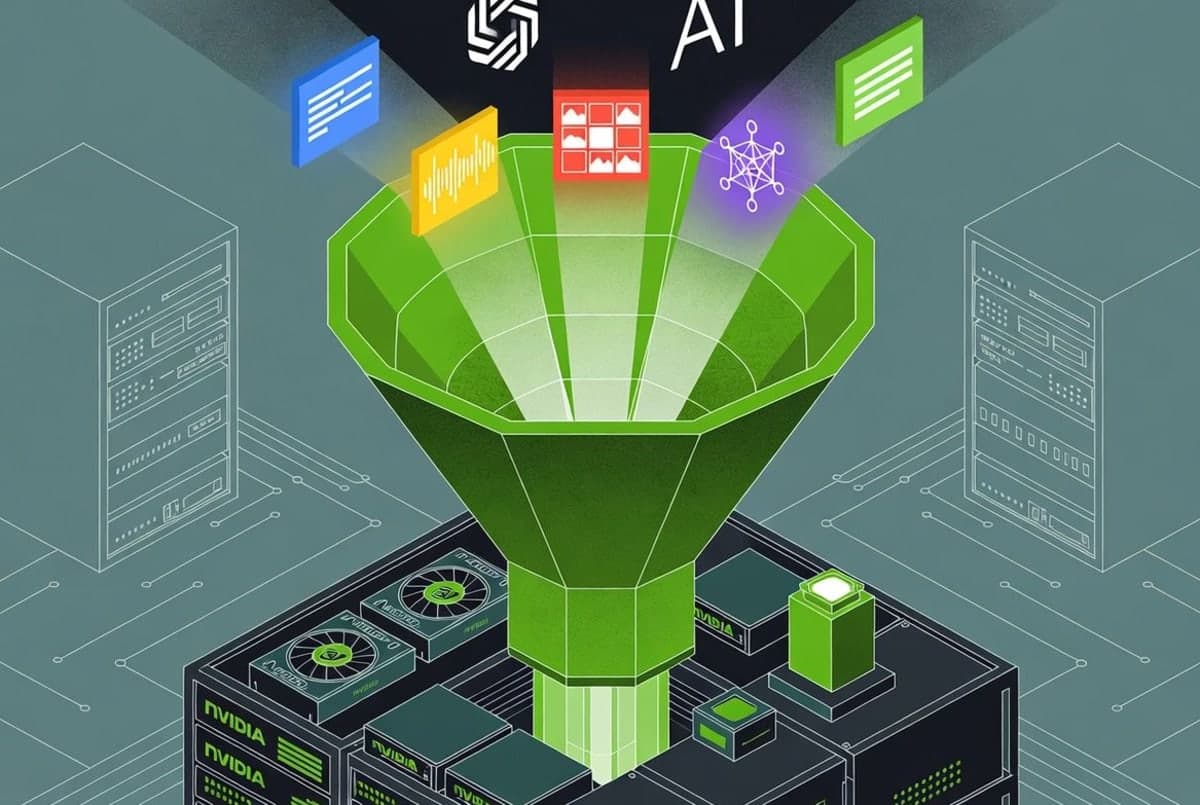
The inference funnel
NVIDIA isn't doing this out of generosity. The catalog is a top-of-funnel play for NVIDIA AI Enterprise, their paid inference platform. The path is designed to be frictionless: prototype on the free API, test on GPU sandbox instances (bare-metal H200 and B300 hardware, available through the same platform), then deploy self-hosted NIM containers in your own data center with a paid license.
The NIM containers bundle vLLM, TensorRT-LLM, or SGLang with pre-optimized configurations for each model-GPU combination. NVIDIA claims roughly 2x throughput improvement on Llama 3.1 8B compared to vanilla deployment. I haven't verified that independently, and "roughly 2x" is doing a lot of work in that sentence. But the basic value proposition is clear: skip the manual work of compiling TensorRT, picking quantization schemes, and tuning batch parameters.
Because every free-tier endpoint uses the same OpenAI-compatible API as the paid self-hosted containers, migration requires zero code changes. You're building against NVIDIA's interface from day one, whether you realize it or not.
The speech models are actually interesting
Most of the attention goes to the LLMs, but the speech and audio offerings are where NVIDIA has genuinely differentiated product. The Nemotron Speech family includes a streaming ASR model (600M parameters, cache-aware FastConformer architecture) that processes 80ms audio chunks in real time. The cache-aware design means each audio frame gets encoded once, no overlapping window recomputation, which yields about 3x higher concurrent streams on H100 hardware compared to traditional buffered approaches.
Then there's Studio Voice, which corrects audio degradations to produce what NVIDIA calls "studio quality" output. And Background Noise Removal, part of the Maxine platform, which strips ambient noise while preserving emotive speech tones. Both are available through the API catalog.
The original Russian-language post that prompted this article specifically recommended Nemotron for cleaning up bad microphone audio. Having looked at the model cards and architecture, that's a reasonable recommendation, though "studio quality" is marketing language I'd take with salt.
Who's actually using this?
A growing developer community is using NIM endpoints as a free backend for coding tools. One tutorial from late March walks through connecting Claude Code CLI to NIM-hosted models via LiteLLM proxy, effectively getting free inference for coding tasks. Another developer documented using NIM endpoints to power OpenClaw agents, noting that frontier model API costs can easily reach hundreds of dollars monthly.
These are creative workarounds, and they work. But they also illustrate the gap between what NIM offers (open-weight models with rate limits) and what developers actually want (frontier-quality reasoning at zero cost). Qwen 3.5 and GLM-5 are capable models. They are not Claude or GPT-5.
What NVIDIA gets out of it
The catalog had over 100 models as of April 2026, spanning dozens of providers. NVIDIA doesn't build most of these models. It optimizes them for its own hardware and serves them through its own inference stack. That's the real business: not the models themselves, but the infrastructure layer underneath.
Every developer who prototypes against NIM is a developer who's learning NVIDIA's API conventions, testing on NVIDIA hardware, and building deployment pipelines around NIM containers. The free tier isn't the product. The enterprise contract that follows is.
Is that cynical? Maybe. But it is also a genuinely useful service right now, today, for anyone who wants to experiment with a wide range of models without managing infrastructure or paying per token. The 40-request-per-minute ceiling is real, the model selection is broad, and setup takes about five minutes.
Just don't confuse the free appetizer for the meal.