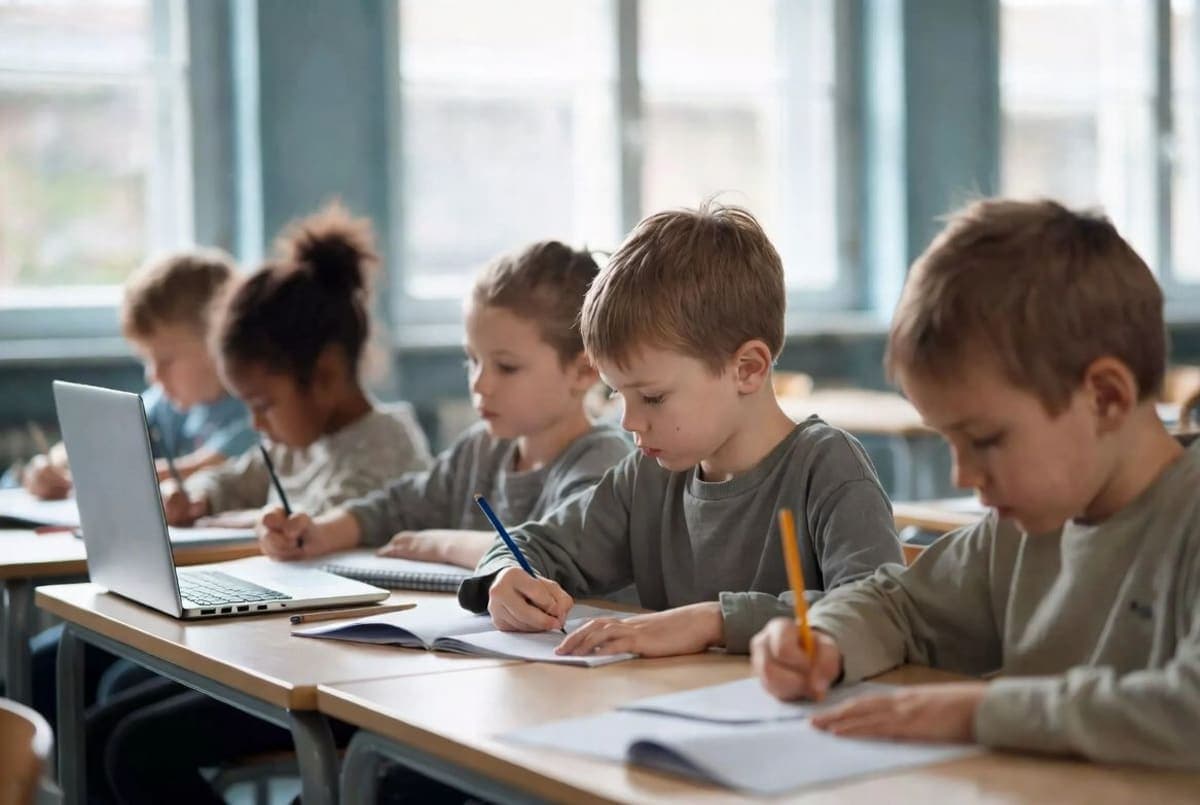
Norway will impose a near-total ban on generative AI tools for elementary school pupils when the new school year starts in late August, Prime Minister Jonas Gahr Stoere announced at a press conference on Friday, June 19. The restriction covers children in first through seventh grade, ages six to 13.
Who can use it, and when
The rules scale with age rather than lifting all at once. Pupils in grades 1-7 are off limits as a general rule. Teens aged 14 to 16 in lower secondary school can use generative AI, but only under a teacher's direct supervision. From 17 up, students are encouraged to use the tools on their own, the idea being they will need the skill for university and work anyway.
Stoere's reasoning is blunt. Using AI, he said, increases the risk that young children skip important steps in their education.
"The most important thing in school is that our children learn to read, write and do mathematics." That is the entire case, more or less, and it is hard to argue with as a priority even if the link between chatbots and worse handwriting is more asserted than measured here.
The paper comeback
Alongside the AI limits, the government said in a related statement Friday it will propose legislation to fund more physical books in classrooms. That reverses a decades-long drift. Norway started putting computers in classrooms in the 1990s and leaned hard into tablets after the iPad arrived around 2010, cutting back on books and handwriting along the way. Now some of that is being undone on purpose.
Does the evidence hold up?
Norway has done this before, and that is the strongest thing going for the policy. The country banned smartphones from schools in 2024 amid declining test scores. Research on that move looks encouraging: a study of more than 400 Norwegian middle schools, cited by The Next Web, found reduced bullying, better grades, and a roughly 60% drop in visits to psychology specialists, with effects strongest among girls.
But that is the phones, not the chatbots. The smartphone ban landed against a clear backdrop of falling national scores. Whether generative AI use in Norwegian classrooms has reached a level that produces measurable harm is not something anyone has shown yet. The government is acting on the precautionary logic that worked last time and betting it transfers. Maybe it does.
What comes next
The standards take effect when students return in late August. Separately, Norway's Labour government plans to bring a bill to parliament before the end of 2026 setting a social media age limit that would apply from January 1 of the year a child turns 16, putting age verification on the tech companies. That one is a minority government's proposal, not a done deal.