Nano Banana 2, Google's next image generation model and the successor to the original Nano Banana, has started rolling out in the Gemini app at gemini.google.com. It is generating images by default. No announcement, no blog post, no fanfare. It just showed up.
This is ahead of schedule. As recently as this morning, community speculation pegged a March 2026 release based on Google's typical rollout patterns. Instead, Google appears to be doing what it did with the original Nano Banana: a quiet, staged deployment that users discover organically.
Good luck finding the right model
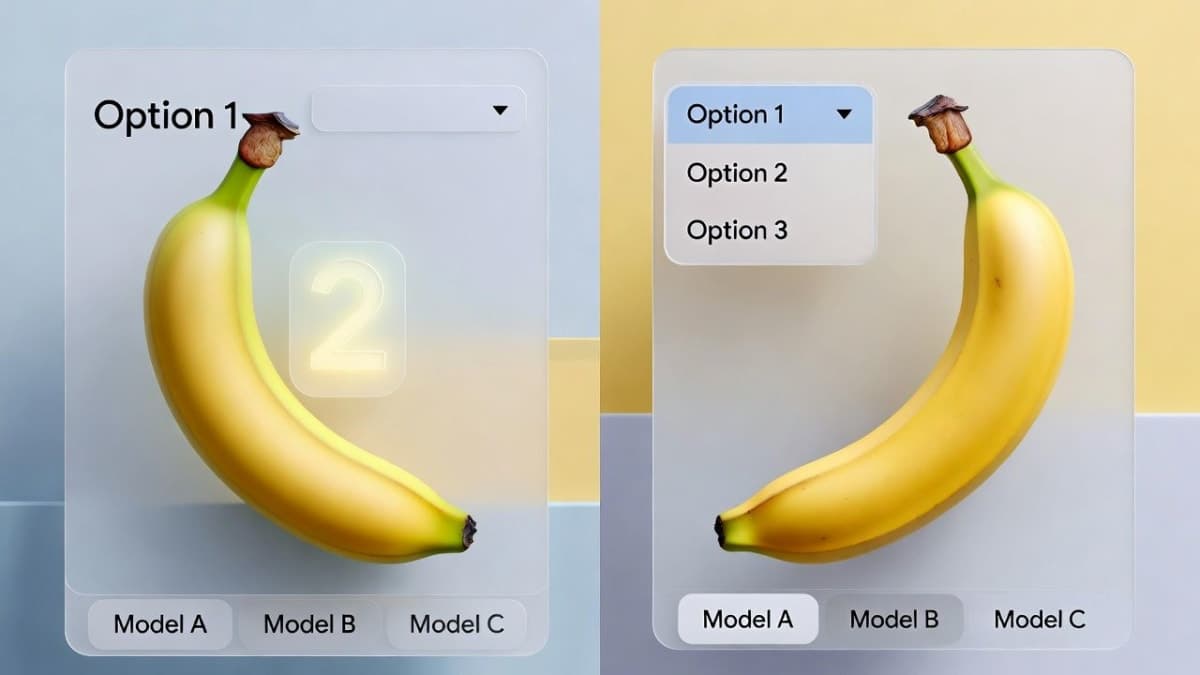
Here's where it gets confusing. The Gemini app's model selector at the bottom of the screen now has three options: Fast, Pro, and Thinking. Previously, both "Pro" and "Thinking" would invoke Nano Banana Pro (built on Gemini 3 Pro Image). That's no longer the case.
Based on early user testing, the mapping now works like this:
Pro mode triggers Nano Banana 2. Thinking mode triggers Nano Banana Pro. Fast mode loads the original Nano Banana (the model just says "Loading Nano Banana .." with no version qualifier).
Read that again. To get Nano Banana Pro, you select "Thinking." To get the new Nano Banana 2, you select "Pro." And the label "Pro" never actually says Nano Banana 2 anywhere. Intuitive, right?
There is a workaround of sorts. After generating an image with Nano Banana 2 in Pro mode, a three-dot menu appears beneath the output with a "Redo with Pro" option, which regenerates using Nano Banana Pro. So even the app's own UI seems to acknowledge that "Pro" mode isn't really giving you the Pro model.
What is Nano Banana 2, actually?
The community has been calling it Gemini 3.1 Flash Image, which would make sense given Google's naming conventions. The original Nano Banana was Gemini 2.5 Flash Image, optimized for speed and low cost. Nano Banana Pro runs on Gemini 3 Pro, the heavier reasoning model. A "3.1 Flash Image" variant would slot neatly between them: faster and cheaper than Pro, but a generational leap over the 2.5 Flash original.
Max Woolf's technical deep dive from December laid out the architectural differences well. The original Nano Banana generates 1,290 tokens per image at about $0.039 each. Pro generates 1,120 tokens for a 2K image at $0.134, or 2,000 tokens for 4K at $0.24. Where Nano Banana 2 falls on that spectrum is still unknown, since Google hasn't published pricing or even confirmed the model's existence through official channels.
Over the past 48 hours, 4K image samples allegedly from Nano Banana 2 have been circulating on X, and the quality does look like a step up from the original. But I'm not sure anyone has done rigorous side-by-side comparisons yet, and screenshots on social media aren't exactly a controlled benchmark.
The naming problem keeps getting worse
Google's Nano Banana lineup now has a genuine discoverability problem. Some third-party sites use "Nano Banana 2" and "Nano Banana Pro" interchangeably, which they are not. The Gemini help page still describes the model switcher as: "To use Nano Banana, select 'Fast' from the model menu. To use Nano Banana Pro, select 'Thinking' or 'Pro' from the model menu." That guidance is now outdated if the rollout is real, since "Pro" no longer serves up Nano Banana Pro for users who have received the update.
And the confusion compounds when you factor in Google's recent Gemini model updates. Gemini 3.1 Pro launched just last week for text and reasoning tasks, and the "Pro" mode in the Gemini app now maps to 3.1 Pro for text conversations. It stands to reason that the image generation pathway under "Pro" would also update to a 3.1-era model. But Google hasn't said this explicitly, so we're inferring from behavior.
Why this matters beyond naming
The original Nano Banana attracted over 10 million new users to the Gemini app when it launched in August 2025, according to Google. Nano Banana Pro, built on the Gemini 3 Pro backbone, added serious capabilities (4K output, accurate text rendering, multi-image fusion) but came with compute costs and daily generation limits that frustrated free-tier users. If Nano Banana 2 delivers Pro-adjacent quality at Flash-tier speed and cost, that's the combination the developer community has been asking for.
Several community discussions on LINUX DO have flagged a potential concern, though: degraded reasoning on complex prompts compared to Nano Banana Pro. That's the expected tradeoff if this is indeed a Flash-class model. Fast inference, lower cost, but the Gemini 3 Pro reasoning backbone (the thing that makes Nano Banana Pro "think" before it renders) gets swapped for something lighter. For casual image generation, probably fine. For the multi-step compositions and accurate text rendering that made Nano Banana Pro a production tool, the gap might show.
Google hasn't announced anything. No blog post, no developer docs update, no API endpoint. Just a quiet model swap behind the existing "Pro" label in the Gemini app. Whether this is an intentional soft launch or an accidental early rollout to some users is anyone's guess. But if you're using Gemini for image generation today and your results look different than yesterday, now you know why.