On December 29, Satya Nadella posted a year-end reflection on his new personal blog. The Microsoft CEO wanted to set the tone for 2026. He got his wish, just not in the way he intended.
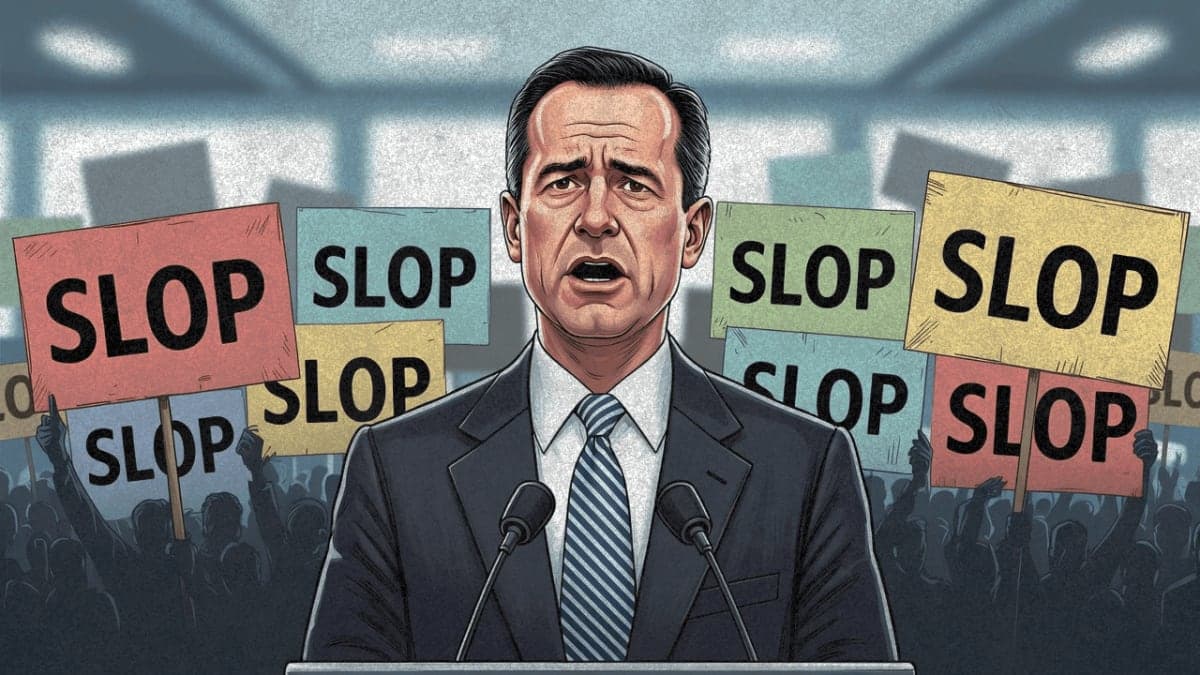
Within hours of publication, "Microslop" started trending.
The blog post that launched a hashtag
Nadella's piece, titled "Looking Ahead to 2026," argued that the tech industry needs to "get beyond the arguments of slop vs sophistication" and develop a "new equilibrium in terms of our 'theory of the mind' that accounts for humans being equipped with these new cognitive amplifier tools."
That sentence is doing a lot of work. I read it three times and I'm still not entirely sure what it means. But here's what people heard: the head of a company that has been stuffing Copilot into every product whether users want it or not is asking them to please stop noticing that the outputs are often garbage.
The timing here is... interesting. Merriam-Webster had just named "slop" its word of the year for 2025, defining it as "digital content of low quality that is produced usually in quantity by means of artificial intelligence." So Nadella chose to push back on the term roughly two weeks after America's oldest dictionary publisher enshrined it.
The backlash was immediate
Windows Central ran a story on Nadella's post. Shortly after, they added an update: "'Microslop' began trending on social media."
The portmanteau spread across X, Reddit, Instagram, and Facebook. Users seized on it as a "concise label for perceived quality declines across Microsoft's product ecosystem." It unified what had been scattered complaints about forced AI features, Windows 11 issues, and Copilot integration problems into a single, repeatable meme.
One response to Nadella's LinkedIn post called the blog entry "polished, but... empty." Some asked whether Copilot had written it.
The internal memo nobody was supposed to see
Here's the thing: Nadella himself is reportedly well aware of Copilot's shortcomings. According to sources, he sent an internal memo late last year criticizing the Copilot integration with Outlook and Gmail as "basically not working."
So the CEO knows the product has problems. He's telling engineers internally that things don't work. And then publicly he's asking customers to stop using a word that describes things that don't work.
Reports indicate Nadella has become increasingly hands-on with AI development, joining a private Microsoft Teams channel with roughly 100 key engineers where he doesn't hesitate to voice dissatisfaction when AI products underperform. In one email to the engineering lead for consumer Copilot, he allegedly pointed to Google Gemini's integration with Drive as superior and called Microsoft's own integrations "not smart."
Make of that what you will.
A billion reasons people aren't upgrading
The Microslop backlash didn't emerge from nowhere. About a billion PCs are still running Windows 10, despite half of them being eligible for an upgrade to Windows 11. During Dell's November earnings call, COO Jeff Clarke confirmed "we have about 500 million of them capable of running Windows 11 that haven't been upgraded."
Microsoft officially ended support for Windows 10 in October 2025. That means hundreds of millions of machines are now running an unsupported OS because their owners would rather risk security vulnerabilities than adopt an operating system saturated with AI features they didn't ask for.
Some users have already switched to Linux. Zorin OS announced it amassed over a million downloads in just over a month following the end of Windows 10 support.
The jobs question
Meanwhile, Microsoft laid off more than 15,000 employees in 2025, roughly 7% of its global workforce. This happened during a year of record profits. The company reported $27.2 billion in net income, up 24% year over year.
The cuts aren't a defensive measure. Microsoft is spending $80 billion on AI infrastructure in fiscal year 2025, and analysts suggest the company may need to cut at least 10,000 jobs annually to offset the margin pressure from that investment.
In July, Nadella addressed the layoffs in a company memo, calling them decisions that have been "weighing heavily" on him. He acknowledged the "uncertainty and seeming incongruence" of cutting jobs while the company thrives by "every objective measure."
The incongruence didn't go unnoticed. As TechCrunch pointed out, Microsoft laid off over 15,000 people in 2025 "even as it recorded record revenues and profits for its last fiscal year." Nadella wrote a public memo about the layoffs but didn't directly attribute them to AI efficiency gains, citing instead "AI transformation" as one of three business objectives.
The fear driving all of this
According to The Verge, Nadella is "haunted" by the prospect of Microsoft not surviving the AI era. He frequently references Digital Equipment Corporation, which once dominated minicomputers before becoming irrelevant.
"Our industry is full of case studies of companies that were great once, that just disappeared," Nadella reportedly said.
That explains the aggression. But explaining a strategy doesn't make it less alienating to the people experiencing it.
What "bicycles for the mind" actually means
The blog post borrowed Steve Jobs' famous metaphor about computers being "bicycles for the mind." Nadella wants to extend that to AI, arguing these tools are "amplifiers of attention, memory, pattern recognition, and decision-making."
The problem, as one outlet put it: "users will be reluctant to ride a bike that seems prone to blowing a tire at any moment."
If Microsoft wants to retire the word "slop," the fix is obvious. Make products that aren't sloppy.
What happens next
Nadella framed 2026 as pivotal, predicting the industry will "evolve from models to systems when it comes to deploying AI for real world impact." He wants to build "rich scaffolds that orchestrate multiple models and agents."
Whether 2026 delivers Copilot experiences that justify the hype or prove the "slop" criticism accurate remains the central question. Microsoft's next earnings call is scheduled for late January.