A computational model out of Cornell argues that flapping-wing flight can be passively stable across a much wider range of body shapes than biologists assumed, and that the same physics could let engineers build insect-sized robots without the heavy feedback electronics that have stalled the field for years. The paper, by Owen Wetherbee and Z. Jane Wang, was published May 1 in Proceedings of the National Academy of Sciences. It distills the messy three-dimensional aerodynamics of a flapping bug into five parameters and two equations.
The five-dimensional shortcut
Wang has been chipping away at this problem at Cornell for over two decades. Her research group built an earlier 3D simulator that, around 2014, made the case that fruit flies sense their orientation roughly every four milliseconds, once per wingbeat, and correct in real time. The dominant view that came out of that line of work: insects fly because their nervous systems are fast.
The new model goes the other way. Wang and Wetherbee, an undergraduate first author, stripped the simulator down to the essential body-wing coupling and unsteady aerodynamics, then identified five parameters that matter: wing-to-body mass ratio, wing loading, hinge position, flap frequency, and stroke amplitude. Plot every possible flapper as a point in that 5D space and certain regions, they argue, are passively stable. Two explicit formulas describe the boundary.
That's it. No neural feedback. No adaptive controller.
The mechanism Wang highlights is something she calls anti-resonance: at the right ratio of wing inertia to body motion, the torque from wing inertia roughly cancels the torque from aerodynamic lift, and the flyer rides out perturbations on its own.
Wait, didn't we already know this?
Sort of. Not really.
The reason this matters is that the previous picture was almost the opposite. Wang's lab had spent years showing that most insects, fruit flies in particular, are passively unstable, and that high-bandwidth neural feedback is what keeps them upright. Her own 2014 PNAS work on fruit fly sensing is one of the cleaner experimental supports for that view.
So what changed? Not the physics, the parameter space. As Wang put it in the Cornell Chronicle, the earlier studies looked at "a few dots" in what turns out to be a much larger morphological landscape. Expand it, and passive stability shows up more often than anyone bothered to check. Which is a polite way of saying the field had been generalizing from a small sample.
The paper isn't claiming fruit flies don't use neural feedback. They clearly do. It's claiming that across the wider universe of possible flapping designs, including ones evolution never produced, you can find configurations that don't need a brain to stay upright.
The robotics pitch
This is the part that's going to interest the people building tiny drones.
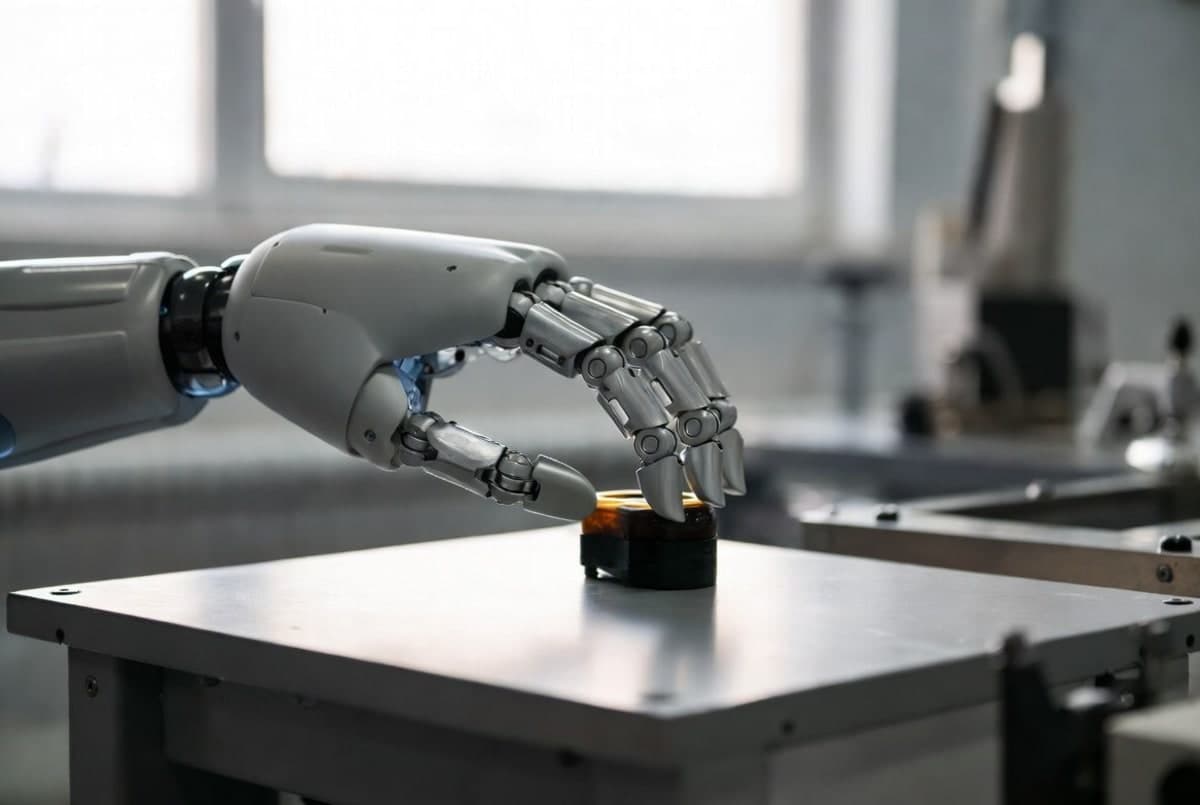
Insect-scale flight has been bottlenecked by control, not aerodynamics. A bumblebee-sized robot can't really carry an IMU, a fast feedback loop, and the compute to run a stabilization controller at hundreds of hertz, and still have payload left for anything else. Harvard's RoboBee program and similar efforts have spent years trying to shrink the electronics. The Cornell paper suggests the inverse move: tune the geometry so you don't need them.
Pick a wing hinge position and a flap frequency that lands the design inside the anti-resonance region defined by the two formulas. According to the model, the bot stays upright because of what it is, not because of what it computes. Control, in Wang's framing, gets "greatly simplified."
That's the pitch. It's a good one. Whether it survives contact with a real prototype is the question I'd want answered before anyone files patents.
How much should we believe?
The authors are upfront about this: it's a computational model, and the predictions still need to be checked against real species and real hardware. That caveat does a lot of work.
A few things I'd want to see. Whether the boundaries actually map onto known insects. The paper claims passive stability is more common than the literature suggested, but real flying species have been catalogued for a long time. If the model says certain hawkmoth-like morphologies should be passively stable when they demonstrably aren't (or vice versa), that's a meaningful gap. Whether anyone can build a flapping-wing robot inside the predicted region that hovers stably with no feedback control at all. Until that bot exists, the design principle is a conjecture, however elegant.
And what the reduced model leaves out is worth thinking about. Real insects flex their wings, ride vortex streets, and deal with gusts an order of magnitude faster than their nominal flap period. The Cornell model abstracts most of that away to keep things tractable. Tractable is the right call for a theoretical paper. It also means the predictions are about a clean mathematical object, not a moth in a thunderstorm.
The peer-review path is reassuring. The paper was edited by mathematician Charles Peskin, a serious name in fluid-structure simulation, and Wang's track record on flapping flight is long enough that the underlying physics is unlikely to be wrong. What's unproven is the headline claim: that you can actually engineer a robot this way.
What happens next
The work was funded by the National Science Foundation and the Cornell group plans to keep going. The obvious next steps are running the predictions against a broader catalog of real species and getting at least one robotics lab to build inside the predicted anti-resonance region and see what flies.
If a feedback-free flapping-wing bot hovers stably in turbulence by 2027, the framework will have earned its keep. If not, we'll have a clearer sense of how much of the gap between Wang's 5D space and the actual world her two formulas can close.