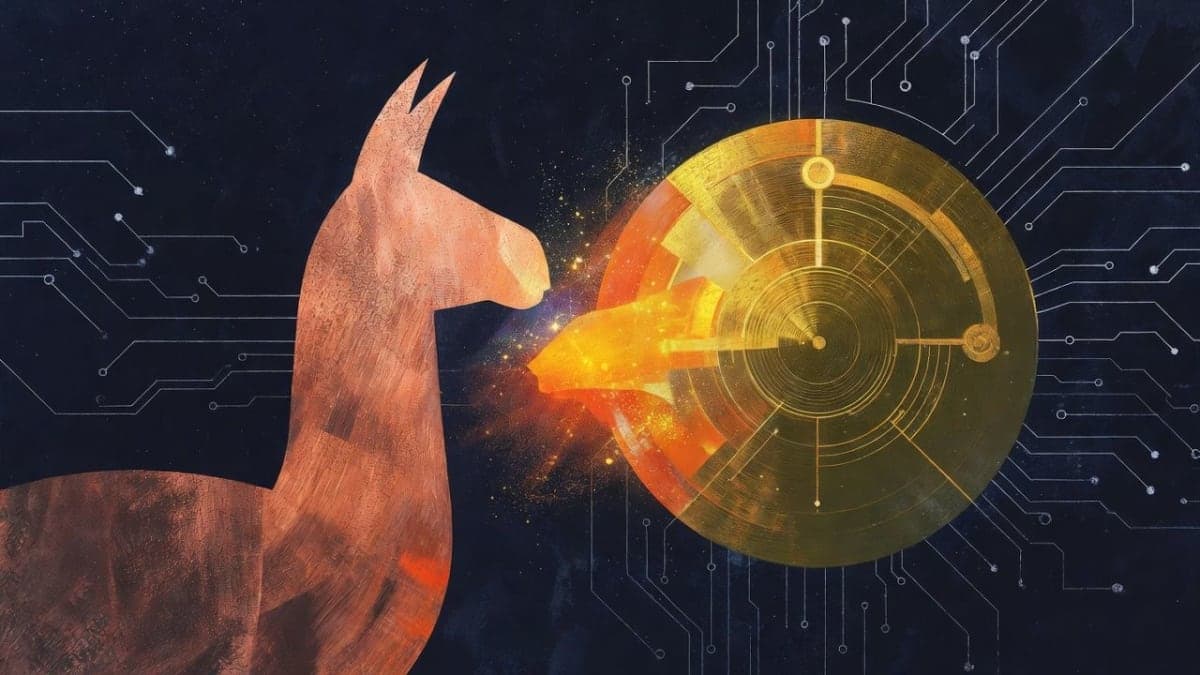
Georgi Gerganov, the developer who made it possible to run large language models on a MacBook, is now a Hugging Face employee. His company ggml.ai, the small team that maintains llama.cpp and the underlying ggml tensor library, announced on February 20 that it is joining Hugging Face. The project keeps its MIT license. The team keeps its autonomy. And Hugging Face gets to fold the most important piece of local AI infrastructure into its growing empire.
The framing is careful: this is a "joining," not an acquisition. The GitHub announcement emphasizes continuity. Gerganov and his team will keep maintaining llama.cpp full-time, make their own technical decisions, and operate the community as before. Hugging Face provides "long-term sustainable resources." That's corporate-speak for salary and infrastructure, which is exactly what a small open-source team running a 95,000-star project needs.
Why this was always going to happen
llama.cpp is one of those rare projects where the gap between its importance and its resourcing has been absurd. Gerganov started it in March 2023, hacking together a C/C++ implementation of Meta's LLaMA inference in a single evening. The original README was disarmingly honest: "This was hacked in an evening, I have no idea if it works correctly." Three years and over a thousand contributors later, it is the fundamental building block for local model inference. Ollama runs on it. LM Studio runs on it. Docker's Model Runner runs on it. If you've ever loaded a GGUF file on your own hardware, you owe something to this codebase.
But sustaining that kind of project with a tiny team is brutal. Gerganov founded ggml.ai in 2023 to support development, though the company was never a traditional startup chasing revenue. Meanwhile, Hugging Face engineers were already deep in the llama.cpp codebase. Xuan-Son Nguyen and Aleksander Grygier, both HF employees, had been contributing core features for over a year: multimodal support, the inference server UI, model architecture implementations, GGUF format improvements. The announcement lists their contributions explicitly, which reads less like a surprise acquisition and more like formalizing something that was already happening.
The transformers play
Here's where the business logic gets interesting. Hugging Face's Transformers library has become the de facto standard for defining model architectures. When a lab publishes a new model, the reference implementation almost always lands on Hugging Face first. But getting those models into llama.cpp's GGUF format has remained a separate, sometimes frustrating process involving conversion scripts and community-maintained quantizations.
The announced technical roadmap promises "single-click" integration between transformers and ggml. If they pull it off, every new model that drops on Hugging Face could be llama.cpp-compatible out of the box. That is a genuinely big deal for anyone running models locally. Right now there's usually a lag of days or weeks between a model release and usable GGUF files appearing, and the conversion process occasionally introduces subtle bugs. Tighter coupling at the framework level could eliminate most of that friction.
But it also tightens Hugging Face's grip on the model distribution pipeline. They already control where most open-weight models get published. Now they'd control the primary path from publication to local inference. That's not sinister, exactly, but it is a concentration of influence worth watching.
The stewardship question
Community reaction has been mostly positive, with one notable thread of skepticism. "I've seen this before and it never ends well," wrote one commenter on the HF blog, citing FreeNAS and other open-source projects that lost momentum after corporate absorption. It is a fair concern. The history of companies acquiring open-source projects is mixed at best.
The counterargument, and it is a strong one, is that Hugging Face has a good track record here. The Transformers library has been under their stewardship for years and remains genuinely open and community-driven. Simon Willison, who has followed the local model space closely, wrote that HF has "proven themselves a good steward for that open source project, which makes me optimistic for the future of llama.cpp."
Johannes Gaessler, a major llama.cpp contributor who is not part of the formal ggml organization, struck a measured tone in the GitHub discussion: he's happy about the sustainability angle but made clear he'll continue cooperating independently. That kind of response, supportive but not absorbed, is probably the healthiest signal you can get from an open-source community processing news like this.
What actually changes
In the short term? Probably not much. Gerganov still runs the show technically. PRs still get reviewed the same way. The MIT license isn't going anywhere.
The medium-term changes are more interesting. The announcement mentions "better packaging and user experience," which is code for competing more directly with Ollama and LM Studio on the UX front. Last year ggml-org released LlamaBarn, a macOS menu bar app for local LLMs. Expect more of that, with HF's resources behind it.
And the long-term vision statement is worth quoting because it's so characteristically ambitious: "Our shared goal is to provide the building blocks to make open-source superintelligence accessible to the world." I'm not sure what open-source superintelligence means, and I suspect they aren't either. But the intent is clear enough. Hugging Face wants to own the full stack from model publication to local inference, and bringing llama.cpp in-house gets them most of the way there.
For the local AI community, the immediate calculus is simple. The project that lets millions of people run AI on their own machines now has stable funding and closer integration with the biggest model hub on the internet. The trade-off is that one company now holds an even larger share of the open-source AI infrastructure. Whether that trade-off ages well depends entirely on Hugging Face continuing to behave the way it has so far. Given their track record, I'm cautiously optimistic. But I'll be watching the commit logs.