Google Labs overhauled Stitch, its AI-powered UI design tool, on March 18, turning what was a straightforward prompt-to-mockup generator into something far more ambitious: an infinite canvas where you talk to an AI agent about what you want your app to look and feel like. Google is calling the approach "vibe design," which is either a useful shorthand or a marketing team earning its keep, depending on your tolerance.
The update, announced on the Google blog, ships five features at once: an AI-native canvas, a smarter design agent, voice input, instant prototyping, and a portable design system format called DESIGN.md. That's a lot. And it lands less than a year after Google acquired Galileo AI and rebranded it as Stitch at Google I/O 2025.
The canvas is the product now
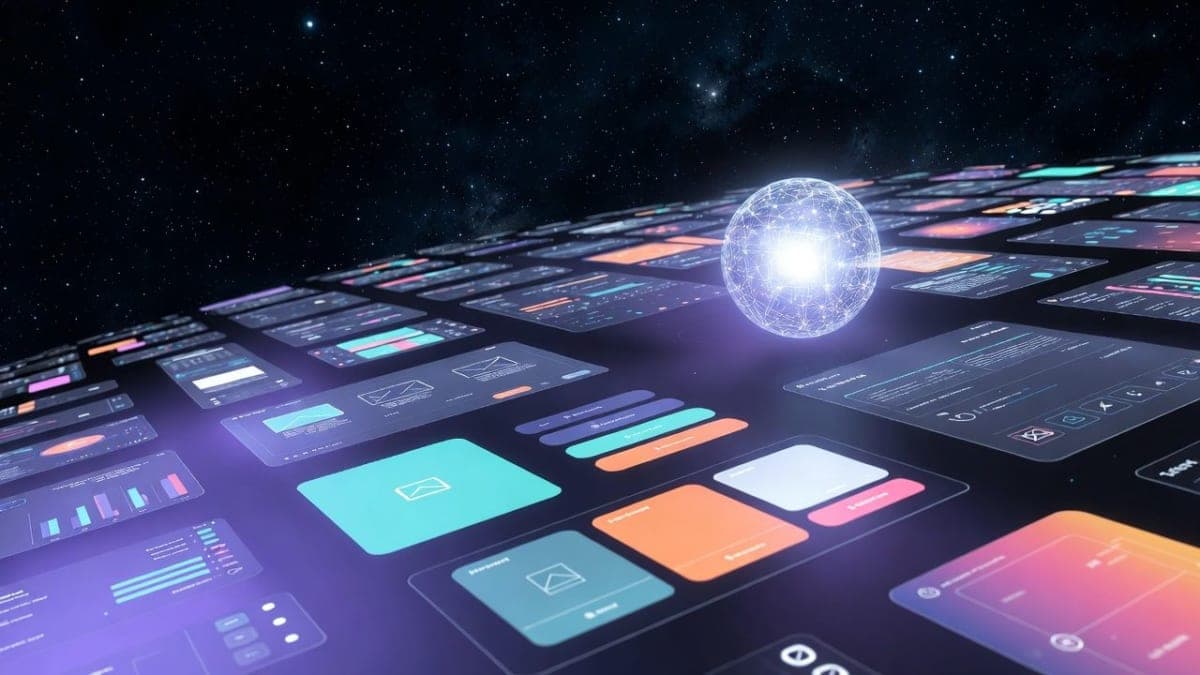
The old Stitch was simple. Type a prompt, get some screens, export to Figma or grab the HTML/CSS. Useful for the first 80% of ideation, not much else. The new version drops the linear prompt-and-response model for an infinite canvas where images, text, code, and previous designs all sit as context for the AI to work from.
A new design agent reasons across the entire project history, not just the last prompt you typed. And there's an Agent Manager (capitalized, because Google wants you to know it's a feature) that lets you run multiple design directions in parallel without losing track. I haven't used it yet, so I can't say whether this actually works or just sounds good in a blog post. The track record for AI agents managing complex creative workflows is, let's say, uneven.
You can talk to it now
Voice control is the feature Google seems most excited about. You speak to the canvas, the agent responds in real time, makes changes, offers critiques. "Give me three different menu options" or "show me this screen in different color palettes," that kind of thing. Google frames it as having a conversation with your design tool rather than clicking through menus.
The demo looks slick. But voice interfaces for creative tools have a spotty track record. Precision matters in design, and natural language is inherently imprecise. Asking for "a warmer color palette" when you mean "shift the primary from #2563EB to #DC2626" introduces ambiguity that you then have to correct. Whether this saves time or creates new rounds of back-and-forth remains to be seen.
DESIGN.md and the interoperability play
The most interesting addition might be the least flashy. DESIGN.md is a markdown file that captures your design rules (colors, typography, spacing, component patterns) in a format that AI agents can read. You can extract a design system from any URL, save it as a DESIGN.md, and import it into other Stitch projects or, critically, into coding tools.
This matters because it connects to the Stitch MCP server and SDK that Google released recently. MCP, the Model Context Protocol, is becoming the standard plumbing for connecting AI tools to each other. With the MCP server, Stitch designs can flow into AI Studio, Cursor, Claude, or whatever coding agent your team uses. Static designs become clickable prototypes, and those prototypes can be exported as working React applications.
That's the real pitch here. Not "vibe design" as a creative philosophy, but Stitch as a node in a larger AI-powered development pipeline. Concept to code without switching tools. Google is clearly building toward something that looks like: describe your app, design it in Stitch, ship it through AI Studio or Firebase. Whether the output is production-quality is another question entirely.
Where Figma fits (and doesn't)
Figma Make already does prompt-to-prototype, and it has the advantage of sitting inside the tool that most design teams already use. Figma's AI pulls from your existing design system, your team's component libraries, your established workflows. Stitch has none of that organizational context.
But Stitch is free. Three hundred and fifty generations per month in Standard mode (powered by Gemini 2.5 Flash), fifty in Experimental mode (Gemini 2.5 Pro). No credit card. Figma Make requires a paid plan. For solo founders, early-stage teams, and engineers who just need a mockup to show stakeholders, free is a compelling argument regardless of feature depth.
The competitive dynamics here are less about which tool produces prettier mockups and more about who controls the pipeline from idea to deployment. Figma owns the professional design workflow. Google wants to own the AI-native one, where the starting point is language, not layers.
What's still missing
Real-time collaboration. Stitch is still fundamentally a single-player tool. Accessibility auditing is inconsistent; color contrast and touch targets often need manual review, according to multiple hands-on reviews. And the outputs, while decent for ideation, still require substantial polishing before they're ready for production. One reviewer on LogRocket noted that Stitch "tends to forget components you liked or reinterpret them in odd ways," which sounds about right for current-gen AI design tools.
Google also has a well-documented habit of killing experimental products. Stitch lives in Google Labs, which is both its incubator and, potentially, its hospice. The Galileo acquisition and the pace of updates suggest real commitment, but anyone building workflows around this tool should keep their Figma exports handy.
Stitch is live at stitch.withgoogle.com for users 18 and older wherever Gemini is available. Google I/O 2026, scheduled for May 19-20, will likely be when Google shows what comes next.