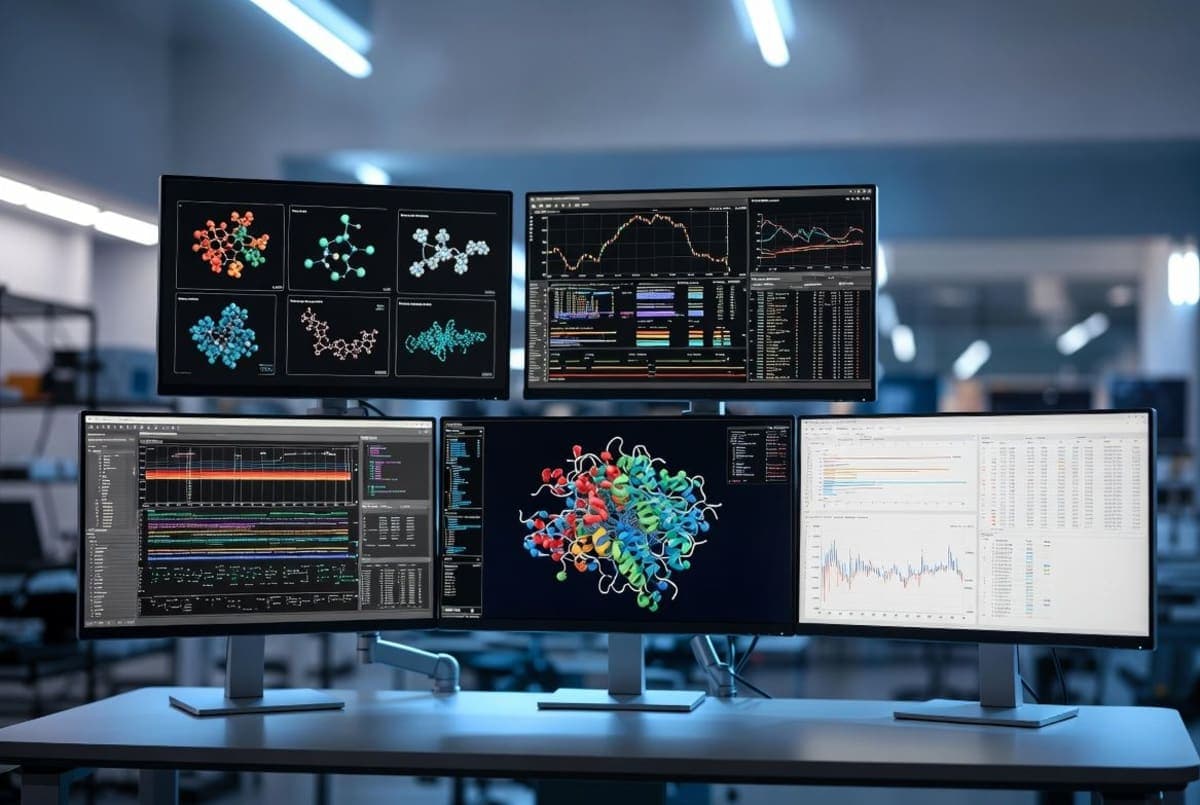
Anthropic launched Claude Science on Tuesday at a briefing event in San Francisco, a standalone application aimed at biologists, chemists, and drug developers who currently juggle PubMed tabs, Jupyter notebooks, and cluster terminals to get anything done. It's in beta now on macOS and Linux for anyone on a Claude Pro, Max, Team, or Enterprise plan, though Team and Enterprise users need an admin to flip it on first.
The pitch, per the company announcement, is that Claude Science becomes to lab work what Claude Code became to software engineering: a place where an agent runs multi-step analysis, keeps a running memory of a session so massive datasets only load once, and hands back figures, 3D protein structures, and genome tracks alongside the exact code that produced them.
A workbench, not a new brain
Anthropic is oddly insistent on this point. TechCrunch reports the company describes Claude Science as
"not a new AI model and not a more capable model for biology"which is a strange thing to lead with at your own product launch, unless you're trying to get ahead of the inevitable comparison to OpenAI's GPT-Rosalind and get people focused on the workflow instead of the underlying model, which is just the standard Claude lineup, Opus 4.8 included.
What's actually new is the plumbing. Sixty-plus scientific databases, a coordinating agent that can spin up specialist sub-agents, and a reviewer agent that checks citations and flags numbers that don't trace back to the code that generated them. Whether that reviewer agent catches its own mistakes as reliably as Anthropic implies is not something outsiders can verify yet.
Borrowed intelligence
For the actual heavy science, Claude Science doesn't try to do it alone. It plugs into Nvidia's BioNeMo toolkit to reach models like Evo 2, Boltz-2, and OpenFold3, protein-folding and genomics tools Anthropic didn't build. That's a notably humble stance for a company usually selling the idea that its own model is the smartest thing in the room. Here the model is more of a translator and project manager, routing a plain-language request to whichever specialist tool actually knows biology.
Does it actually save two years?
Anthropic's flagship case study involves Jérôme Lecoq, a neuroscientist at the Allen Institute, who reportedly built a 20-skill pipeline that reads thousands of papers, extracts findings into an evidence database, and drafts full literature reviews with a second agent acting as critic. Anthropic says work that once took his team up to two years now produces roughly ten reviews, some over 100 pages. That number comes from Anthropic's own writeup, not an independent audit, and vendor-supplied efficiency claims deserve exactly the skepticism you'd apply to any company grading its own homework.
A second example, Manifold Bio, used the tool to rank drug-binder candidates against internal criteria the company had already built up over past programs. Useful, maybe, but also a reminder that these showcase stories are chosen by Anthropic's PR team, not sampled at random from the beta's actual user base.
The land grab
The timing isn't subtle. OpenAI shipped GPT-Rosalind for research in April. Google demoed Gemini for Science at its May developer conference, bundling more than 30 life-science databases of its own. Anthropic's head of life sciences, Eric Kauderer-Abrams, told MIT Technology Review the product sits
"right up there with Claude Code and Claude Cowork"in importance to the company, which is either a genuine bet on life sciences or the kind of thing you say when three AI labs are racing to plant a flag in the same market ahead of public offerings everyone already knows are coming.
Applications for Anthropic's $30,000 research credit program, aimed at postdoc and graduate projects, close July 15. Award notices go out July 31, with funded projects running from September 1 through December 1.